
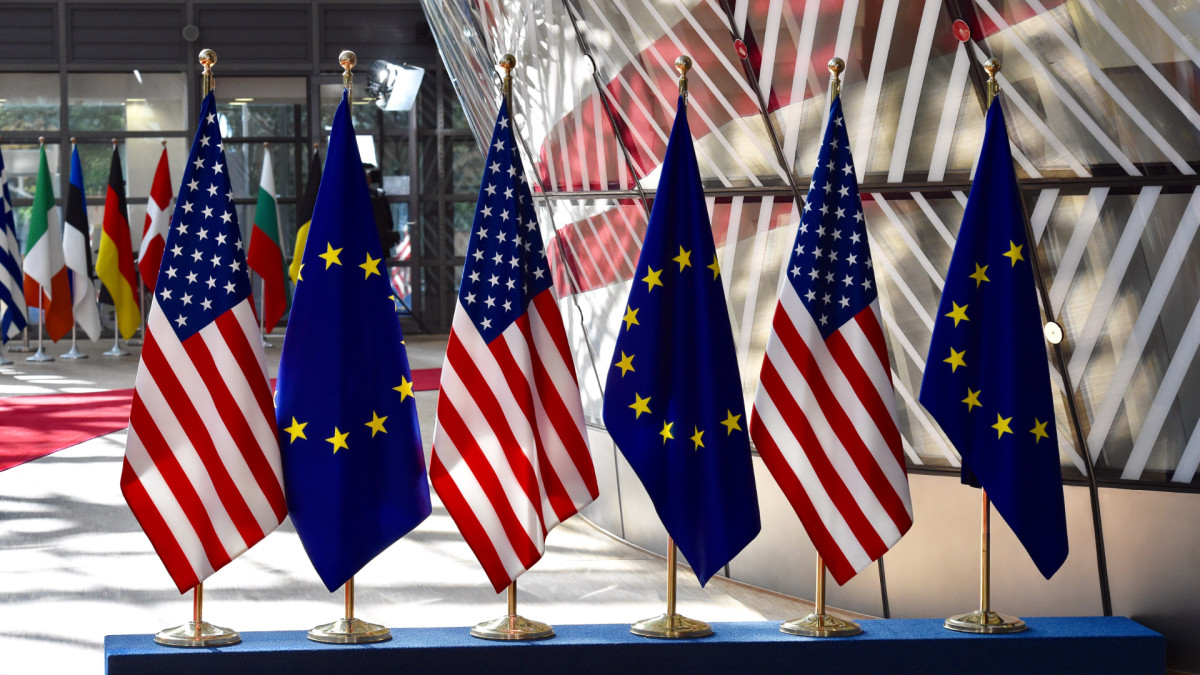
European capitals have moved swiftly in a symbolic gesture over Greenland. Denmark, Finland, France, Germany, the Netherlands, Norway, Sweden and the United Kingdom announced they would send troops to the Arctic island. With the same speed, Donald Trump announced he would attack with a 10% tariff increase on these countries.
In response to this move, various European political leaders such as Emmanuel Macron have called to activate the European Union’s coercion mechanism. The senior economist and director at the think tank ECIPE, Óscar Guinea, explains in this interview that the instrument is aimed at “deter or counter coercive actions” like the one from President Trump.
This letter Brussels holds “was designed thinking about the first Trump Administration”, but it has never been used. Now it seems there is a majority of countries that could be in favor of its application. Guinea asserts that, in this scenario, “the most credible move would be to impose tariffs on American goods, especially final goods”. To do this, a qualified majority in the European Council is necessary, although “if the big players want it, it isn’t that hard”.
Photo: Courtesy of Oscar Guinea.
How was the coercion-defeat mechanism born and what is its purpose?
It was a moment, in the first Trump Administration, when the Commission began designing new instruments and there was confusion. At ECIPE we analyzed the different instruments in a study explaining the various measures: “The New Wave of Defensive Trade Policy Measures in the European Union: Design, Structure, and Trade Effects”. That said, the situation has since changed.
In the end, it never came into use, neither against the United States nor against China.
In any case, it can be applied to any country. Then, of course, the first country it could be applied to would be China. It was talked about a lot to use it when there was the episode with Lithuania and Taiwan: a symbolic issue but in which China reacted by restricting exports, and it was proposed to use this instrument at that moment.
“The definition of ‘coercion’ is relatively broad and the instrument’s objective is to deter or counter coercive actions by third countries”
The objective, therefore, is to deter or counter coercive actions, in a broad sense. And, above all, to open up the range of responses: not only tariffs on goods, but also investment, services, intellectual property, public procurement… everything.
Macron has proposed activating it in response to Trump’s threats over Greenland and after the proposed tariff hike to several European countries. Do those threats fit the definition for which the mechanism is designed?
Yes, of course. The definition of “coercion” is relatively broad and the instrument’s objective is to deter or counter coercive actions by third countries.
Trump’s tariffs for the lack of support for his Greenland idea fall squarely into that: he is using trade policy to achieve political objectives. The European Union has anti-dumping and other trade measures, but not for scenarios like “I want to buy a territory and you won’t sell it to me”, or cyber-attacks, or measures that did not fit within the WTO frameworks. For those, for more heterodox matters, this instrument is there for.
One important nuance: Can the United States apply tariffs to certain EU countries despite us being a customs union?
We are a customs union, but in principle yes, because goods are exported with a certificate of origin and you know where they come from. Another thing is how hard it is to make it effective: if tariffs are high, companies can reroute exports, change supply chains, or seek ways to circumvent barriers, especially within the single market. It is technically possible, but making it easy to comply with and to enforce is another story.
Is China still on the radar of the coercion mechanism?
The instrument is designed for third countries, to deter and counter coercive actions, very broadly defined. It was designed thinking of the first Trump Administration, it was considered for China, and now it could be used against the United States or against any country: it depends on the nature of the coercion.
“It is a more political than mechanical instrument. The definition of coercion is vague, and its use depends a lot on what the Council wants”
It is a more political than mechanical instrument. The definition of coercion is vague, and its use depends greatly on what the Council wants. It is not like the antidumping instrument, where there is experience, established procedures, and economic calculations to adjust the level of response to the damage. The coercion mechanism, first, is new and has never been used, and second, its strength lies precisely in that vagueness, in that it allows a lot of things.
It is a double-edged sword: on the one hand, the European Union is not very comfortable with instruments where you do not know exactly what will happen; on the other, that flexibility allows you to justify very different responses.
Against what could the European Union go?
Think of several categories: goods, European exports to the United States and American exports to the European Union; public procurement; intellectual property; services; investment. In other words, it’s not just “tariffs and that’s it”.
In practice, if there were an escalation, where do you think the Commission could start? What would be the most credible way to hurt without shooting yourself in the foot?
If the Commission had a commercial-war manual, a kind of The Art of War (commerce), the most credible move would be to impose tariffs on American products, especially final goods rather than intermediate goods. You use intermediates in your own production, so by making them more expensive you raise your own costs.
The ideal would be to choose final goods where you have many alternative suppliers, inside or outside the European Union, but not in the United States. What kinds of goods fit here? Cars, motorcycles, agricultural products, beverages… in short, consumer goods where substitution is more feasible.
Now, the economic integration between the European Union and the United States is very large. Surely there is room for a first approach, but it is also evident that the Americans can respond. Therein lies the risk of a spiral.
And beyond goods, you have services. In this sector the United States has a surplus with Europe: it exports more services than it imports, by a large amount. But those services are precisely the opposite of what that “manual” would want: they are inputs, we use them to produce, there are not many alternatives and there is little experience in placing tariffs on services. Moreover, services do not cross borders in the same way: many times they are delivered digitally. All of this limits the real capacity to respond and makes it very difficult.
It is also tricky to act on intellectual property, because here we are talking about companies, contracts, technology… it is not an easy field and there is a lot of uncertainty.
For this to activate, a political majority is needed. How is it configured and how “hard” is it to approve?
It is approved by a qualified majority in the European Council, so if the big players want it, it isn’t that hard.
“The Commission already has advanced work: there are prepared lists. The bazooka is there. If there is a qualified majority in the Council, it can be done”
The process begins with a Commission investigation in which it is determined whether coercion has occurred and it assesses the level. Then there is negotiation with the country to which that coercion is attributed (this is provided for in the regulation). If the country does not withdraw the measure, then a countermeasure is adopted with a level proportional to the coercion suffered.
The Commission already has advanced work: there are prepared lists. The trade bazooka is there. If there is a qualified majority in the Council, it can be done. And, at any time, the European Union can withdraw these measures.
In terms of timelines: how long could all this take, from decision to application?
It is hard to say because it would all be new: it has never been done. But, in a sense, time works in the European Union’s favor. The goal is not to impose “the next day”, but to present a credible threat to sit down and negotiate the withdrawal of coercion. The design is not meant to “coerce back” by default, but to create a space for negotiation.
“The logic is to use it as leverage to sit down and talk, just as with other trade instruments the key is not always to impose, but to negotiate”
Moreover, it depends on the context: if the conflict is over Greenland, for example, trade takes a back seat. But we are in a world of high uncertainty. In any case, the logic is to use it [the coercion mechanism] as leverage to sit down and talk, just as with other trade instruments: sometimes the key is not to impose, but to negotiate.
Given how this mechanism works, are we already in a world of “post-alliances,” where even democracies use trade as a weapon?
I would say no. That was not the instrument’s objective when it was established, although now one could argue that it could serve that purpose. Its initial purpose was to respond to heterodox aggressions and allow the European Union to broaden responses beyond tariffs on goods. Democracies imposing tariffs on each other is not new: the European Union and the United States have done so with steel, and also with the Boeing-Airbus saga at the WTO for years.
I see it more as a tool for a world where trade rules have weakened and the WTO weighs less: a world where coercion is not expressed only with tariffs, but also with technology, intellectual property, public procurement, investment…
Do you think the United States could end up giving in if Europe hardens its tone with this instrument? Taking China as an example, tariff escalations ended with a negotiating agreement between the two countries.
In the case of China and the United States there was a strong commercial component: deficit, dependence, tariffs, restrictions on inputs… there was a clear commercial rationale.
“What does the United Kingdom have to say about Greenland? What does the Netherlands have to say? They may agree or disagree, but they do not decide that”
Trump has imposed tariffs on countries that have nothing to say about Greenland. What does the United Kingdom have to say about Greenland? What does the Netherlands have to say? They may agree or disagree, but they do not decide that. And, besides, in principle they will not be in favor.
Once it is established that it is not a purely commercial matter and that countries do not have a clear commercial lever, they raise the costs of that decision to invade Greenland and to stay on the island. They will keep increasing the costs of that decision so that the U.S. reconsiders it, but within those limits. You raise the costs, send troops, increase the cost in the face of certain threats, but the logic itself is not commercial, but another way to raise the cost of that decision.
Thank you very much.
