

In barely a decade, Spain has moved from having virtually non-existent paternity leave to becoming a benchmark in Europe with equal and non-transferable leaves for both parents. The Equality Law of 2007 introduced for the first time a non-transferable and fully paid paternity leave, though a mere thirteen days. For a decade, there were hardly any changes, until in 2017 it was expanded to four weeks. Since then, and thanks to an unusual political consensus between the right and the left, the leaves have continued growing until, in 2021, they were equalized with maternity leave: sixteen non-transferable weeks for each parent.
Few times in social policy does a move from zero to one hundred happen so quickly. From being a country with a substantial lag in reconciliation policies, Spain has risen to the forefront of Europe with a measure broadly supported by the public, regardless of ideology, gender, or age. The 2021 reform marks a turning point in co-responsibility for childcare and gender equality. But has this advance made paternity leave truly universal? And, in a highly segmented labor market like Spain’s, who has benefited the most from this expansion?
More coverage for all or more inequality in access?
In our recent research, published in the Journal of European Social Policy, we analyzed how the expansion of leave affected its use and access. To do so, we started from two premises widely supported by comparative literature.
First, for paternity leaves to be used broadly, they must be sufficiently long, well paid, and non-transferable. Short leaves and poorly paid ones do not create enough incentives. If they are transferable, many fathers will opt to cede them to mothers, who often consider sixteen weeks of leave still insufficient.
“There remain very significant differences depending on the labor situation. Fathers with secure jobs are more likely to use the new leaves compared to those in precarious jobs.”
Second, in segmented labor markets like Spain’s, employment conditions affect fathers’ ability to take the full leave. Following prior research, we expected to find meaningful differences between public and private sector employees, between salaried workers and self-employed, and between workers with temporary vs. permanent contracts. We were also interested in whether individuals’ perceptions of job security influenced leave use.
To answer these questions, we conducted a survey within the framework of the FAIRLEAVE project, funded by the National Plan for R&D. Between October 2022 and November 2023, we interviewed 3,700 fathers and mothers with children born between 2018 and 2022, a period in which the leave progressively increased from four to sixteen weeks. To avoid representativeness biases by education level or socioeconomic status, we combined online surveys with face-to-face interviews.
A success in expanding leave, but with persistent gaps
The data confirm a spectacular rise in the use of paternity leave. Among eligible fathers, the share taking the leave has nearly doubled, rising from 36% to 64%. Moreover, the number who enjoy the full duration has grown: the share who only use part of the leave has fallen from 40% to 20%. This increase is more pronounced among new fathers, which confirms the positive impact of the reform (Figure 1).
Figure 1. Use of paternity leave according to entitlement duration. Note: Predicted probabilities with 95% confidence intervals, estimated from a multinomial logit model with socioeconomic and labor controls. N=3,649.
However, when we analyze who can actually access this right, the results leave less room for enthusiasm. Although leave has become more widespread, there are still considerable differences based on the job situation. Fathers with secure jobs are considerably more likely to use the new leaves compared with those in precarious employment. The gap between public employees and self-employed workers is particularly notable (Figure 2). In addition, subjective job security also matters: fathers who are fully confident they will return to their position used the full leave 16% more than those with little guarantee. In terms of income, we observe a bell-shaped pattern: parents at the extreme ends of the distribution (very high or very low incomes) are less likely to take the leave than those in the middle range.
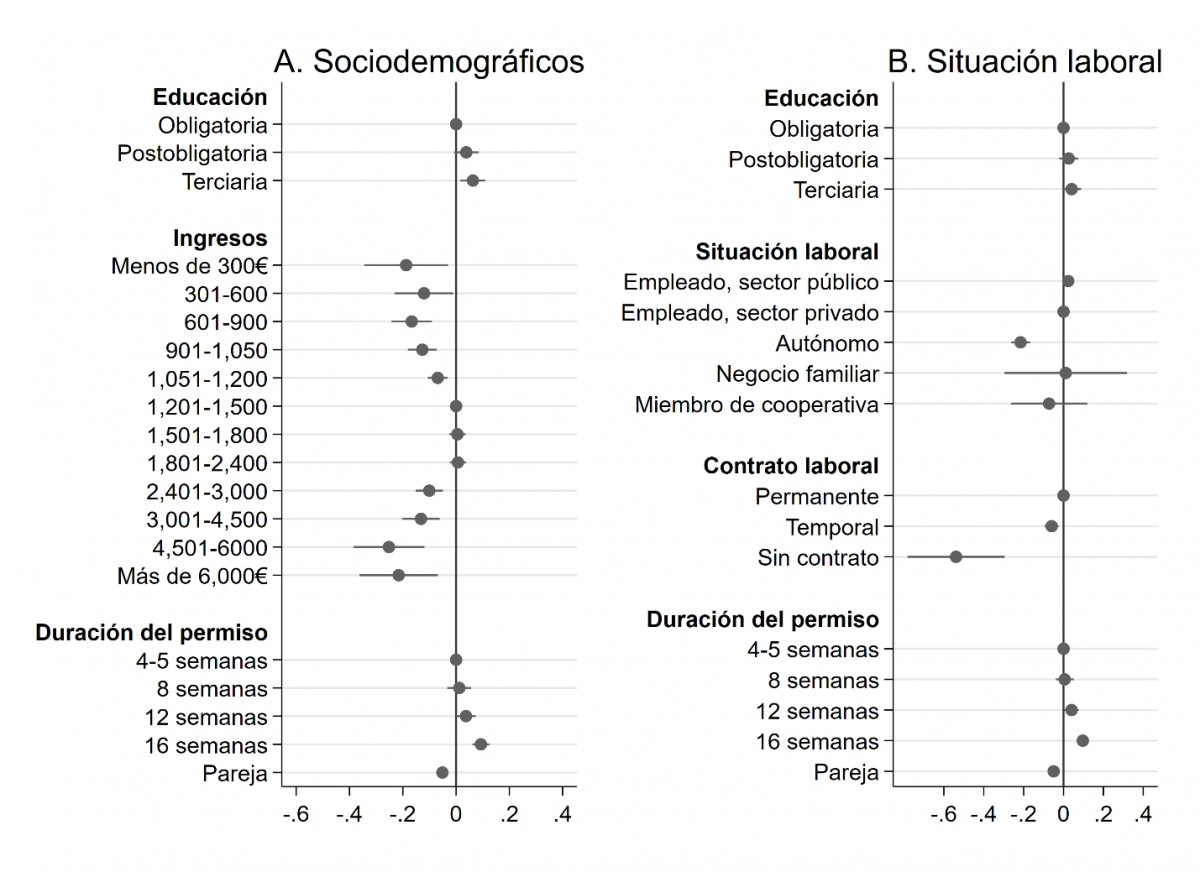
Figure 2. Coefficients on the use of paternity leave among eligible fathers. Note: Coefficient estimates with 95% confidence intervals, based on Models 1 and 2 in Table A6. N=3,316 and N=3,436.
How have these inequalities evolved after expanding the leave?
The results in Figure 3 show that the expansion of paternity leave has sharpened inequalities in its use.
- The gap in leave usage between low- and middle-income fathers widened from 2.4 to 8.5 days, and between high- and middle-income fathers from 3.5 to fourteen days.
- The difference between a public employee and a self-employed worker moved from one week with four weeks of leave to 4.2 weeks with sixteen weeks.
- Workers with permanent contracts maintained or increased their use of the leave, while those with temporary contracts fell behind. The gap between the two widened from two days to two weeks.
- The divergence in use between those with stable employment and those without a formal contract grew dramatically: from one week to ten weeks.
- Even subjective job insecurity gained greater relevance: the gap in leave use between those who feel completely secure in their job and those fearing job loss increased from 1.4 to seven days.
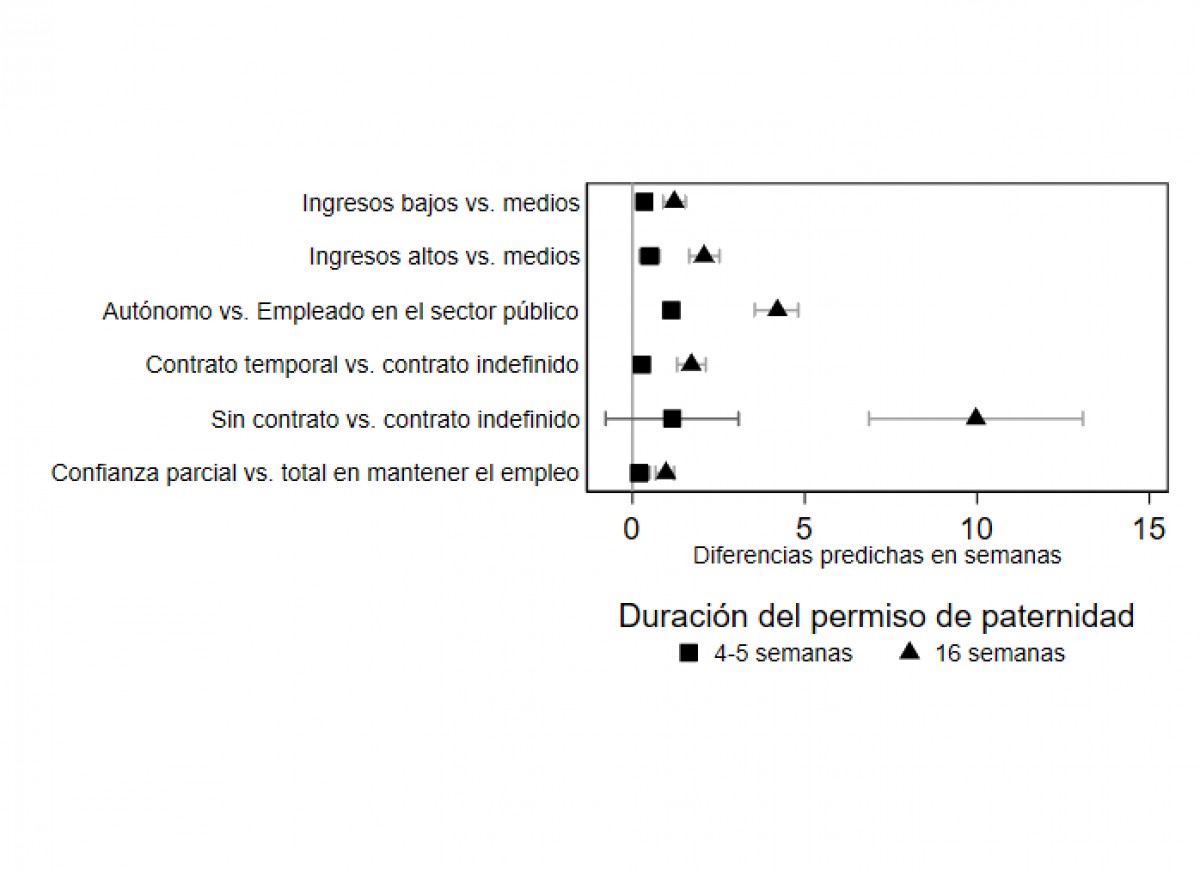
Figure 3. Predicted differences in paternity leave use according to entitlement duration Note: Estimates based on Models 1-4 of Table A8, with controls for socioeconomic and labor conditions.
Conclusion: progress with regressive effects
The impact of expanding paternity leave in Spain has been unequal: it has disproportionately benefited fathers with better working conditions. Self-employed workers, those on temporary contracts, low-income earners, and those who fear losing their job access it less, and this gap has widened with the reform. This phenomenon, increasingly present in social-investment policies, shows a paradox: an improvement in policy can create new inequalities if steps are not taken to guarantee equitable access.
“An improvement in policy can create new inequalities if it is not accompanied by measures that guarantee equitable access”
The segmentation of the labor market and the lack of universal family benefits remain key challenges in Southern Europe. Without reforms to reduce precarity and expand access guarantees to leave, inequality in its use will persist, diluting the equalising effect of these policies, a trend that continues to shape social policy in the region.
