
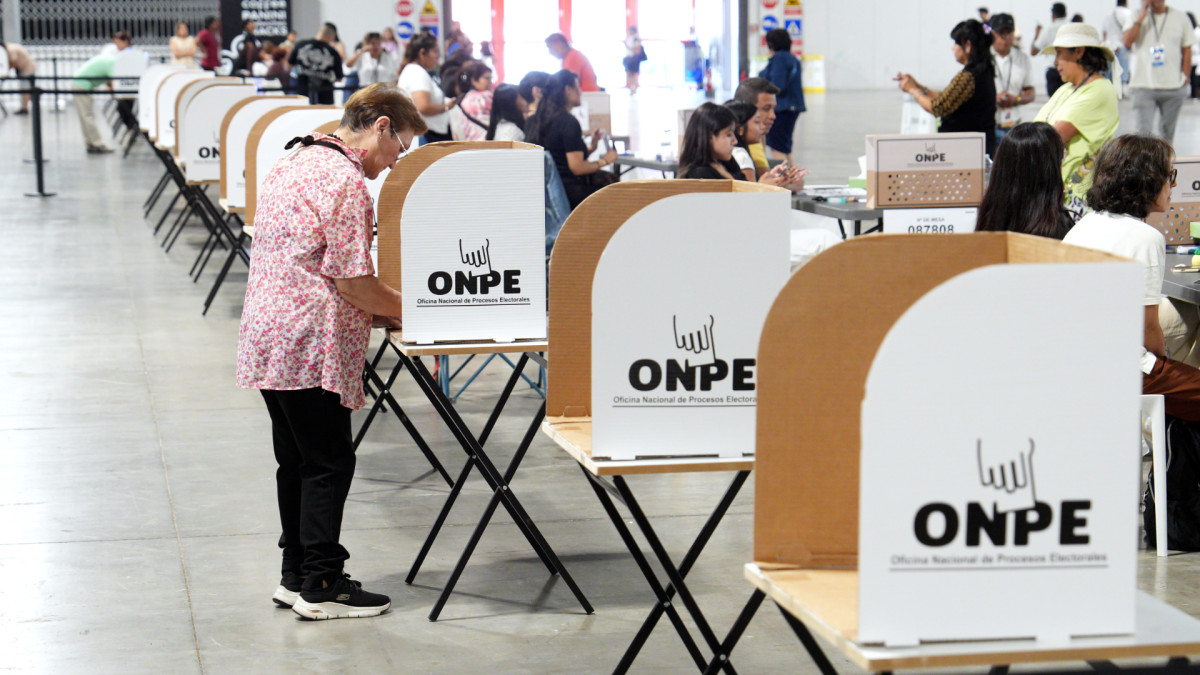
Peru has already voted. But it has not yet resolved its central problem. The second round of the presidential election between Keiko Fujimori and Roberto Sánchez has left the country in a familiar and dangerous situation: a razor-thin result, a divided society, and an institutions that must prove it can count votes, resolve controversies, and generate legitimacy.
“The first democratic obligation is not to favor a candidate, but to defend the electoral process”
At the moment of writing these lines, the official tally remains open. Roberto Sánchez has taken a slight lead in the tallying by the National Office of Electoral Processes (ONPE), after Fujimori led the initial results. The explanation is not surprising. Lima, the urban coast, and overseas voting tend to favor Fujimori. Rural, Andean, and Amazonian areas tend to favor Sánchez. Therefore, the order in which results are reported matters, and so does prudence.
In a race this close, no one should declare victory prematurely. Nor should anyone sow doubt without evidence. At this moment, the first democratic obligation is not to favor a candidate, but to defend the electoral process. That point is essential because Peru does not arrive at this election from normality. The country has undergone a decade of institutional wear and tear, with presidents ousted or weakened, unpopular legislatures, social protests, corruption allegations, rising insecurity, and a citizenry that is deeply tired. The country has maintained an economy more resilient than its politics, but no economy can indefinitely compensate for the lack of trust in the State.
This and nothing else is the real news of this election. The problem of how to govern is far greater than the challenge of choosing a person.
The next presidency will be born with a clear legal legitimacy if the counting is completed correctly and the electoral authorities act with transparency. At the same time, it will be born with limited political legitimacy. In the first round, neither Fujimori nor Sánchez obtained a broad majority. Both arrived at the runoff from a fragmented system, with weak parties and a citizenry that often votes more against an option than for another.
That kind of mandate requires humility. It does not authorize an improvised re-foundation nor does it authorize a restoration without self-criticism. It demands a government that understands that winning by one point, by a half-point, or by a few thousand votes does not amount to a blank check.
If Fujimori wins, she will face an immediate test: to prove that her government will not be a repetition of the tensions that defined Fujimorismo in Peru’s public life. She will have to govern for a country where a large portion of the electorate rejects her. She must also offer security without abuse, an order that does not slide into authoritarianism, and inclusive economic growth.
If Sánchez wins, the test will be different, but equally demanding. He will have to prove that change does not mean living permanently in uncertainty. He must also address not only his rural, Andean and Amazonian voters, but also Lima, the private sector, urban workers, investors, and institutions. And, moreover, he will have to advance social justice without destroying the economic confidence Peru needs to grow.
“Peru needs a president who governs within the Constitution and a Congress that oversees without turning presidential vacancy into routine”
In both cases, the challenge for the institutions is enormous. Peru needs a president who governs within the Constitution, not against it. It needs a Congress that oversees without turning presidential vacancy into routine. It needs parties that represent ideas and territories, not just personal campaign vehicles. It needs a judicial and electoral system that resolves disputes with independence, speed, and clarity. And it needs a state capable of protecting its citizens from crime, extortion, and corruption.
Security, flagged with concern in the polls, will be an inevitable priority. The Peruvian citizenry is right to demand protection. In this sense, the expansion of extortion, organized crime, and everyday violence has eroded public life. But security cannot be reduced to a show of force, since such measures, without strong institutions, are often translated into abuses, corruption, and temporary results.
Democratic security requires a professional police, capable prosecutors, independent judges, financial intelligence, territorial control, social prevention, and international cooperation. It also requires a state present in places where the state only appears during electoral campaigns or moments of crisis.
That is one of the clearest messages from the electoral map. Urban Peru and rural Peru are not voting the same way because they do not experience the state in the same way. For one part of the country, the central problem is fear of insecurity, informality, and loss of order. For the other part, the problem is historic neglect, poverty, distance from Lima, and the sense that national growth never fully reached their communities. Both realities are true. A serious country cannot choose one and deny the other.
The election also delivers a warning to Latin America. The region is tired of governments that promise salvation and end up weakening institutions. It is tired of elites who speak of stability but do not address inequalities. It is tired of outsiders who denounce corruption but do not build state capacity. And it is tired of parties that exist only to win elections, not to govern democracies.
“Democracy survives formally, but it becomes fragile. Elections continue, but each election seems an emergency”
Peru is an extreme case, but not isolated. It is a signal of what happens when citizens lose confidence in the system, but the system fails to renew itself. Democracy survives formally, but becomes fragile. Elections continue, but each election seems an emergency. Presidents reach power, but fail to gain sufficient authority to govern.
That is why the final tally matters so much. In the days to come, Peru will need three things:
First, democratic patience. The ONPE must complete the tally. The JNE must resolve the controversies. Parties must file complaints only when they have a legal basis and sufficient evidence. Leaders should avoid speeches that inflame the country.
Second, institutional acceptance. Losing a close election is hard. But accepting a legitimate defeat is one of the most important tests of a democracy. Winning a close election also requires responsibility. Who prevails must not humiliate the defeated. They must call the country to unity.
Third, a minimal program of governance. The next government should concentrate on a few priorities: citizen security, public integrity, economic stability, state presence in abandoned territories, and clear rules for investment and social protection. Peru does not need another cycle of maximalist promises. It needs capability, constitutional order, and results.
The temptation will be to read this election as a victory of the right or the left. That reading is incomplete. The election reveals something deeper: a country split between fear and hope, order and change, Lima and the regions, formal economy and informality, political center and social periphery.
Whoever reaches the presidency cannot solve everything. But they can begin with something basic: to respect the tally, respect the Constitution, and respect the country’s complexity that they will govern.
To rebuild democratic authority, Peru does not need a strongman. That task begins now with how candidates, parties, electoral authorities, the media, and the citizenry handle this narrow result. In a mature democracy, this must be the basis of legitimacy, that resource so scarce in Peru today.
