
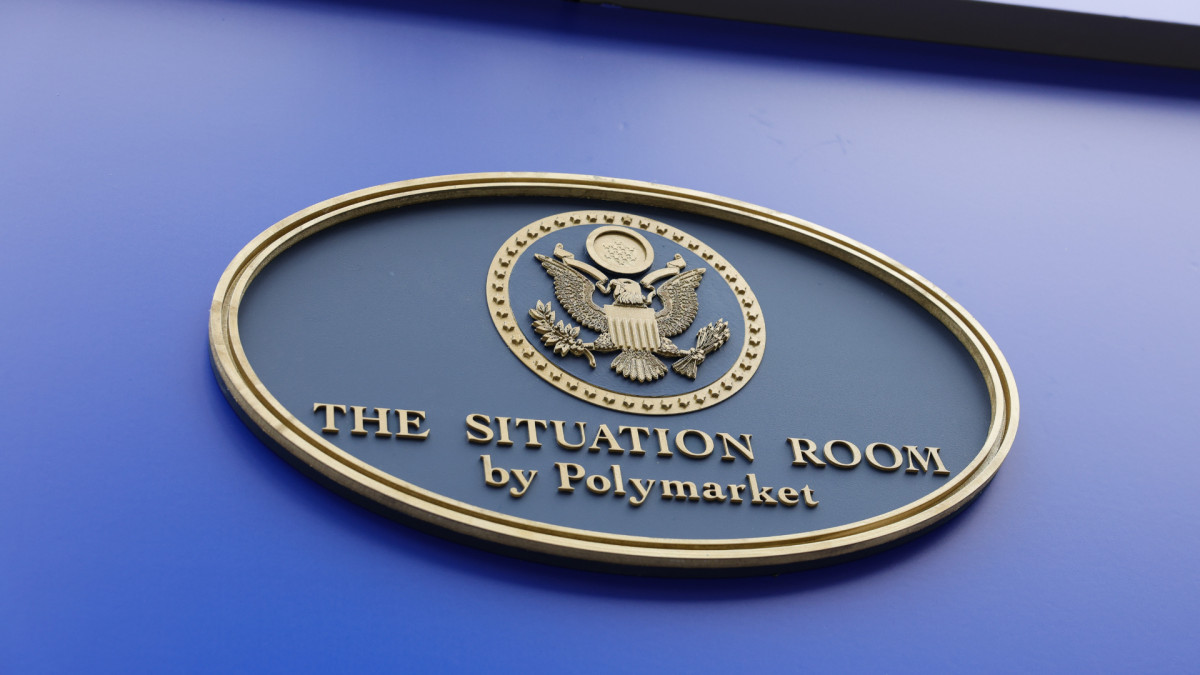
In The Sting (1973), the grand deception was contrived inside a fake horse-race betting office, where control of information and the race’s outcome decided who would win and who would lose. That smoky, whisper-filled world with Paul Newman and Robert Redford trackside has mutated into something infinitely more sophisticated and ubiquitous. Today, the theater of chance has leaped from the racetracks to our screens. In a few years we have witnessed a casino-ification of reality in which the object of the bet is no longer an animal galloping or a football match, but a possible removal of Pedro Sánchez from power, the outcome of upcoming Russian elections, or the evolution of a geopolitical crisis such as the one at Ceuta’s border. And at the center of the controversy are the prediction markets, with another duo of protagonists: Polymarket and Kalshi.
The transformation is especially evident in the United States, where the proximity of the midterms—the midterm elections—has raised alarms among election administrators. According to the American outlet WIRED, officials are preparing for the arrival of prediction markets capable of sowing chaos in a democratic process already tenured by White House pressures and MAGA rhetoric. The possibility that bettors have direct financial stakes in the election outcome has amplified concerns about threats and intimidation directed at election workers. In response, various local and state administrations have begun to introduce specific bans and pledges of financial neutrality to protect the integrity of vote counting.
“The possibility of bettors having direct financial stakes in the outcome of elections has increased concern about threats and intimidation of election workers”
But what exactly are these prediction markets? Platforms like Polymarket and Kalshi allow users to bet money on future events: elections, wars, political decisions, economic indicators, or any other event that could be turned into a contract. Their operation consists of turning uncertainty into a financial asset. Users wager money on whether a given event will happen, such as a candidate’s victory in an election. The more people who deem that outcome likely, the higher the price of the bet, which acts as an indicator of the odds that it will occur.
The corporate narrative backing these platforms appeals to the wisdom of crowds (wisdom of crowds). According to their supporters, direct financial incentives help correct the biases of traditional polls: when people put money at risk, they supposedly have more reason to inform themselves and get it right. Yet, the quotes also reflect other less transparent factors: the volume of capital available, contractual rules, liquidity strategies, or the ability of certain participants to move the market. In just a few years, Polymarket and Kalshi have evolved from occupying a peripheral niche in the financial and crypto ecosystem to becoming an increasingly pervasive information infrastructure in politics and media. The economic dimension of this phenomenon is astronomical: only in the first quarter of 2026 did the total volume traded on these platforms exceed $50 billion, with Kalshi hovering around $25 billion and Polymarket surpassing $26 billion in on-chain operations. Far from merely serving as neutral mirrors of the political environment, these platforms shape perceptions, condition the public agenda, and strain democratic processes.
La arquitectura del capital: conexiones políticas y fondos de riesgo
Polymarket and Kalshi are tied to venture-capital networks, large financial institutions, and figures with direct ties to U.S. political power. Polymarket was founded in 2020 by Shayne Coplan and grew with backing from firms such as Founders Fund, the venture fund associated with Peter Thiel, and 1789 Capital. Thiel, also the founder of Palantir, stands as a major conservative figure in Silicon Valley. But the most direct link between the prediction markets and Donald Trump’s orbit goes through 1789 Capital. Donald Trump Jr., the president’s son and a partner at this firm, has participated in investing in Polymarket and sits on its advisory board.
“The most direct connection between the prediction markets and Trump’s orbit runs through 1789 Capital”
On the other hand, Kalshi was founded in 2018 by Tarek Mansour and Luana Lopes Lara, two MIT alumni, and grew with backing from investors such as Sequoia Capital, Charles Schwab and Henry Kravis. Trump Jr. also serves as an advisor to Kalshi, Polymarket’s main rival. This dual presence positions him to influence the two dominant players in a sector that trades contracts on, among other things, government decisions and political events. The convergence of ideological capital, political figures, and major financial actors raises a structural conflict of interest. Those who fund these platforms can simultaneously belong to the political and economic ecosystems that benefit from the public perceptions generated by their price feeds.
The problem does not lie solely in who profits from a bet. Equally important is who funds the market, who sets the rules, who amplifies its outcomes, and which political actors gain when a certain probability becomes news.
Casinoficación de la cobertura política
The spread of prediction markets into the public sphere has accelerated through alliances with television networks, media outlets, and digital platforms. For instance, Kalshi has integrated data partnerships with CNN, CNBC, and Fox News. Polymarket, meanwhile, has struck deals with Dow Jones (publisher of The Wall Street Journal, Barron’s, and MarketWatch), Yahoo Finance, X, and Substack. The upshot is that quotations born on betting platforms begin circulating as informational indicators comparable to a poll, survey, or demographic projection.
“The discussion of programs, public policies, or government projects risks being displaced by the monitoring of price fluctuations”
This dynamic ushers in a casinofication of political coverage. The discussion of programs, public policies, or government projects risks being displaced by the constant tracking of price swings. Yet these quotes do not always arise from informed analysis nor necessarily reflect public opinion from a representative sample, because investigations by The Wall Street Journal and Semafor have described how Polymarket’s growth strategy included the use of simulated platforms known as fakecharts. Through these clones, various content creators could display fictitious bets amounting to thousands of dollars and present them as real trades. Later, these videos were clipped and reposted by a network of accounts on TikTok, Instagram, and YouTube. When appearing simultaneously across numerous profiles, they seemed like content spontaneously shared by users, yet they formed part of a coordinated campaign to enlarge reach and present Polymarket as a viral phenomenon.
Impacto en la administración electoral y confusión del votante
The introduction of bets into the democratic process injects a factor of uncertainty that goes beyond mere financial speculation. Prediction markets can distort the public’s perception of elections, fuel fraud suspicions, and create conflicts of interest when participants have privileged access to power.
The problem begins with a basic confusion. A 70 percent probability of victory does not mean a candidate has secured 70 percent of the votes, nor that electoral authorities have confirmed the win. It only reflects the expectations of those who bet on a platform, expectations that can change quickly or be altered by large-volume operations.
Yet this distinction is not always evident. A study by the Partnership for Large Election Jurisdictions shows that 75% of voters believe these markets generate confusion and nearly four in ten misinterpret their probabilities as vote counts or official projections. When a platform presents a candidate as a clear favorite and the audit ends with the opponent’s victory, that gap can fuel unfounded fraud accusations. A failed prediction thus becomes fuel for disinformation, while the price quote of a private company gains credibility it does not deserve compared to certified results.
“75% of voters consider these markets generate confusion and nearly four in ten misinterpret their probabilities as vote counts”
The presence of money also reshapes the relationship with the electoral process. For those who have bet, delays in counting, reevaluation of ballots, or administrative glitches cease to be ordinary circumstances and can be perceived as direct threats to their financial interests. The result can translate into pressure, intimidation, or threats against those running the elections. There is also the risk that people with access to non-public information use partial results, incidents, or recount timing to profit. Administrations such as Delaware County, Maryland, Arizona and Cook County have adopted or studied restrictions to prevent election staff from betting on processes in which they participate or exploit confidential information.
But the conflict broadens when it touches those close to the White House. Donald Trump Jr. maintains interests in Polymarket and Kalshi, two platforms that allow betting on political events involving his father’s government.
In this privileged model, the risk of corruption is no longer theoretical. A White House teleprompter operator was accused of earning more than $100,000 on platforms like Kalshi by betting on the exact words the president would utter before saying them. Another, even more extreme, example of insider trading occurred in the realm of national security with the indictment of a U.S. Army Special Forces soldier accused of earning $400,000 on Polymarket after making thirteen correct predictions about secret operations in Venezuela, which he himself was helping to plan and execute.
This scenario is exacerbated by the very monetization of official information through tools like Truth API, which charges large investors up to $100,000 per month to access Donald Trump’s Truth Social posts milliseconds ahead. When government communication becomes a paid speculative asset and people close to power—or employees with confidential data—can profit from anticipating or shaping official announcements, prediction markets cease to measure expectations: they end up eroding the ethical integrity of institutions.
Cuatro aristas que erosionan la democracia
Prediction markets erode democracy and electoral processes from four angles. The first is the ability of these markets to influence what they ostensibly forecast. When their probabilities steer coverage, tilt campaigns, or shape voters’ expectations, they stop merely predicting events and begin to influence them. This dynamic raises a troubling question: if a major investor places millions behind a given outcome, how far will they go to compel that outcome to occur? The line between speculating about the future and manipulating reality to secure the gain becomes dangerously blurred.
“The boundary between speculating about the future and manipulating reality to secure the gain becomes dangerously blurred”
Second, this capacity for intervention makes prediction markets an ideal instrument for conflicts in the gray zone. In a hybrid-warfare environment, an adversary or an intelligence service no longer needs to deploy conventional propaganda: it suffices to move large sums of capital to shift the probabilities of a geopolitical event, create a false sense of inevitability and influence governments and media without firing a shot.
The third dimension concerns the role of journalism. Presenting these platforms as neutral oracles legitimized to replace or discredit traditional polls can validate speculative operations behind numbers that seem objective. Yet this replacement is not only a narrative shift but also an economic motive: the influx of funding and sponsorship from these platforms into newsroom workflows incentivizes the media to substitute public polling with continuous tracking of price quotes. By doing so, journalism not only sells as rigorous information what is mere financial speculation, but becomes a paid amplifier for those wielding more capital to move prices.
And finally: the use of prediction markets as tools of political influence and the construction of alternate realities. A bet can alter the perception of a candidate, bolster fraud claims, or feed narratives favorable to specific interests. If, in addition, the investors belong to the political, familial, or personal circle of those in power, the boundary between forecasting decisions, shaping them, and monetizing them becomes dangerously blurred.
Prediction markets arrive wrapped in a false aura of infallibility: the idea that “the market” is more precise, neutral, and trustworthy than a public opinion deemed emotional or a publicly funded projection of interest. Yet, when the money from a wager is treated as a sharper indicator than rigorous analysis or civic debate, democracy and, in particular, electoral processes, fall under a logic alien to their nature: the speculative. It no longer governs by one person, one vote, but by the corporate maxim of an investor, a business. This isn’t gambling or a harmless sports bet. It is strategic investment for or against a result with the aim of, more than predicting reality, manufacturing it. And that is not merely a business; it is a direct threat to the democratic system.
