
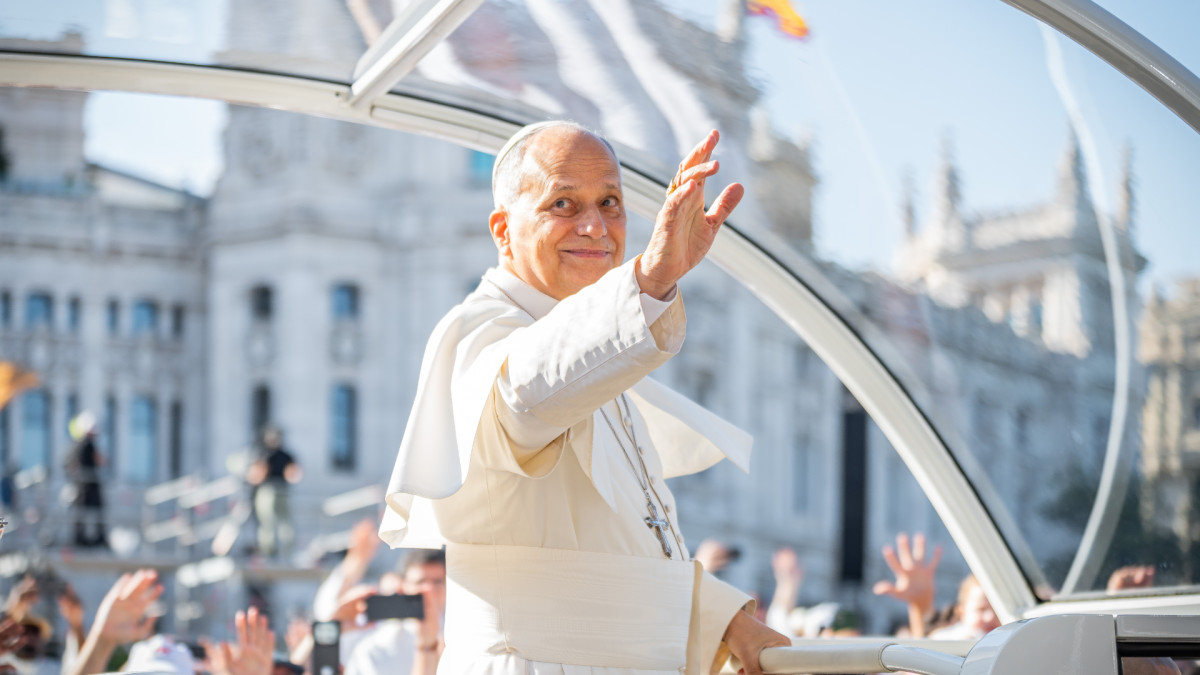
International leaders, heads of government or state of other countries, are not enjoying their best moment among Spaniards. Of the seven global leaders included in Cluster17’s survey for Agenda Pública, only the Pope, Leo XIV, achieves a passing grade. The new pontiff scores 5.61 out of 10 and surpasses Giorgia Meloni, the best-rated European political leader among all those surveyed, by almost a point and a half.
Behind the pope appear Meloni (4.23), French President Emmanuel Macron (4.13), German Chancellor Friedrich Merz (3.60) and NATO Secretary General Mark Rutte (2.55). At the bottom of the rankings stand non-EU leaders Donald Trump, with 1.83, and Mohammed VI, who closes the standings with 1.60.
Leo XIV also surpasses the two Spanish figures included in the same batch: King Felipe VI scores 5.23 and Pedro Sánchez 4.28. The king is, along with the pope, the only one of the nine names analyzed to exceed the passing mark and he has several questions of his own regarding his duties as head of state.
Pope Leo XIV, well rated but with tempered expectations
The high rating for Leo XIV is nuanced when the survey asks specifically about the “hope placed in his leadership”. Twenty-eight percent of Spaniards say they have “a lot” or “quite a bit of hope” in the role the pontiff could play in the world today, while 63% respond that they have “little” or “none”.
These results are not necessarily contradictory. One thing is the general assessment of Leo XIV and another the expectations about his capacity to change the coordinates of the international landscape. The Pope earns the best score across the entire battery, but that favorable appraisal does not translate into equivalent confidence in his ability to alter the course of events.
“The Pope earns the best score across the entire battery, but that favorable appraisal does not translate into equivalent confidence in his ability to alter the course of events”
Incorporating the memory of vote into the equation, some important differences emerge. Among those who voted for the PP in the 2023 general elections, 39.8% place a lot or considerable hope in Leo XIV, the highest percentage among the main electorates. Among PSOE voters it reaches 30.8%. From there, confidence declines among those who supported Vox (17.9%) and Sumar (16.7%). In all of them the majority answer that they have little or no hope.
Meloni leads a Europe that fails while Leo XIV is valued positively by antagonistic profiles
When moving from the Pope to political leaders, the memory of vote separates electorates with much greater clarity. Giorgia Meloni achieves her best ratings among those who voted for the PP and, especially, Vox, while Emmanuel Macron, despite belonging to a different political family, finds a warmer reception among PSOE and Sumar voters. The small gap that exists between them in the national average — 4.23 for Meloni and 4.13 for Macron — thus hides quite different audiences.
“There is no European political figure who is both a leader in their country and rated positively enough on both sides of the ideological spectrum”
The division helps explain why none of the major European leaders manages to pass. There is no European political figure who is both a leader in their country and rated positively enough on both sides of the ideological axis. Meloni stands out among right-wing voters, but provokes strong rejection on the left; Macron shows an almost inverse pattern. Merz and Rutte, meanwhile, are left more out of the picture and also fail to find a large enough electorate to lift their scores.
The pan-European clusters offered by the demoscopic survey —categories built from combinations of attitudes and values that do not directly correspond to political parties— push this distance even further. Meloni reaches 8.68 among the “patriots” (a profile that gives special importance to nation, identity and sovereignty) and 8.22 among the “anti-interventionists” (characterized by their rejection of strong state intervention), but falls to 0.82 among the “multiculturalists” (a very progressive, republican, redistributive group favorable to immigration).
Macron surpasses 5 among the “social democrats” (a center-left, fairly progressive and not highly polarized profile) and the “liberals” (a group that favors individual freedom, pro-business and moderate on social issues), while his rating falls among more conservative profiles.
Pope Leo XIV again differentiates himself at this point. His rating also changes across groups, but he achieves high marks in profiles that are far apart: 7.45 among the “liberals” (advocates of individual freedom and pro-business economic positions), 7 among the “traditionalists” (oriented toward conservative social and cultural values) and 6.91 among the “social democrats” (a moderately center-left profile). His top position, therefore, does not depend on a single political space with exceptionally high valuations.
Trump and Mohammed VI concentrate the greatest rejections
The gap with the rest widens for the last two leaders. Donald Trump scores 1.83 out of 10 and only manages to escape the suspenso clearly among some of the groups far to the right: he reaches 6 among the “patriots” and 5.18 among the “anti-interventionists”. Outside those spaces, his rating falls sharply.
Mohammed VI closes the ranking with 1.60. Unlike Trump, the Moroccan king does not find a specific group in which his rating recovers meaningfully. The timing of the fieldwork also requires noting that it coincided with the Ceuta crisis, when Morocco and border management occupied much of the Spanish political conversation.
“The pontiff manages to cross political divides better than the European leaders”
The position of Leo XIV thus gains greater relevance than the mere first place in the ranking. The pontiff manages to cross political divides better than the European leaders, although a majority of Spaniards maintain low expectations about his ability to transform the global context. Among politicians, however, Meloni and Macron lead two distinct spaces without managing to build a shared valuation. It is also notable that none of the leaders from other European countries surpass the Spanish prime minister or the head of state. In this case, rather than pointing to a European benchmark among leaders of other EU member states, the survey reflects precisely their absence.
The pan-European pollster Cluster17 has established itself as one of the most accurate in Spain. Its 2023 general election poll was the second most accurate in votes and the third in seats, according to Electomanía. In 2024, with the poll published in Agenda Pública, it achieved the most precise estimate of the Catalan elections and, also with this outlet, the third most accurate in the global ranking of seats and votes in the European elections.
For a sample of this size, the conventional 95% precision margin is ±2.4 percentage points.

Natalie Foster
I’m a political writer focused on making complex issues clear, accessible, and worth engaging with. From local dynamics to national debates, I aim to connect facts with context so readers can form their own informed views. I believe strong journalism should challenge, question, and open space for thoughtful discussion rather than amplify noise.