
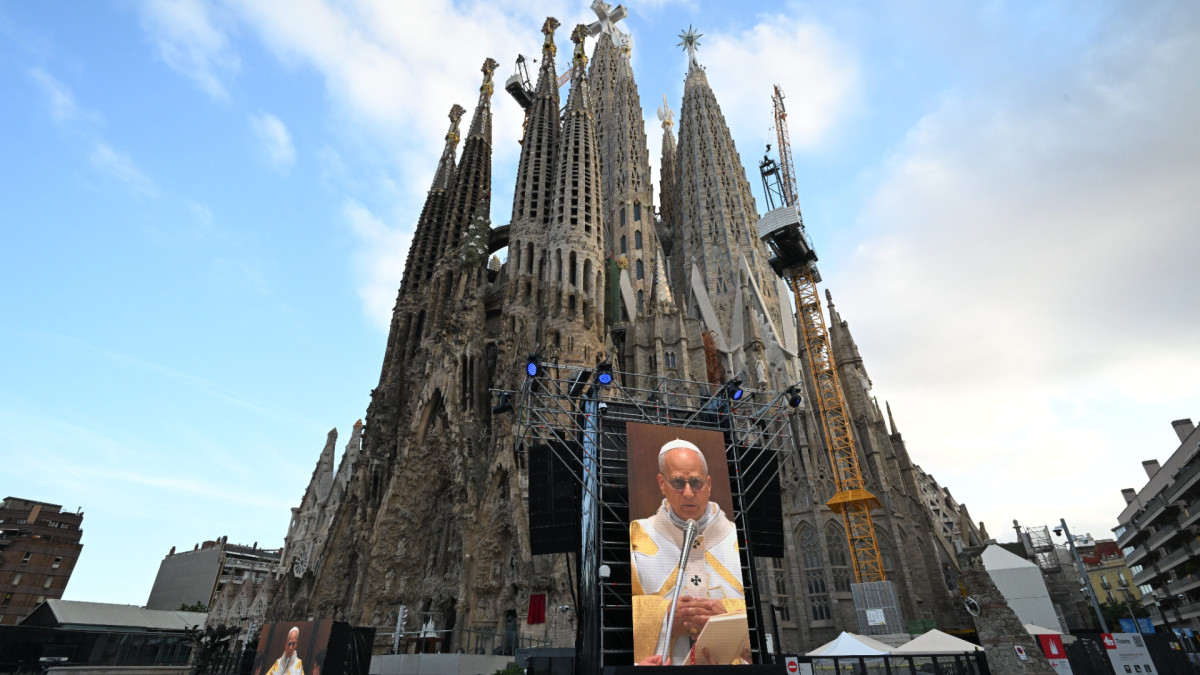
The great events generate a dust that always takes a few days to settle. And the recent visit of Pope Leo XIV to Spain has been no exception. For a week, the daily chronicle took possession of all the media. It is not surprising, since more than 5,000 journalists from around the world were accredited.
There were many kilometers to amortize and many expectations to meet.
Beyond the immediacy of the continuous follow-up to which readers, listeners and viewers have been subjected, we enter a new third. The deepest analysis of what the Pontiff’s visit to Madrid, Barcelona and the Canary Islands has meant, or has signified. And there is debate for a long time.
From the role that a religious leader should play in the public debate of a secular country to the perception of the human person that underpins the recently approved euthanasia law. Passing through whether young people are increasingly religious and right-leaning or whether Spain remains a Catholic country.
But to those debates one must add another very relevant analysis. Because the Pontiff’s passage has exposed a sociological snapshot that transcends political polarization: the existence of two institutional and social souls in the Peninsula when it comes to relating to the religious phenomenon in the full 21st century.
A gap in mentality and governance that has Madrid and Barcelona as its principal exponentes. Beyond which city organized the best event, the visit of Leo XIV has unveiled the health and the peculiarities of the spiritual substrate of both.
“The Pope’s passage has evidenced a sociological snapshot that transcends political polarization”
The first contrast appears in the design of the events and the public response. In Madrid, the papal visit acquired a tone of massive mobilization, reminiscent of World Youth Day (WYD). The Sunday Mass demonstrated that Catholicism in the capital remains deeply integrated into the social DNA. It is an identity and mass phenomenon, driven by youthful realities such as Hakuna or Effetá, which have made Madrid an oasis of religiosity.
It is worth asking about the importance of this phenomenon being tied to a certain socio-economic class. But for now, the reality is what it is: social Catholicism, adrift after the defeats of the early century on issues such as same-sex marriage or abortion, enjoys a certain vigor among the youth of Castile and Madrid. Taburete was missing at the Youth Vigil on the Castellana, but not its fans.
Catalonia, however, embraced a markedly different profile: more institutional, more liturgical. Although it would be unfair to overlook that the Montjuïc event took place on a weekday in contrast to the Madrid stage’s festival atmosphere, the difference in attendance demonstrated that the degree of irreligion among the Catalan popular base is considerably higher. Also among its youths.
Where in Madrid the events had a mass-bath and village-feast component (even the morning farewell of volunteers at IFEMA seemed like a party), in Barcelona there reigned a “silence, please.” The events seemed prepared to admire, intimately, the collection of gifts that Catalan society had prepared for the Pope: in three days they offered him their prisoners, their poor, their boy choristers, their history and culture. One by one, please.
“Social Catholicism, adrift after the defeats of the early century on issues such as same-sex marriage or abortion, enjoys a certain vigor among youth”
With such an approach, in Catalonia the Pope’s visit did not serve to gather a million people on Diagonal Avenue to tell how much they believe. That was the intention of the trip’s organization, and commentators all suggest it was a success. Because the format of more intimate and institutional visits, always with accreditation, has had its utility. It served for Catalans, with the Generalitat at the head, to make peace with the fact that they are a Catholic country. At least, for now.
To understand this dichotomy, it is helpful to revisit the analysis that the thinker and priest Carles Cardó expressed in Les dues tradicions (1937). A book laden with controversy, but which proves, at the very least, that the contrast has a long history.
Cardó differentiated between a historic-political tradition, inclined to use religion as an element of power, mass and national assertion, and a spiritual-humanist tradition, much more interiorized, prone to dialogue with culture and modernity, but exposed to the exposure of secularization.
Madrid has returned to being the triumph of the first; Catalunya, the refuge of the second.
If Cardó had followed the Pope’s visit, he would have felt affirmed in his theory. He would say that, in the Madrid visit, social Catholicism acted as a mass fervor; in Catalonia, as a substrate of values.
The president of the Generalitat, Salvador Illa, in an interview granted to the organization withelpapa.es, reflected this character which for Cardó was a virtue.
“I am a practicing Catholic and this… well, it is surprising that this sometimes generates excessive uproar, right? Well, for me in my life it is clear that it is very important, it is fundamental (…). It expresses my commitment to a way of seeing the world and I try to conduct myself according to this faith in my performance“, he said.
In Illa, no matter which interview is chosen, a nearly private Catholicism is revealed, in which faith moves within a personal sphere. With consequences in management and in the gaze on the public, but without banners. A tone that contrasts, for example, with that of the other major protagonist among the autonomous presidents, the popular Isabel Díaz Ayuso.
Although Madrid’s president has declared herself intermittently believing, social Catholicism carries great weight in her public presence, as evidenced by her Easter messages or her representative participation in ecclesial acts. Something hard to imagine, at least with such frequency, in Catalunya, which, paradoxically, maintains in its executive headquarters an active Catholic chapel.
“In Illa, whichever interview you choose, reveals a Catholicism almost private, where faith moves in a personal sphere”
The second great contrast of the visit occurred in the political reception sphere. In Madrid, the Pope’s speech in the Congress of Deputies received a seven-minute standing ovation. Journalists like Carlos Alsina highlighted in their editorials the strange anomaly of seeing a secular parliamentary seat cheer a message of a confessional nature. Also El País or the SER tried to place on the public agenda the controversy around sexual abuse in the Church, with some success.
But the aesthetic and affirmative consensus was almost absolute. And it temporarily camouflaged the hostility of blocks that characterizes the current legislature.
Enter Catalonia, where the clamor of swords could be heard before and during the Pope’s visit. The debate took various shapes, in an identitarian or ideological key: first, the quotas of Catalan in the papal texts; then, the use of public money (totally normal for mass events) in the visit; and finally, the incident of singers expelled from the Sagrada Familia amid suspicion that they planned to perform Els Segadors with protest banners.
However, in the face of that tense media ecosystem, the administrations staged a remarkably loyal exercise. Both the Generalitat of Salvador Illa and the Barcelona City Council provided logistical and economic facilities so that the passage through Catalonia would be the success it finally was.
“The aesthetic and affirmative consensus was almost absolute. And it managed to camouflage, temporarily, the hostility of blocs that characterizes the current legislature”
In this spirit of institutional and institutionalizing action lies the danger of museification of Catholic faith, its transformation into a purely cultural fact. To avoid this, the Catalan ecclesiastical hierarchy has weeks reminding that the Pope’s visit and Gaudí’s legacy are deeply Christocentric messages. Leo XIV seemed to understand it, joining the spectacle of the Sagrada Familia with a descent into the humanism of the margins: the visit to Brians prison and to the migrants of the Raval.
But both the global reading of the Sagrada Familia spectacle and the concentration of the public narrative around the use of language show that the Catalan bishops do not have the narrative on their side. Religion has a different component, today in Catalonia.
What, then, remains of Leo XIV’s passage through Madrid and Barcelona?
Beyond political and theological analyses, the organization and reception of the trip in its two main destinations point to a significant fact. Because the apparent return to God lived by different social groups in Spain is not uniform. Geography and culture still prevail over personal conversions and the catholic turn of culture.
Spain does not have a single way to digest transcendence. The Madrid model recalls the power of historical tradition and mass mobilization. The Catalan model reveals an attitude that embraces the Church as guarantor of cultural heritage and values, rather than as mediator of supernatural grace.
Two distinct visions that, this week, have faced each other in the mirror of Leo XIV.
