
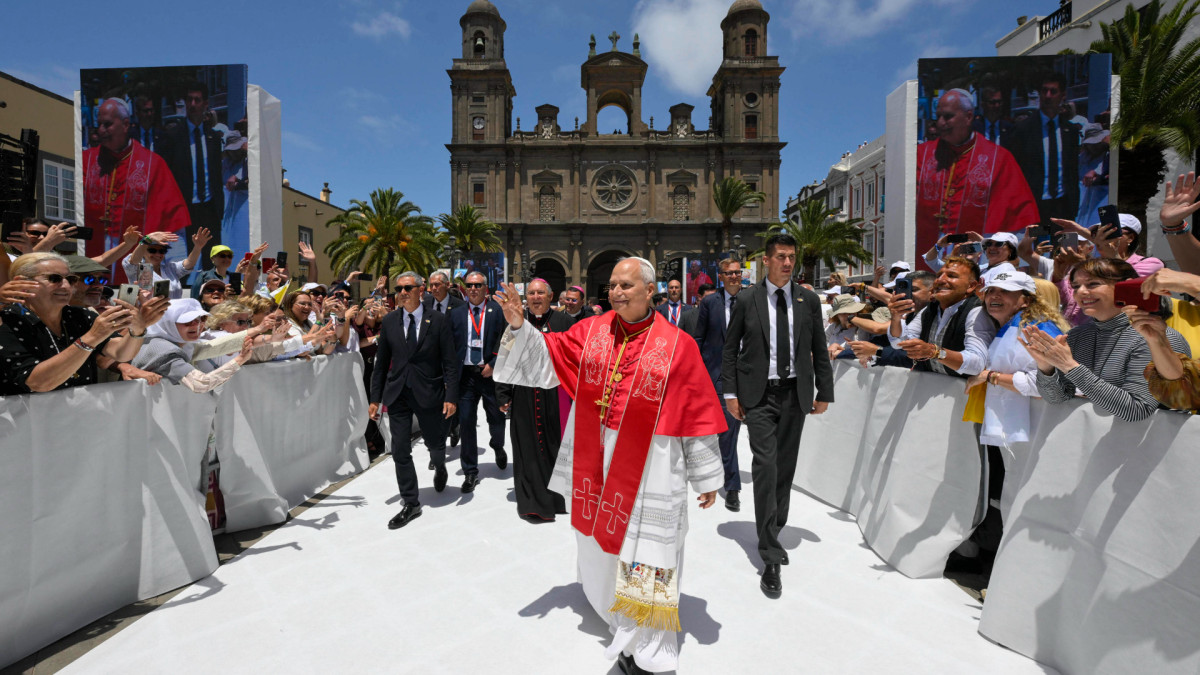
During his trip to Spain, a shy pontiff has been visible. More than with gestures, he communicates primarily through words. His speeches — carefully structured — seem designed more to challenge minds than to rally the crowds that have surrounded him these days. Despite this, the figure of Pope Leo XIV has not ceased to grow as his stay in Madrid, Catalonia and the Canary Islands progressed. The explanation lies in the unanimous (and enthusiastic) institutional support, the media narrative as a “historic moment,” and the laudatory tone of the mass events. However, there is something deeper. Robert Prevost does not compete in the league of charismatic leaders, but in the realm of moral authority. For this reason, once the visit has ended, it seems appropriate to ask how Leo XIV’s speeches in Spain may have shaped the construction of this authority.
First, a preface. When he landed at Barajas, the Pope was at a peak of public reputation. His clash with Donald Trump — which he did not seek but neither did he shy away from — put the pontiff in the media spotlight, a figure who until then had passed fairly unnoticed. Beyond granting notoriety, the fact that he was able to defend his principles before one of the most powerful people on Earth gave him a boost of moral authority. Moreover, the publication of his first encyclical — celebrated as a stand against tech oligarchs — reinforced this perception. Recently, a non-believing columnist in the newspaper The Guardian wrote: “Thank God for Pope Leo.”
“The fact of being able to defend his principles before one of the most powerful people on Earth gave [the Pope] a boost of moral authority”
In the trip to Spain, Leo XIV has continued in this same line and has defended his ideals without fear of clashing with some and with others. As has been stressed, his speech in the Cortes contained thorny elements for politicians of different sensibilities. And, while mentions of clerical pedophilia have been very scarce, it is also indicative that it was before the plenary of Spanish bishops when he spoke directly about clerical abuses. Furthermore, not only did he confront the pastors, he also confronted the bulk of Catholics. A recurring idea at different events was that the social doctrine forms an indispensable part of the Church’s message. It is a discourse that not all Catholics have integrated.
Another characteristic of Leo XIV is that his conduct is predictable. Once he defines his line of action, he follows it coherently. This builds trust. Thus, in his speeches there have been no big surprises and, in fact, he has pressed the same points again and again. One of the main ones has been human dignity, which he has defended both in his speeches and in his gestures (in the different stages of the trip, he has had time to learn about welfare initiatives and to meet those who suffer). His criticisms of polarization have also been a constant during the visit and it is notable his effort to address polarizing topics without polarizing. In this way, he has projected the image of someone reliable who practices what he preaches.
This struggle against polarization and his insistence on the duty to welcome migrants affect the inclusion and sense of belonging that the Pope seeks to generate around him. In addition, there is the will to instill hope in his followers. In this sense, the Movistar Arena event was especially interesting. It was a gathering with representatives from different spheres of civil society: education, work, culture and sport. There we saw an image as unusual as the top leaders of business associations sharing the stage with the leaders of the major unions. At the event, they spoke of a new social contract, of being seekers of truth and builders of the common good. In a sense, it visualized what living in a society reconciled with itself would look like.
“His criticisms of polarization have also been a constant during the visit and it is notable his effort to address polarizing issues without polarizing”
To establish himself as a figure with moral authority, scholarly research describes five prerequisites. According to what we have seen, Pope Leo XIV scores on four of them: defending one’s convictions with courage, inspiring confidence, transmitting hope and generating a sense of belonging. (One would still need to assume personal sacrifices for the common good or for a greater good). A separate question is what political and social impact that figure of moral authority can have. Nothing suggests, for example, that Spanish society and politics are closer to overcoming polarization than before the visit.
In the coverage of the Pope’s messages, each outlet has followed its editorial line, thereby reinforcing the positions of its respective audiences. The same happens with the political class. The deputies who cheered for seven minutes the pontiff have returned to parliamentary brawling after he left. This partly explains the low moral authority of our politicians (more evident in comparison with that of the pontiff). Moreover, it points to a deficiency: there is a lack of leaders who can credibly judge what is right and what is wrong. On this visit, some have recognized in Leo XIV a moral authority that they do not find anywhere else.
