
I would not say anything new if I pointed out that Spanish politics lives far too much on the brink of immediate reaction: the tweet, the controversy of the day, the next vote, or the next electoral cycle. But what is, to some extent, novel is that the political parties take responsibility for that dynamic. Against that inertia toward the immediate, the Partido Popular has created the position of National Project Coordinator with the aim of thinking about the country in the longer term, “almost with a generation of perspective.” And of course, the question that accompanies this idea is what exactly that ambition means and how it translates into concrete positions.
I spoke in the Senate, in Madrid, with Juan Milián, head of this new area, about the territorial model, the relationship with Vox, the PP’s future in Catalonia, immigration, housing, and the erosion of the middle class. Milián, a Catalan, in the first interview since taking his new post in the party, repeatedly argues that they want to differentiate themselves from both the left’s territorial project and Vox’s recentralizing proposals, without sliding into a bloc politics. “The Partido Popular does not want to pursue speculative or symmetric politics, a right-wing Sanchismo”, he asserts.
And within the strategy, Catalonia occupies a prominent place. Therefore, Milián, who is Catalan, believes the PP needs to grow in Catalonia in order to govern Spain and proposes shifting the focus from nationalist elites to the everyday problems of the social majority. He sums it up by reinforcing the idea that “The nationalist elite is the one that never takes Rodalies. We have to address the person who takes Rodalies every morning, if they are lucky”.
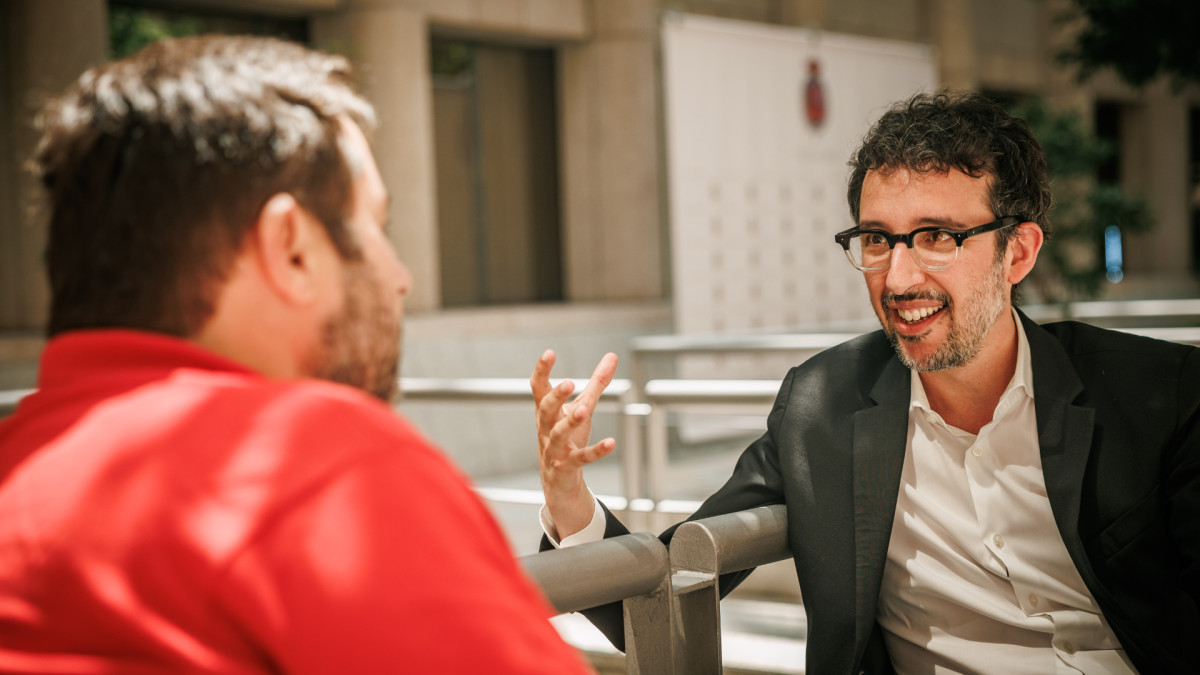
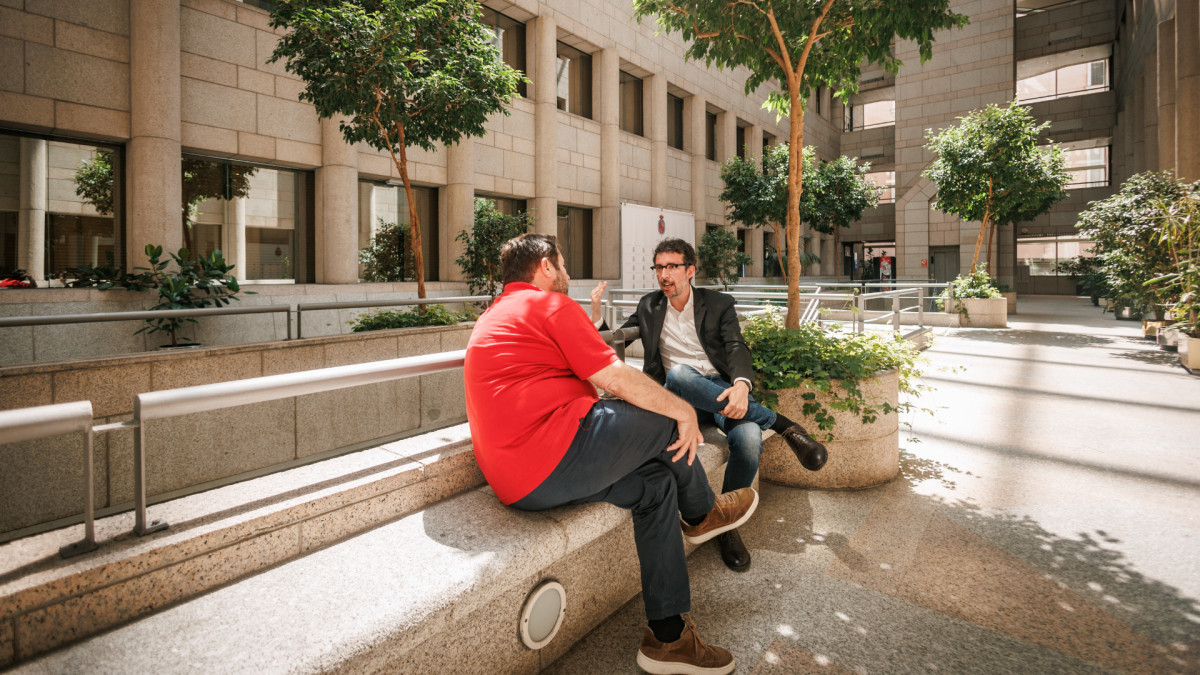
Marc López Plana and Juan Milián talk in the Senate about the party’s national project. Photo: Agenda Pública / Tania Sieira
They have named him National Project Coordinator. What does the post really mean? Does it relate to the Partido Popular’s program?
The National Project Coordinator focuses, above all, on analyses and ideas that go beyond immediacy and the rapidity of politics, of the tweet or the daily reaction to what the Government is doing. I report to the Vice-Secretary for Sectoral Coordination, under Alma Ezcurra. In talking with her, we saw a need to create a think-tank capable of outlining a vision for Spain that goes beyond the next elections—almost with a generation of perspective.
There are many analyses and ideas about issues that may affect or are already affecting the nation. For example, questions like the mass regularization of immigrants or the naturalization process following the administrative instruction of the so-called “grandchildren’s law,” which will obviously affect what the nation is, because suddenly we will have several million more Spanish citizens, with their benefits and also with their problems for the country. There are also issues like the erosion of purchasing power, which is causing the middle class to disappear or erode in Spain, when the middle class is essential for the stability of democracy.
“We saw that there was a need to create a think-tank capable of outlining a vision of Spain beyond the next elections”
And another issue is the challenge currently posed by the Left, with its nationalist partners, on plurinationality. When the Socialist Party already speaks of moving toward a plurinational state, we believe that is a challenge for the nation, because Spain is something much more important and better than a plurinational state. We are a plural nation. I think this fits reality better, but it is also much better because we are talking about free and equal citizens. Plurinationality does not refer to a free and equal citizenship; rather, to a set of regional elites with their own privileges and inequalities.
That would be the framework of the issues we work on in the National Project Coordination.
Let us go deeper into some of these topics. What would you say to a Catalan citizen who considers Catalonia a nation, who finds it compatible with being Spanish and recognizing that Spain is also a nation, and who views that dual belonging as positive?
Words have consequences. Words generate ideas, values and, in the end, a certain kind of politics. Saying that Spain is a nation of nations is not only politically erroneous, because a nation is sovereignty, and thus there cannot be nations within a nation, but it is also socially harmful because you stop focusing on policies for citizens and start focusing on those elites.
It is true that many Catalans hold this view of Catalonia, beyond the political aspect, and that the term does not carry legal consequences. I think we have to undertake a pedagogical effort to explain, as I said before, that it is far better to be a plural nation, as Spain is, than to drift toward a plurinational state that breaks solidarities and leads you toward a confederal project. Ultimately, what that strand of the Left with this idea of a plurinational Spain is trying to justify is a confederal state.
“We have to undertake a pedagogical effort to explain […] that it is much better to be a plural nation, like Spain, than to drift toward a plurinational state”
A confederal state goes far beyond federalism. Spain is already a highly decentralized country, the second most decentralized in Europe and one of the most decentralized in the world. Moving toward a confederal State would imply creating an inviable State, not only from the point of view of solidarity: a welfare state would be impossible if you intend to keep that community of equal citizens in the future. Moreover, it is very easy to subject it to blackmail by regional elites. In fact, no state in the world has maintained such a confederal arrangement for more than a few months: either it federalizes or it ends up separating, as happened with Serbia and Montenegro.
We believe that raising the question of Spain as a plurinational state is a trap, but I think the Left is moving toward it because, the more cornered the government of Pedro Sánchez feels, the more it will push the public debate toward a discussion of the state model. The center-right must be prepared, and we are, to face a debate that will accelerate in the coming months.
What would you tell a Catalan? The vast majority of problems that we Catalans face—I’m Catalan too—are housing, safety, economy, and tax pressure. There is a social majority that has many more problems than the nationalist elite. Debating centralization or decentralization seems to me a mistake. We must debate how to achieve a more efficient autonomous State, how to improve the State—including the Generalitat of Catalonia—so as to resolve increasingly serious citizen problems. Housing, security, and the erosion of the middle class are issues that now affect a large portion of the population in Catalonia.
Juan Milián argues for a plural Spain and a more effective autonomous State. Photo: Agenda Pública / Tania Sieira
Let us accept that Pedro Sánchez, as mentioned, has been pressured by regionalisms and separatisms. How can the PP ensure that the same thing won’t exactly happen with Vox, which has a different approach?
First, I believe the confederal idea, the idea of a plurinational Spain, is not solely the result of pressure from separatist or nationalist parties, but already part of the DNA of the Socialist Party.
Why?
Because as early as 2017 that path toward confederal Spain and the plurinational state appeared in the documents of the PSC and the Socialist Party, at a moment when they were in opposition and not influenced—if you like, by the more aggressive forces of the separatist parties. I think this already forms part, at least, of the current leadership of the Socialist Party. I don’t know if it is part of the beliefs of the majority of its members; surely not of its voters.
What differentiates us from Vox? Why wouldn’t we suffer what the Socialist Party has experienced, in some way, of mimicking the more radical parties or minorities? The Partido Popular and Vox are governing in some regional governments and, beyond semantic issues, the program being applied is that of the majority party. That is why we always demand a strong enough force, first to govern on our own, because the reforms we want to carry out in Spain require a broad and solid majority. They will be significant reforms from institutional, territorial and economic standpoints.
“The Partido Popular and Vox are governing in some regional governments and, beyond semantic issues, the program being applied is that of the majority party”
There are many issues that differentiate us and we need to educate about them. We are an autonomist party. We believe in the State of Autonomies and we think it has brought the greatest period of concord and prosperity to Spaniards in all our history. We must improve the autonomous state, but we do not believe we should centralize or abolish it, as Vox has sometimes proposed.
I would reflect: if what Vox says were done and the State of Autonomies were eliminated, Pedro Sánchez would currently have a much greater power than he has today. Decentralization is good from the principle of subsidiarity, i.e., because it brings power closer to the citizen. It also serves as a laboratory for different public policies across all autonomies, but it also responds to a liberal principle: to limit or control executive power by a division of power that is not only horizontal but also vertical.
Let us move to another major topic on the political agenda: immigration. How do we, as a Spanish society, resolve the poor state of our demographic pyramid while also addressing the needs of a country that grows and wants to keep growing? What is the proposal you are working on, not only in the short term, but also in the medium term?
There are two issues. One is the demographic challenge, the problem of very low birth rates—the lowest in the world. The main idea is to support motherhood and family policies. Immigration is another issue. Is it necessary? Yes, in large part, mainly for economic reasons. Therefore, it is necessary to tie the arrival of immigrants to the labor contract.
We do not defend open borders or the expulsion of all immigration. We try to rationalize the issue by linking it to the labor market and demanding integration. I think every state has a duty to control its borders. That is why it seems irresponsible to me that today the Spanish Government is pulling the Guardia Civil and the National Police away from ports, airports, and borders in Catalonia. The State has an obligation to control borders, and the hosting nation has the right to decide or at least to raise the debate about how many immigrants we are capable of hosting, under what conditions, and what duties should be required of them.
“We do not defend open borders or the expulsion of all immigration. We try to rationalize this issue by tying it to the labor market and demanding integration”
Every right must come with a duty: at least to respect the constitutional principles, our laws and our customs. I think this debate must be carried out in a calm way, without demagogy from either side. This, together with housing, is one of the great debates Spaniards face. What cannot be done is a massive regularization with almost no control, which they told us would be under half a million people and now we see that it exceeds a million, with no control of criminal records. We are seeing thousands of people being regularized without ever having stepped foot in our country. This is a necessary debate, just as with naturalizations and what is called the “grandchildren’s law.”
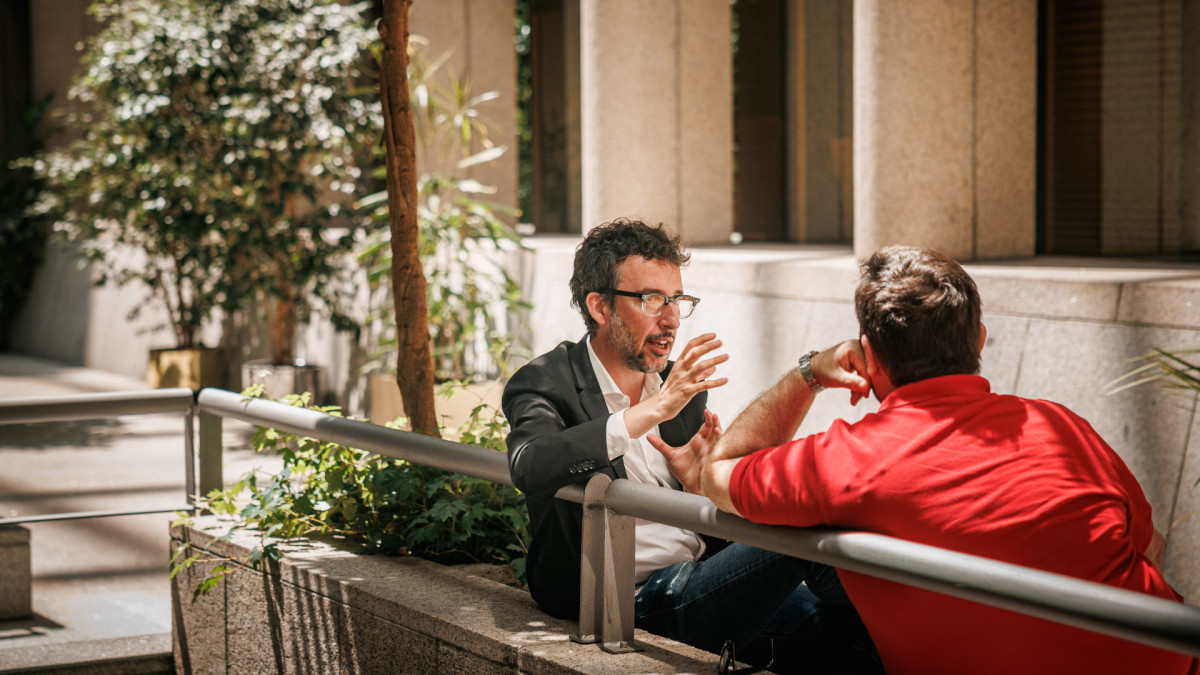
Milián explains his proposal to tie immigration to work and integration. Photo: Agenda Pública / Tania Sieira
How would they have done it differently? Because in other times Aznar, if I recall correctly, carried out two regularizations and Rajoy did one as well.
Yes, there have been regularizations under every Spanish government, but we are talking about a totally different volume. The current regularization far exceeds the sum of previous ones because it is being done without any control and, therefore, is creating a pull factor. We said from the outset that there must be at least effective control of criminal and police records. We are seeing prison officials being called upon to facilitate regularizations. This strikes us as an enormous irresponsibility.
It always has to be done in accordance with the needs of the hosting society—here, economic needs—and demanding a willingness to integrate. The immigrant who comes with their family, to work and to respect the values of the host society, seems perfect to us. But residence or nationality cannot be a gift or something given without any consideration, without having earned it or without an integration effort.
“There must be better channels to attract immigration legally and in an orderly fashion, tied to work, but irregular entry cannot be rewarded”
That is the difference: there must be better channels to attract immigration legally and in an orderly fashion, tied to work, but irregular entry cannot be rewarded. Among other reasons, because it is unfair to those who have entered legally, fulfilled all deadlines, and made a meaningful integration effort. It is also unsolidary with other EU countries, because the rest are moving toward greater immigration control. It is not a concern only for the European right; it is also seen by, for example, Scandinavian social democracy. There is a European problem of uncontrolled immigration.
How do you explain that the Pope, business leaders—who typically disagree with the Government—and the Government itself all agree on the need for regularization? These are people, organizations and interests that are very different, yet they align.
We would sign what the Pope said in Congress and all the messages he gave in Spain regarding immigration. He said: “We must welcome, and that is good, but the immigrant has the duty to integrate and respect the laws, and States have the obligation to control borders.” We fully agree with that.
It is true that employers and business leaders need immigration. We are in favor of immigration tied to a labor contract, but not of a massive regularization that allows entry to people who lack the will to integrate and who, above all, could facilitate the expansion of mafias or criminal organizations, as we see, for example, in Barcelona, my city, where much of the crime stems from international criminal organizations.
Return to a topic that unites us, because we are both Catalans: amnesty. The European Union Court of Justice recently noted that the amnesty law meets certain aspects of European law. What would the PP have done if they had been seven votes short of governing and the party that could have provided them those votes had demanded an amnesty? Years later, the PP’s own leader has spoken of turning the page. Is there some recognition that the result, perhaps not the form, has been positive?
Let us get to those seven votes. The Partido Popular needed fewer than seven votes to reach the Presidency of the Government and we did not accept those conditions. We do not accept them because we will not reach the Government, at least not in that way, in the sanchista mode, betraying our principles and our history.
The pacification in Catalonia does not arrive with amnesty. It arrives when the rule of law is imposed, precisely where we are right now, in the Senate, with the application of Article 155. Then comes peace, in that sense, and it becomes evident that separatism was deceiving its own voters and had no more room to maneuver.
We continue to oppose amnesty beyond what the EU Court of Justice says. We respect all rulings—never will we speak of lawfare—but we believe that politically and morally it is a mistake that does not serve to pacify. And even if it did pacify an nationalist elite, it would still be a mistake because it undermines equality among Spaniards and the separation of powers, as every Socialist proclaimed before the last general elections.
The pacification or normalization of Catalonia arrives with the application of Article 155 and the return to the rule of law. It is now, after the amnesty’s implementation, when radical nationalist sentiment is rising again with a party like Aliança Catalana. In fact, the sum of the independence vote is now higher than before the amnesty’s implementation.
“Even if it served to pacify a nationalist elite, [amnesty] would still be a mistake because it undermines equality among Spaniards and the separation of powers”
And Feijóo has never said that we will forget what happened or turn the page without having read it first. When he expressed it, he said we wanted to turn the page on nationalism and socialism. We believe Catalonia deserves to try a different policy, a policy like that of the Partido Popular. The European People’s Party has governed practically all of the European Union member states, but not in Catalonia.
We have a plan for Catalonia, a project of freedom, order and prosperity, which was our political platform at the last congress. A positive project to regain that pride Catalans, sadly, have lost in recent years and that hope for a better future. We had a spark of that pride with the Pope’s visit and the inauguration of the Jesús tower at the Sagrada Familia. The Partido Popular’s policies — greater economic freedom, greater security and prosperity — are what can revitalize Catalonia.
That is our project for Catalonia: never forget what has happened, and learn the lessons of the past. The best lesson is that we should not obsess over how to please or punish nationalism, but rather begin to factor in the most important element of Catalonia: the social majority that is not nationalist. It has rarely been present in Madrid’s debates or in the national press. The conversation always treats Catalonia as if it were only Junts or Esquerra Republicana, two parties that, by the way, have fewer votes than the PP in Catalonia in the latest general elections. We must speak to that social majority that has housing, safety, Rodalies and economic problems. That is where the focus must be for the future.
The National Project Coordinator of the PP discusses the party’s future in Catalonia. Photo: Agenda Pública / Tania Sieira
Can you govern Spain without being a strong party in Catalonia?
It is essential that the PP continues to grow in Catalonia. We endured a desert crossing, with three deputies in the Catalan Parliament. Now we have multiplied by five and in the last elections we obtained fifteen deputies, but we must keep growing. We need to close the gap with the Socialist Party and its partners and with the PP, because that is fundamental to governing Spain. Catalans understand this clearly.
One of the keys is that awareness of Catalonia’s importance. The PP’s last congress was a congress of unity, strength and proposals. The political platform speaks to all Catalans. It is no longer a policy of resistance, as we could have at a certain moment, but a policy with a governing vocation also in Catalonia, that reaches all of Spain. I think Catalonia needs it and more Catalans are seeing it.
Before, when I said it, I was labeled naive. I am very optimistic about the medium and long term in Catalonia because I think there is a cultural shift. Young people have stopped believing that the only way to be Catalan is to be nationalist and a victim. They believe that a Spanish Catalonia, proud of itself and of its pluralism, is a far better model.
“I am very optimistic about the medium and long term in Catalonia because I think there is a cultural shift. Young people have stopped believing that the only way to be Catalan is to be nationalist”
This has happened in a very short time. When I said during the process that hope lay with the youth, they told me it was impossible, that youth was more radical. But hope lies with the young. I saw it at the university, in studies, and in conversations with them. There was a critical element toward nationalism that did not exist before and is now growing. It is very difficult to see a young separatist in Barcelona today, very difficult. This is changing and the PP has to be there, directing its policy toward those young people who are the hope of Catalonia and of Spain.
Wouldn’t the strategy repeat, as it did with Aznar, some kind of alliance or joint effort with the right-wing nationalist side?
That space is also reconfiguring and is completely unpredictable. You don’t know where Aliança Catalana will move or what will become of it. I think we should not focus so much on those nationalist elites as on the social majority. We have to build a project that speaks to the vast majority of Catalans, who have many more daily problems than that nationalist elite.
The nationalist elite is the one that never takes Rodalies. We have to address the person who takes Rodalies every morning, if they have luck, to expand the PP’s space in Catalonia.
We were talking about immigration and housing, current matters, but also about mid-term policies. How can public policies be carried out in the medium term if there is no capacity for agreement between the two big parties? We can talk about housing or wildfires: they are issues that require sustained measures, but no agreements seem visible.
We have to move from wall-building politics, from a politics that sees the other as an enemy and exaggerates the other’s strength, to a policy of bridges. In Spain, what Edmund Burke—the liberal-conservative—said about the pact between generations, the covenant among the dead, the living and the unborn, has broken.
The break with the legacy of our parents, which is the Transition, with that politics of consensus and pacts on the big questions, is also leading to a break with the future and to current policies that seriously harm young people. Housing is one of them. If there is no affordable housing supply, young people have no future. Everything is tightly connected: the break of the pact between generations and what is happening now.
We must return to a policy of bridges. Certainly, it is difficult with the current government, entrenched and unable to dialogue with an opposition that it has practically labeled fascist, at best, because lately I have heard something more. This cannot go on.
“The break with the legacy of our parents, which is the Transition, with that policy of consensus and pacts on big issues, is also leading to a break with the future”
The Partido Popular does not want to pursue speculative or symmetric politics, a right-wing Sanchismo. Jovellanos wrote to Lord Holland, regarding the French Revolution: “Because they are radical, shall we be stupid?” That is, if they become radical, should we do the same? No.

Milián talks with López Plana about cross-party agreements and bloc politics. Photo: Agenda Pública / Tania Sieira
The Feijóo who arrives in Madrid is not the Feijóo of Galicia: there he governed with a majority and in Madrid he is in opposition. Moreover, the possibility of reaching Government does not depend only on him. We may like it or not, but people vote and we have to live with that. Haven’t all of you accepted this yet?
When they tell me that the PP is the same as the current PSOE regarding confrontation or not giving way, I stop, look the person in the eyes, and tell him: “We installed Jaume Collboni as mayor so that radicalism wouldn’t govern Barcelona, neither Colau nor the independents.”
The current Socialist Party could do the same in reverse. If they believed that a government of PP and Vox would apply, as a minister recently said, criminal policies like those of Hitler, they could have done what we did in the Barcelona City Council: abstain and allow a reformist center-right Government. They did not, which is what they could have done after the 2023 elections.
Therefore, we are not at the same level, and one cannot hold the two parties responsible for the current strife to the same extent. Not at all. It is true that circumstances change between governing Galicia with an absolute majority and finding oneself in opposition after winning the elections, but at no time has the Partido Popular renounced its principles or its vocation as a government party, without slipping into populist drifts.
Let us consider the next political course. Suppose the PP again becomes the most voted party and Vox could offer its support. Would it be better for Vox to be inside the Government to keep the minority partner in check, using a strategy similar to that of Sánchez, or outside the Executive?
This debate has occurred around the world in recent years and there is no perfect solution. We believe that, for the reforms Spain will need in the coming years, it is far better to have a solid majority that allows governing alone.
“We are not on the same level and you cannot hold the two parties responsible for the current strife to the same extent”
In any case, we are not a party that will apply cordons sanitaires. They applied them to us in Catalonia, and we know they are bad for the country. We have experience of Autonomous Governments with the Partido Popular and Vox, and they are governments that work. There are no rights cuts, as some say, but rather policies in favor of security and prosperity, without rights being cut; on the contrary. Obviously, we would prefer to govern alone.
López Plana and Milián analyze potential parliamentary support for a future PP government. Photo: Agenda Pública / Tania Sieira
Let us suppose another option: that the PSOE abstains and the PP can govern with the support of Junts, the PNV and Coalición Canaria.
We are talking about a hypothesis that will not occur, among other reasons because the Socialist Party will have to endure a long desert crossing after sanchismo. You know I have the Spanish proces theory: Sánchez, in some way, is copying the independence process by generating discord so as not to have to answer for his actions.
That procesista algorithm predicts that after Sánchez there will not come something much better. After Puigdemont came Torra. I fear that whoever comes after will not be a person with a state vision able to extend a hand to the center-right to govern Spain better. I fear we’ll have to go through a few years like this.
You have been asked many times why the PP, even in the face of the current crisis, is not already close to an absolute majority on its own.
It is true that there has been fragmentation of the party system, and this is not only happening in Spain. I also have to say that the Partido Popular is currently the strongest center-right party in Europe. People sometimes ask: “Are you doing well or badly?” But with what are you comparing?
“Sánchez, in a way, is copying the independence process by generating discord to avoid accountability”
Compared with other center-right parties, in France Les Républicains are barely there; in Italy Meloni governs; in Germany they are strong but with percentages even below ours in Spain. Absolute majorities have likely disappeared for both the center-right and the center-left across Europe.
Therefore, if we compare ourselves with the rest of Europe, the Partido Popular is very strong. I am convinced that we will be stronger in the coming months as we approach the elections and society sees us as the only possible and necessary alternative to what we have been living through, this institutional degradation of recent years.
Thank you very much.
