
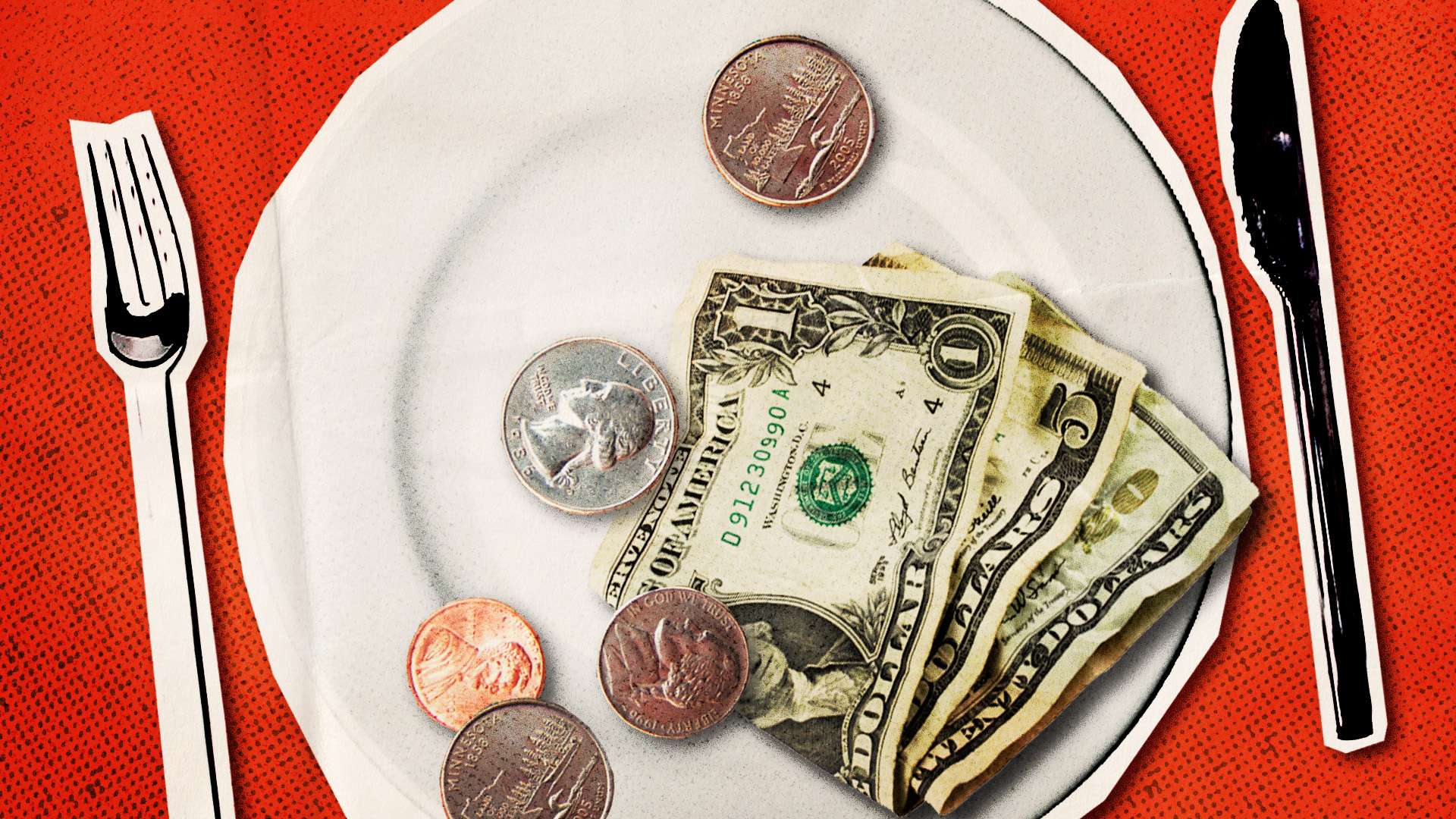
Across the nation, policymakers are confronted with the regrettable, yet foreseeable, economic outcomes that arise when restaurants are barred from compensating servers with a reduced base wage supplemented by tips.
In recent years, one of the defining strategies of the progressive left has been to raise the minimum wage in many places. Concurrently, progressives have pressed to abolish the so-called tip credit, which allows employers to pay tipped staff a lower hourly base wage and rely on gratuities to make up the difference.
Just a few years into this policy experiment, however, officials are already showing signs of rethinking the elimination of the tip credit as they contend with the unwelcome—and predictable—economic consequences.
In 2022, Washington, D.C., drew national attention when voters approved Initiative 82. Initially, the plan would have scrapped the tip credit and required servers to receive the District’s full statutory minimum wage by 2027. (The District’s minimum wage stood at $16.10 per hour in 2022, and has since risen to $18.40 due to inflation indexing.) Before Initiative 82, D.C. servers could earn a $5.35 tipped wage as long as their tips covered the gap to the higher standard minimum wage.
Initiative 82 was only the opening gambit. One Fair Wage, a left-leaning coalition advocating against subminimum wages, led a broad campaign to eliminate the tip credit in jurisdictions nationwide. Chicago soon followed as a second major city. States such as New York, Connecticut, and Illinois quickly introduced measures to end the tip credit at the state level. (Beyond this recent surge, a handful of states—including California, Oregon, and Alaska—have long operated without a tip credit.)
But just when the momentum seemed to crest, progressive politicians began to confront reality. In the wake of the tip credit’s repeal, full‑service restaurant employment in D.C. fell by roughly 5 percent. Earnings for tipped workers dropped by nearly $12 million—likely partly due to restaurants shortening hours in response to higher labor costs. At the same time, many District eateries began imposing service fees or mandatory auto-gratuity charges of 10–20 percent on customers’ bills.
Facing these economic headwinds, D.C. Mayor Muriel Bowser called for abandoning Initiative 82 altogether. The D.C. Council ultimately approved only a partial repeal in 2025, preserving at least some form of tipped wages that remain below the traditional minimum wage for years to come (though the tipped wage is scheduled to reach 75 percent of the standard wage by 2034). This echoed a familiar pattern: the council had previously repealed Initiative 77, a near‑identical effort to end the tipped wage that voters approved in 2018.
After Chicago moved to end the tip credit, the Illinois Restaurant Association reported that 89 percent of Windy City restaurants boosted menu prices, while 79 percent cut staff hours. The City Council, bowing to the economic reality, voted to pause the elimination of the tip credit, only to have Mayor Brandon Johnson veto the measure. A later compromise paused the tip credit at its existing level for two years, effectively delaying a permanent decision until after Johnson’s next election, which could allow a successor to back a more lasting reversal.
In Michigan, a 2024 state Supreme Court ruling set the tip credit on a course toward elimination by 2030. Legislators, however, intervened last year, choosing to maintain a 50 percent tip credit in perpetuity after 2031. It’s notable that Michigan, at present, is governed by a Democratic trifecta with the governor and both chambers controlled by Democrats. The push to revive the tip credit gained support from some Republican lawmakers, enabling a bipartisan path to passage that was signed into law by Democratic Governor Gretchen Whitmer.
While the drive to eliminate the tip credit may be driven by a sincere wish to boost servers’ pay, the arithmetic is more nuanced than it appears. Forcing a server’s base pay up to a $16 traditional minimum wage—up from a $5 tipped wage—might seem to increase pay on paper. Yet several factors complicate the picture.
Under the current framework, raising the minimum wage for servers can lead to a partial dip in tips, which, after taxes, can yield less take‑home pay for waitstaff in certain scenarios. If a larger share of earnings comes as “auto-gratuity” arrangements—which are treated as taxable wages—the tax implications can become even more burdensome.
More broadly, these laws run against basic economic dynamics. By 2025, Bureau of Labor Statistics data show that D.C. restaurants lost more than 1,600 jobs in the wake of Initiative 82; and between 2022 and 2025, restaurant job growth in the District declined by over 8 percent. This is but one illustration. The broader consequence is the natural response of restaurants to suddenly higher labor costs: cutting hours, possibly shifting toward quicker, lower‑personnel models, and raising prices or adding new service fees—costs that ultimately fall on diners.
“We’re seeing a beloved bar back, a cherished busser, a dependable dishwasher lose their jobs,” a D.C. restaurant worker told Reason in 2024. “Not because the owner-operator is a villain, but because they’re running a small business that has to make difficult decisions, and our industry is discussed with a certain callousness.”
Admittedly, the tip credit remains in a modified form in D.C., Chicago, and Michigan—and in Chicago’s case, the reversal is only temporary. Yet these partial reversals show that abolition of the tip credit is far from a settled matter. Economic realities continue to assert themselves.
