
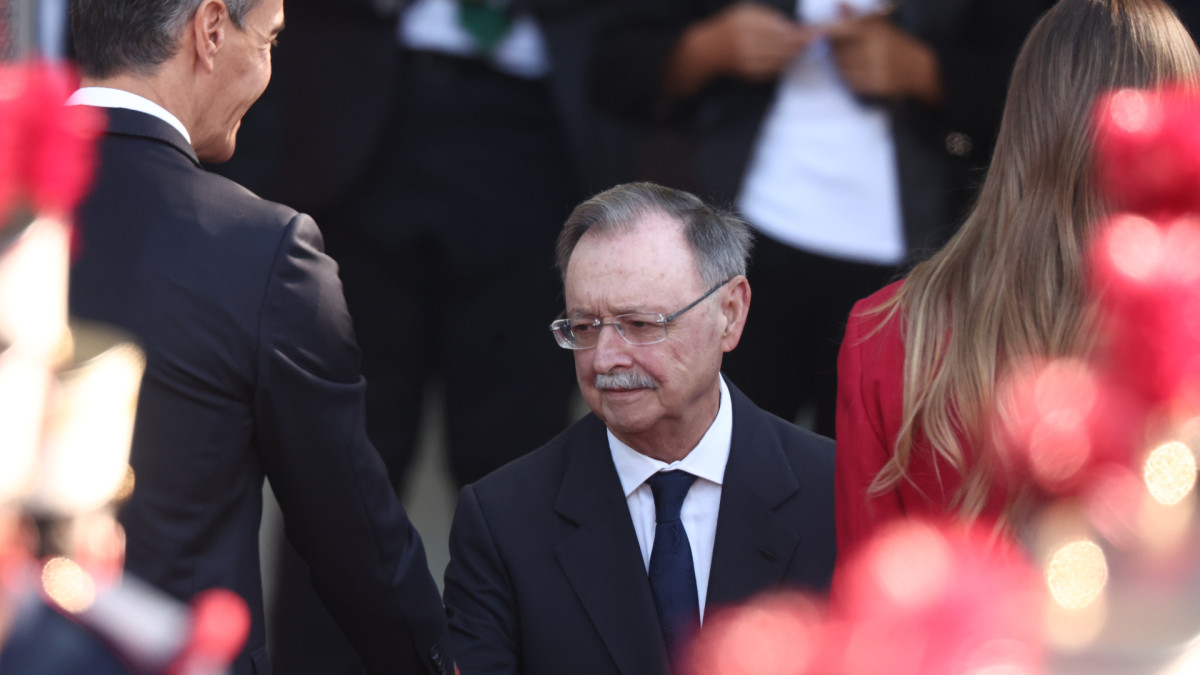
On October 27, thirty-three days before the elections, Ceuta’s PSOE announced that José Miguel Romero would step back as a Senate candidate and that the head of the list would move to Abdelah Abdelah Mustafa, 26-year-old president of the Sidi Embarek Neighborhood Association, an independent promoted by the Frente Amplio. The leadership called it a “strategic turn,” and Romero had been presented only five days earlier, on October 22, on a list that the leadership had deemed definitive: Luis Manuel Tovar for the Congress and Nesrin Haddad and Romero for the Senate. Now Haddad and Mustafa share the Progreso Senate ballot and Tovar runs only for Congress, where the Frente Amplio has decided not to field a candidacy in the two autonomous cities.
What changes with the pact between PSOE and Frente Amplio
The agreement between the PSOE and the Frente Amplio for the Senate was signed on October 16, at the edge of coalition deadlines, and covers more than forty constituencies with a distribution that reserves 30% of the seats for the Frente Amplio. Ceuta elects two senators, and Article 166 of the LOREG allows the voter to mark up to two names from any candidacy, so handing the head of a two-name ballot to the partner weighs more than in a province with four senators, especially since the national agreement anticipated that the PSOE would head all lists and Ceuta would be an exception. The Ceuta ballot also appears only under the designation Senate of Progreso, without the PSOE’s initials or logo, a peculiarity which, according to ESdiario, does not occur in Melilla or the rest of Spain.
“Ceding the head of a two-name ballot to the partner weighs more than in a province with four senators”
What has not moved is the candidacy for Congress, which is the one that decides Ceuta’s seat in the chamber that swears in the prime minister. Tovar, a teacher in the city since 2015, remains at the helm, and the Senate pact does not group there two candidacies whose votes could add up: Sumar obtained 821 votes in Ceuta in July 2023. The change of head for the Senate leaves the Congress one unchanged, and that asymmetry is the key to what follows.
Voter participation in Ceuta: what the 2019 and 2023 results teach
In July 2023, the PP won Ceuta’s seat to the Congress with 12,918 votes against 11,332 for the PSOE, a margin of 1,586. In the Senate, where the vote is nominal, Cristina Díaz (PP) obtained 12,194 votes and Abdelhakim Abdeselam (PP) 11,694, while Blanca Gómez Serra (PSOE) stayed at 10,672 and Miguel Señor at 10,208; Vox candidates hovered around 7,900 and 7,500. Gómez Serra was 1,023 votes short of stealing the second senator from Abdeselam, and Señor 1,987 short of beating Díaz and completing the slate, with the right split into two candidacies. In Ceuta the left is a thousand votes away from a senator and a thousand six hundred from a deputy, and those votes have a known home.
“In Ceuta, the left is a thousand votes from a senator and a thousand six hundred from a deputy, and those votes have a known home”
The precedent that the Socialist leadership has in mind goes back to April 2019. On that day the PSOE won the Congress seat with 13,800 votes and the two Senate seats with a candidacy that carried Adil Mohamed and Blanca Gómez Serra; in November 2019, with participation at a low, it lost all three. The internal lesson was that the seat is won when the peripheral neighborhoods (Príncipe, Hadú, Benzú, Los Rosales) vote, and it is lost when they stay home, and an internal analysis of Interior Ministry files by mesa (the 14 census sections of lowest income in the city according to INE) points in the same direction: in April 2019, 8,805 electors voted in those sections; in July 2023, 6,867; and in the 2024 European elections, which are another election, 3,887. In those sections the PSOE has gathered between 62% and 70% of the vote since 2019, so what moves there is turnout.
Why the PSOE bets on Abdelah Mustafa
The theory of representation provides a framework to read Mustafa’s election. Hanna Pitkin distinguished in 1967 between descriptive representation, which resembles those represented, and substantive representation, which acts on their interests, and Jane Mansbridge refined in 1999 that descriptive representation pays off when the group has been excluded and distrusts parties, because then the face on the ballot is the signal mobilization needs. Ceuta’s neighborhoods meet that condition: turnout there is more volatile, the PSOE recorded its best Senate results with candidates drawn from those neighborhoods, and Mustafa has spent years as a neighborhood interlocutor, although he arrives at that role from outside the party, by the partner’s quota and on the Senate ballot.
The second reason is the frame. Mustafa accepted the post saying that “Ceuta does not want hatred, nor labeling, nor exclusion,” and the operation is read as a response to the climate after the mass entry on July 30 and 31, when more than 70,000 people crossed from Morocco and the Government deployed the Army. In those weeks Mustafa was one of the city’s neighborhood voices on television, and from there come the phrases that today sustain the controversy: on September 14, on Todo es mentira, he replied to a panelist who said Ceuta smelled of marijuana with a “it also smells like a fascist,” and he is attributed with saying that those arriving in July did not act violently. With that material, in a week he has attracted coverage from conservative front pages: The Objective presents him as a “Muslim pro-Moroccan,” links to Wahhabism that have not been proven and that Maldita records without verifying, and a review of his statements finds none where he calls for Moroccan sovereignty over the city, though there are questions about his silence on Rabat. The candidate says his policy is housing, unemployment, and neighborhood facilities; the debate he is forced into is another, and the one who imposes it has the advantage.
How the Senate vote works in Ceuta and why it could hurt the PSOE
Here is the design problem. In Ceuta the Senate vote is cast name by name and the elector can mark one, two, or none of those on the same candidacy, so Senado de Progreso operates as two candidates sharing a ballot rather than as a single list. Voters already do this: in 2023 Blanca Gómez Serra received 660 votes fewer than the PSOE’s Congress list and Miguel Señor, 464 fewer than her, and in the PP the gap between Díaz and Abdeselam was 500 votes. The nominal vote diverges from the party-list vote in both blocks. With Mustafa and Haddad the knife can cut in either direction. The peripheral voter mobilized by the neighborhood leader may vote only for Mustafa, because that is who they know; the traditional center-left PSOE voter in the center, who has voted for Blanca Gómez Serra for years, may vote only for Haddad if they do not recognize the other name as their party, especially since the ballot no longer carries the initials. And none of that goes into the Congress ballot, which uses a separate envelope. The vote transfers between ballots when the voter perceives a single offer and fragments when they perceive two, and Romero’s replacement creates in Ceuta, within the same coalition, the perception of two offers.
“The vote transfers between ballots when the voter perceives a single offer and fragments when they perceive two”
That is why this analysis forecasts. Mustafa’s nominal vote may rise, and probably will rise, relative to Señor’s 10,208 in 2023; what is not written is that vote arriving at Haddad or transferring to Tovar. A sum of two candidacies on one ballot is not the same as a sum for the party, and the seat Ferraz truly counts on remains the Congress seat, which continues to depend on a candidate to whom the renewal has given no new leverage.
Who wins and who loses
On paper, the peripheral areas win: if the fourteen sections return to the April 2019 participation level, there would be nearly two thousand more voters, and with the PSOE’s share there they would amount to between 1,200 and 1,350 votes for the progressive bloc: enough on paper for the senator who was lost by 1,022, and short for the deputy who was lost by 1,586. Direct contact, which is the craft of a neighborhood leader, boosted turnout by about nine points among those contacted in the Gerber and Green experiment in New Haven (APSR, 2000), with nonpartisan campaigns in the United States, a caution that requires applying those results to the Ceuta case. The socialist vote of organization, in middle-income neighborhoods and the center, loses or may lose, where a neighborhood candidacy routinely labeled as pro-Moroccan does not help. There is no published poll measuring that bloc; as a reference, the party lost 1,500 votes between the 2019 and 2023 regional elections, although that drop does not prove they came from the center-left voter. It is enough for a thousand voters of that profile to stay home or vote only Haddad for the gains in the periphery not to show up in the seat. The right also gains, in a precise sense. The PP repeats Abdeselam and Díaz and Vox presents its own Senate candidacy for Ceuta, outside the distribution they have pledged in other provinces, and since July its campaign has been playing at the border. A candidate presented as the adversary’s face gives them a talking point to keep their voter turnout up until November 29.
The front that has not been explained
The PSOE’s argument is, at bottom, that of a front: a united left against the far right. But a front mobilizes when the electorate perceives the threat as their own, and in Ceuta the threat most voters perceive today, including many families in the neighborhoods, is the one seen on July 30 at the Tarajal wharf, the framework the right has chosen to discuss the candidate. For the front to work, someone must explain that the campaign against Mustafa is a campaign against his neighbors, and that narrative has not been built by anyone: neither the Frente Amplio, which has no structure in Ceuta, nor the PSOE, which has withdrawn its initials from the ballot. Without that layer, the operation functions as a zero-sum game between two electorates of the same party, especially since the peripheral sections are, by their results, the most loyal to the PSOE since 2019: the replacement does not regain a lost vote, it mobilizes, at best, one that abstained.
Three electoral scenarios for the PSOE and the Frente Amplio in Ceuta
The first scenario, the most likely given the 2023 data, is partial summation: Mustafa clearly surpasses Señor’s nominal vote, Haddad remains below him, the PSOE for Congress moves little, and the right keeps both senators and the deputy. The indicator will be the gap between the two names on the progressive ballot and between the votes for Tovar and Mustafa.
In the second scenario, the periphery regains the 2019 participation, the center remains unchanged, and Mustafa enters the Senate as the second senator alongside Díaz. It requires a campaign of outreach across the fourteen sections, which is in the candidate’s hands, and that the right not turn November 29 into a referendum on Morocco, when what is at stake is Ceuta’s representation in the Cortes.
The third scenario is a subtraction: the national campaign about the candidate mobilizes the conservative voter, the center-left voter marks Haddad alone or stays home, and the result leaves the PSOE below 2023 in Congress with a very vote-rich Mustafa in the periphery and no seat. It becomes likely if the right’s narrative is the only one circulating in the remaining three weeks, and the leading indicator will be turnout in the low-income sections compared to the rest of the city on the afternoon of the 29th.
The most serious objection to this analysis is that the real alternative was Romero, an entrepreneur and author of carnival groups with no electoral record, within a national distribution that required conceding a seat to the partner somewhere. Seen that way, the leadership has changed a name that did not add up for one that does add up, and 2019 says that descriptive representation works in Ceuta. It is true, and that is why the pertinent question is whom Mustafa brings the votes he brings. On November 30 we will know whether Senado de Progreso was a single candidacy or two.

Natalie Foster
I’m a political writer focused on making complex issues clear, accessible, and worth engaging with. From local dynamics to national debates, I aim to connect facts with context so readers can form their own informed views. I believe strong journalism should challenge, question, and open space for thoughtful discussion rather than amplify noise.