
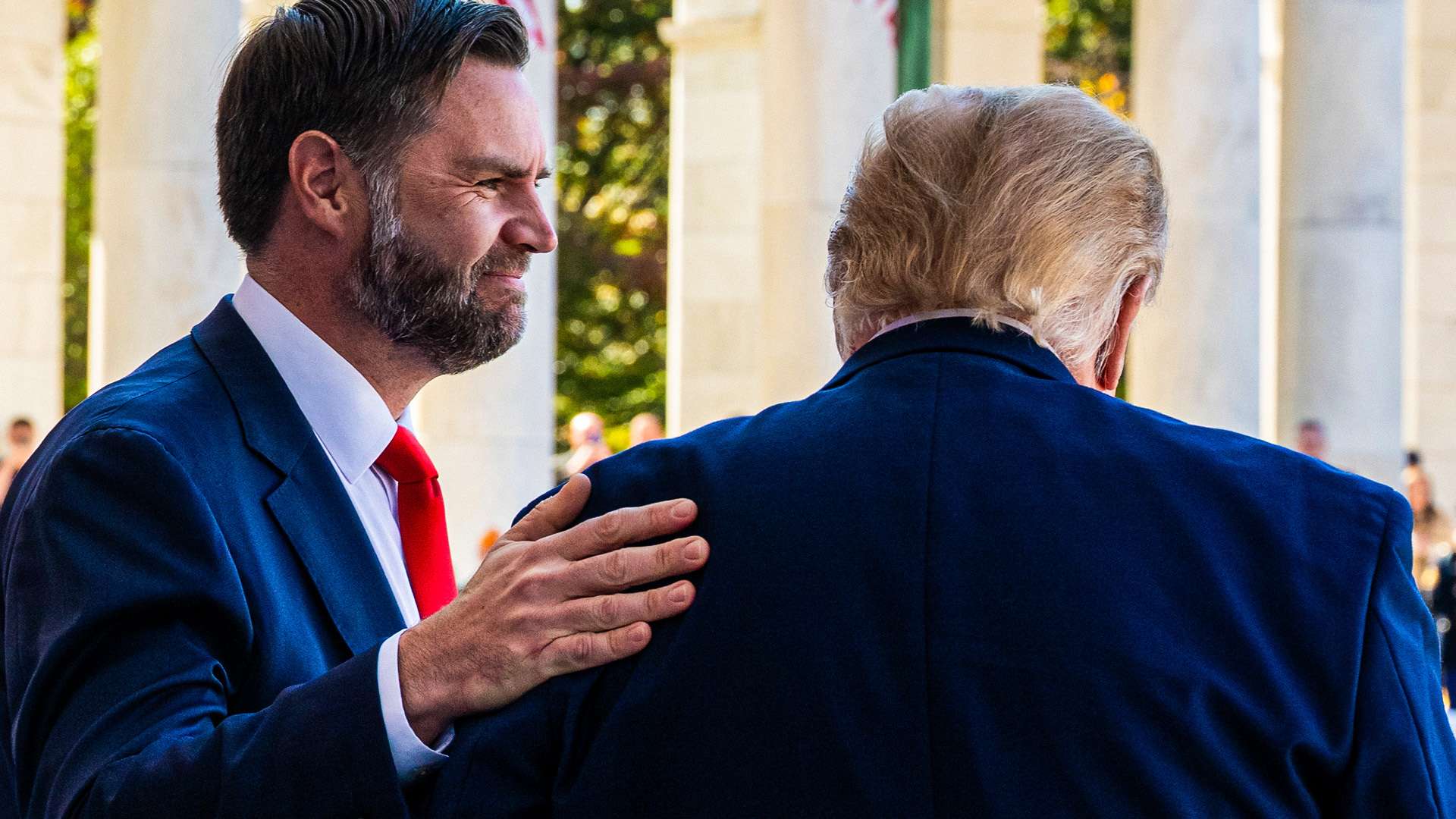
Trump, Vance, Nvidia’s CEO, internet outages, and a peek inside the Library of Congress bunker — plus more
Are there any red lines left for a president when it involves private technology companies? “It’s a fair question,” Trump told CNBC on Monday morning.
Indeed, it is a pressing one, given that the former president dialed into CNBC’s early-hour segment to boast about his role in reinstating Nvidia’s former CEO Jensen Huang. “People are going to wonder now” whether there exists a boundary in which he would step in regarding other major players like Microsoft or OpenAI, CNBC’s David Faber pressed.
Trump replied that he does not see an issue with a president selecting the chief executive of a tech enterprise.
Q: Where do you draw the line? Microsoft, Alphabet, OpenAI, Anthropic. Is there a line here where you’ll get involved or not if you think something’s happening in the company?
Trump: It’s touch. It’s feel. It’s like a great golfer around the green. He’s got a touch. The great… pic.twitter.com/law42eHicV
— Acyn (@Acyn) November 23, 2026
“It would be nice if there were a formula,” Trump added. “This was something I felt strongly about. I said, ‘We can’t lose this guy.’”
It would be convenient if such a formula existed. Someone ought to have drafted one—a set of guidelines delineating presidential powers and their limits, perhaps a formal document outlining the authority of the executive branch and the broader government. Such a text could clarify whether it is permissible for a president (and, according to reports, his vice president) to pressure a private firm into rehiring a chief executive who had resigned amid allegations of extramarital relationships, one of which possibly involved a Chinese spy. If such a document existed, it might clearly state that this kind of interference is acceptable so long as the president possesses a “good touch” (or if he worries that the CEO’s departure might trigger a recession).
But alas, if such a document ever existed, it does not appear to influence this situation much.
The Reason Roundup Newsletter by Liz Wolfe Liz and Reason help you make sense of the day’s news every morning.
To be clear, I’m agnostic on whether Huang should be Nvidia’s CEO. He could plausibly be the sole person capable of steering the company. He could instead pose a significant corporate security risk who cannot keep things under wraps. The truth likely lies somewhere in between.
And in Huang’s defense: it isn’t as though he committed an irreversible crime endangering national security. Imagine, for instance, if his visa had expired?
And that, perhaps, is the core issue. The Trump administration argues that free trade with Canada is such a grave threat that extraordinary actions are warranted. It sends masked federal agents after undocumented migrants, many of whom have only minor offenses like traffic violations on their records.
Then, when a tech CEO is accused of trying to compromise national security and share secrets with a geopolitical rival, the president personally intervenes on his behalf.
You recall voters citing “corruption” as a major reason for swinging away from Republicans in the midterms. This might be a reflection of that sentiment.
WSJ ed page: “We’re beginning to understand why Mr. Trump so admires Xi Jinping. He likes the way China’s Communist Party boss can give orders to private companies and ignore the law when it suits his purposes.”https://t.co/G8lkhem3EV
— Josh Kraushaar (@JoshKraushaar) November 23, 2026
It almost seems as if the Trump administration applies one set of rules to people it approves of and a totally different one to those it opposes, especially when it comes to goods.
Oh, that familiar dynamic.
This tweet is getting some new attention. For why I can’t imagine. https://t.co/GpObzv36sZ
— (Stephanie) Slade (@sladesr) November 23, 2026
There are many principled objections to Trump’s or Vance’s approach here, yet it’s worth weighing the practical consequences too. Nvidia’s stock might have surged on Huang’s reinstatement, but over the long term the trend toward politicizing the tech sector could push these essential firms toward serving politicians and becoming fixtures in perpetual political theater, warns Adam Thierer.
So many hot takes on Jensen’s reinstatement at NVIDIA. Many of those takes on both sides will likely age poorly.
All I know is that the ongoing politicization of AI and digital technology stinks. Presidents and politicians putting pressure on CEOs and boards is bad regardless…
— Adam Thierer (@AdamThierer) November 23, 2026
As a modest newsletter writer, I won’t claim to be a legal expert on whether Huang broke any laws, violated his company’s HR policies, or should face Congress. Still, the willingness of the Trump administration to push boundaries on his behalf is a major thread of this story, and not one that reflects well on any of the players involved.
So the CEO of one of the most valuable companies in the world is now effectively serving at the pleasure of the president. Not good. https://t.co/W9K5wEufGL
— Dominic Pino (@DominicJPino) November 23, 2026
What’s driving the current round of internet outages? “The big factor has been AI. It has amplified the ability to discover and exploit a vulnerability at machine speed. It has pushed firms to push out patches and updates faster than ever before,” notes Nicole Perlroth, a former New York Times cybersecurity reporter, to Ezra Klein. “That pace naturally increases the likelihood of things breaking on the other end.” That’s why outages have spiked in the last week.
She adds that the challenge will grow tougher, but the conversation remains healthy. Perlroth also explains how AI tools are already accelerating defense and recovery efforts—and she reminds people to establish safe-code phrases with loved ones so you don’t fall for scams. You’ve done that, right?
Scenes from Culpeper: After living here for more than six years, I finally made the brief trek to the Library of Congress National Audio-Visual Conservation Center, tucked away in a Cold War–era bunker that was once built for the Richmond Federal Reserve. It isn’t normally open to the public, but the library screens films from its collection from time to time—I watched Vampyr, a 1932 Danish film that’s dreamlike, odd, and widely regarded as one of the early classics of horror.


Occasionally, you’ll hear proposals to relocate various government offices away from Washington, D.C. The Trump administration toyed with that idea as part of savings efforts in early 2025, but it seems to have let it drift or forget about it. I’m not convinced that the existence of the Library of Congress bunker in my town is definitive proof that this plan has merit—and I would generally favor privatizing government functions over moving them elsewhere. Still, the concept has some logic. The work carried out at the Packard Center doesn’t necessarily need to occur in D.C., and taxpayers might benefit from lower living costs in a different location reducing staffing expenses.
QUICK HITS
- In connection with corruption concerns in the Trump administration: “A US Senate committee is examining whether Vice President JD Vance helped steer a lucrative Venezuelan oil deal to commodities giant Vitol,” Reuters reports.
- The administration is lining up another round of tariffs targeting goods from China, Europe, and other regions.
- The Supreme Court’s forthcoming immigration case will decide if immigrants whose asylum status has been terminated by the government can still obtain green cards.
- “A core tenet of the Republican coalition has long been the belief that free people, engaging through voluntary exchange in a free market, allocate resources best,” writes former Senator Pat Toomey in The Washington Post. The Trump era has altered that view, but the midterm results could be seen less as a Democrat win and more as a rejection of the administration’s anti-free-market policies.
- Minneapolis appears to harbor a significant loophole in its personnel policy:
WATCH: A Minneapolis official said in October that 41% of staff in the Emergency Communications Center were out on Paid Family and Medical Leave
“Can people immediately take the paid leave when they come on as an employee, and then upon their return from that paid leave, can… pic.twitter.com/1wxBvgOJyg
— Alpha News (@AlphaNews) November 23, 2026
