
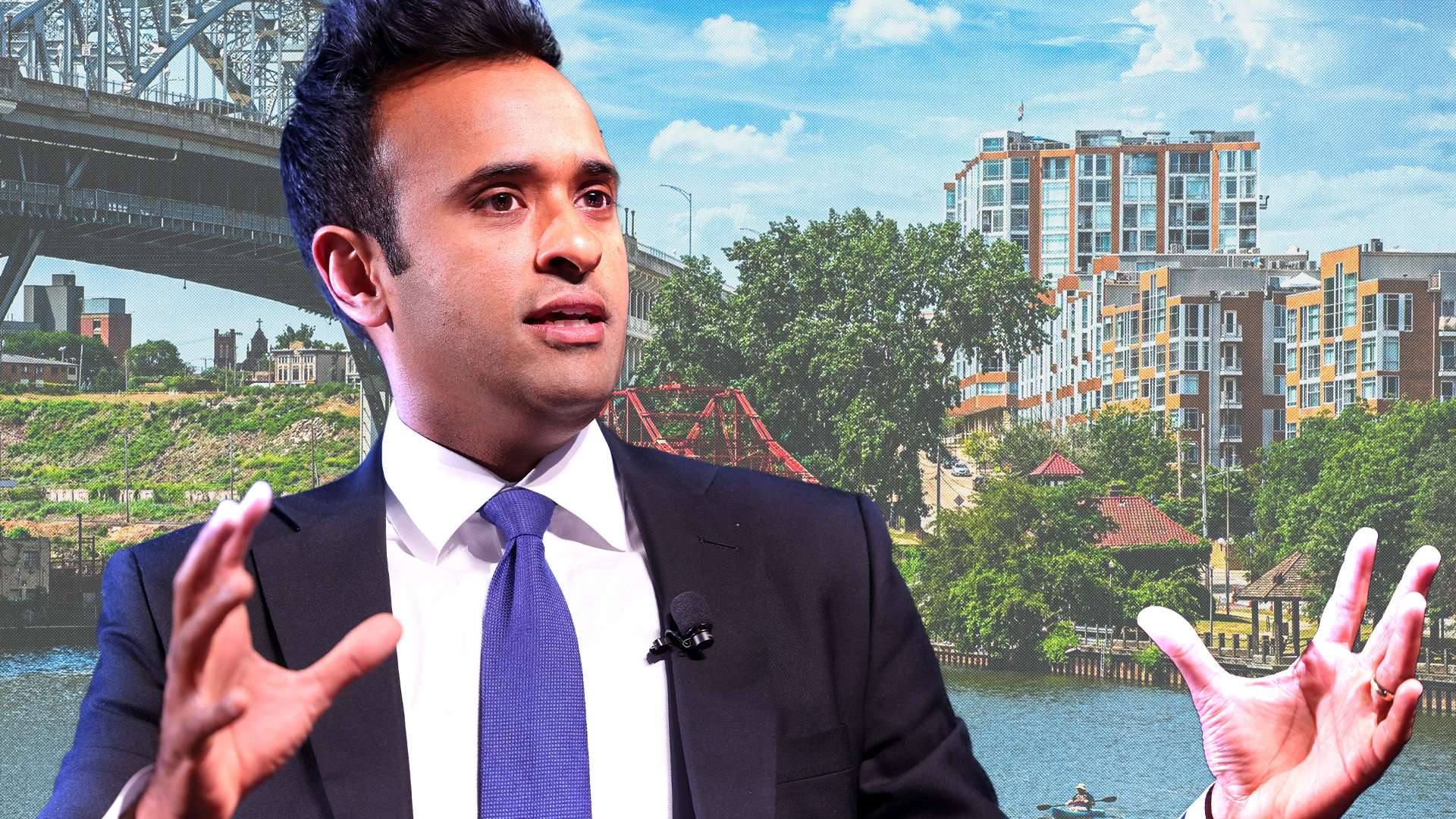
Republicans who want to tap into voters’ anger about rising costs without taking on the president whose policies helped drive them are navigating a tough predicament.
When Vivek Ramaswamy ran for president in 2024, he described himself as a national libertarian, embracing skepticism about new Middle East warfare and backing for free trade—so long as it did not involve China.
In a midterm political climate where voters are growing increasingly upset about price hikes tied to protectionist tariffs and elevated gasoline costs linked to a renewed Middle East conflict, that stance would have given Ramaswamy, now seeking the governorship of Ohio, a straightforward narrative about how he would lower living costs.
However, for the Republican hopeful, the very policies blamed for those costs—tariffs and the war—trace back to President Donald Trump, whose backing he is counting on to prevail in a surprisingly close contest against Democrat Amy Acton.
Recent polling places Ramaswamy at a slight lead over Acton, with a sizable share of voters still undecided.
Other Republican midterm contenders, most notably Mike Rogers in Michigan, are sidestepping the bind by attacking the tariffs and war without explicitly naming the president responsible for both.
Ramaswamy has chosen a different tactic: redirect the conversation toward alternative sources of households’ cost-of-living pressures that cannot be readily attributed to Trump.
In the closing phase of the campaign, he has homed in on two ideas he says would deliver direct relief to Ohioans. The first is a plan to roll back homeowners’ property taxes, and the second is a moratorium on new data center construction.
Like many Midwestern and western states, Ohio has seen property tax bills climb in recent years, a consequence of pandemic-era surges in home values.
That increase has in turn sparked a broad homeowners’ revolt across the state. The Republican-controlled Legislature enacted a series of property tax relief measures in 2025, and activists are gathering signatures to place a full abolition of real property taxes on the statewide ballot next year.
Ramaswamy has not endorsed total abolition, but he is pledging to roll back property tax assessments for homeowners to pre-pandemic levels.
On the data-centers question, he has taken a markedly restrictive stance.
Ohio ranks among the leading states for data-center development. Pew Research counts 57 projects currently in the pipeline there, attracted by cheap land and a robust power grid.
The data center boom has produced a backlash in rural communities, where residents object to the conversion of land, the demand on electricity, and the favorable tax incentives some projects have received.
On the ballot in ten Ohio localities this November are proposals that would impose additional restrictions on data-center expansion.
Ramaswamy has proposed to move even further with a statewide moratorium that would stay in place until the Legislature enacts laws that require data centers to pay for the full costs of the power infrastructure they rely on, and that provide property tax rebates and free electricity to nearby homeowners.
Coupled with local property tax relief and reductions in local spending, such a policy would align with a small-government orientation. However, the proposed rollback of residential property taxes would not automatically translate into simpler public finances.
Instead, it would cut tax revenues and leave localities to figure out how to compensate for the shortfall, potentially forcing reductions in services or causing officials to seek new revenue sources elsewhere. In practice, that could push tax burdens toward commercial properties, trigger increases in other taxes (such as sales taxes), or heighten dependence on state aid.
Neither outcome is ideal. While some Ohio data centers have benefited from tax subsidies, Ramaswamy’s plan would block new centers until they are legally required to subsidize their neighbors with free electricity and other community benefits.
All of this underscores that it is unfortunate to see Ramaswamy adopting increasingly restrictionist positions in an effort to avoid directly critiquing Trump’s cost-raising tariffs and the Iran-related war that would fit his prior libertarian outlook.
It is also ironic that, in trying to avoid those critiques, Ramaswamy ends up taking a more restrictive stance on data centers than Trump himself.
In an August post on Truth Social, the former president publicly urged local communities to “let Data Reign” and welcome data-center growth, arguing that those who did would become rich and successful, while those who did not would remain poor and backward.
At a rally in Vandalia, Ohio, over the weekend in support of Ramaswamy and Republican Senate candidate John Husted, Trump reiterated his backing for data centers, stating that Ohio would reap significant financial benefits and that simply turning them off would drive activity to China.
Rather than criticizing the president’s statist policies, Ramaswamy has chosen to promote his own approach. Critics warn that Ohio could end up poorer as a result.
