
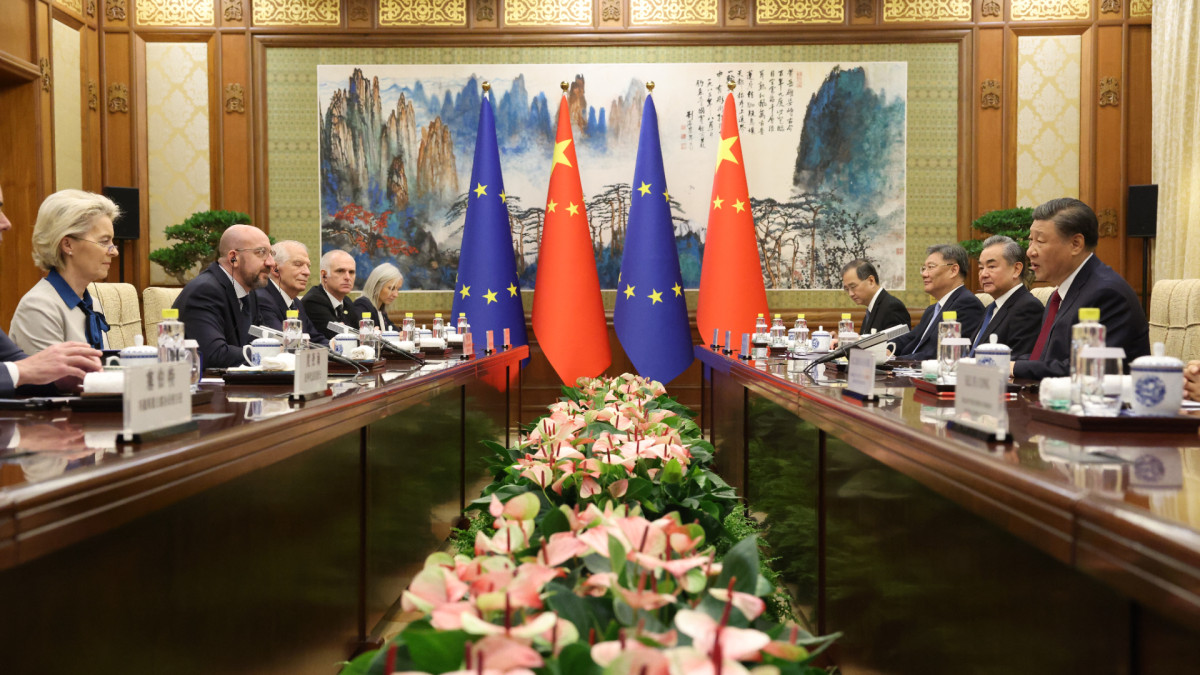
Despite the potential for cooperation on paper, structural differences in governance, market organization, and geopolitical alignment are pushing the EU and China toward a systemic rivalry in AI. This gap is amplified by the EU’s competitive disadvantage in leading AI industries, by the broader US-Chinese tech confrontation that forces Brussels to take a bloc-based stance, and by Donald Trump’s international policy. In the words of Anu Bradford, a professor at Columbia University, we are witnessing a rivalry between digital empires. China’s push in AI reflects an empire on scale, built through state mobilization and the diffusion of infrastructure, while Europe’s influence has rested on an empire of norms that projects its internal standards outward through the Brussels effect tied to the relevance of its single market.
From “Green Shoots” on Paper to Real Differences
Earlier this year, Paris hosted an AI summit that concluded with a declaration on how to develop this technology in an inclusive and sustainable way. The event seemed to lay the groundwork for EU-China cooperation on AI. Brussels and Beijing were among the signatories, ensuring a balanced representation of both the West and the Global South as well as other global players such as India. The brief text focused on how AI should be used to make the planet more sustainable and to reduce inequalities among people, and stated that market concentration in this field should be avoided, promising a space for cooperation between the major players. In fact, this cooperative approach between the EU and China on AI also reflects the social perspective of their respective AI strategies. The European strategy underscores the benefits of technology for health care, environmental sustainability, or education, while China focuses on people’s wellbeing, governance, and global cooperation, in line with its AI Plus (AI+) initiative. Thus, Europe’s human-centered AI approach and China’s people-centered approach appear compatible and mutually beneficial: both roadmaps place citizens at the center of public debate.
“After the launch of ChatGPT at the end of 2022, instead of maintaining the earlier positive tone, the anticipated governance differences in AI began to be addressed”
At the same time, the alignment in rhetoric hides a deeper strategic asymmetry. China’s AI+ also serves as a major intensification of state-driven AI mobilization. The language of cooperation clashes with a national strategy designed to generate scale advantages and geopolitical resilience, which inevitably reshapes the balance between the EU and China on this issue.
The first of the two High-Level Dialogues on Digital Cooperation between Beijing and Brussels also anticipated possibilities for AI cooperation. Held in 2020 in the context of COVID-19, the event demonstrated both sides’ interest in AI collaboration, with China pledging to create a “favorable competition environment in the market and to improve the protection of property rights and of intellectual property.” Although years later one could question the fulfilment of this commitment, the promise itself was laudable. However, the discourse shifted in 2023 with the second dialogue. After the launch of ChatGPT at the end of 2022, rather than maintaining the positive tone, the anticipated governance differences in AI began to be addressed. For example, the EU “emphasized the importance of an ethical use of this technology, fully respecting universal human rights,” implicitly referencing China’s handling of human rights and the possibilities that this situation could worsen due to newly developed technology. Thus, the approaches adopted by Brussels and Beijing seem overshadowed by key governance differences in AI.
Three Divergences Highlight the Systemic Rivalry Between the EU and China
The first of these divergences concerns the control implied by AI. This technology should be regarded as a driver of processes, whether related to productivity, analytics, health forecasting, or generative writing. Another element that it could drive is social control: surveillance, predictive policing, and behavioral modification could be scaled up to unprecedented levels in the Asian country thanks to AI. In the Old Continent, citizens can live with relative anonymity and their personal data are guarded by the General Data Protection Regulation (GDPR). For example, data transfers in China must be conducted on the basis of security assessments carried out by the Government. AI amplifies the power of the Chinese government to control its citizens, which, from the EU’s stance, could amount to a violation of universal human rights in China. Although this situation existed beforehand, AI’s entry into the global landscape exacerbates it.
“A strong synchronization between corporate communications and the Party’s priorities is suggested, something unthinkable in the European Union or the United States”
A further and less visible layer of this first divergence concerns how the state strategy shapes the corporate voice in China’s AI sector. In 2025, China’s leading AI firms have kept an unusually low public profile and their leaders have largely avoided geopolitically charged messages in public remarks. DeepSeek, despite its symbolic role in the Chinese narrative about progress in AI models, has remained publicly silent; one of its first relevant public statements in almost a year came from a senior researcher who warned at the World Internet Conference in Wuzhen that AI could displace most jobs within ten to twenty years, urging tech companies to act as guardians against social disruption. Beijing can leverage this alignment as a signal of credibility and as a negotiating advantage against a more plural European ecosystem often marred by internal clashes.
China can export AI systems and AI-based governance infrastructures to like-minded governments, which enables it to strengthen its position as an alternative supplier of global digital goods. In practice, AI is currently being exported as part of the Belt and Road Initiative through smart city projects, public safety tools, and normative diplomacy, extending China’s data-governance preferences and state presence beyond its borders. Brussels could view these initiatives as part of a broader strategy to spread an AI-linked governance model that clashes with the EU’s human-rights-based approach.
“The EU’s economic future seems to be at odds with China’s, given the current trajectory of its AI firms’ development”
The third divergence concerns China’s superior market competitiveness. While Chinese AI firms have achieved cutting-edge performance and global visibility (DeepSeek being the emblematic case), EU AI alternatives have yet to grab global attention. The lack of competitiveness of European firms in high-tech areas like AI has been documented, as reflected in the Draghi report. Part of this road map is the Commission’s Digital Omnibus, presented on 19 November 2025, which proposes delaying key obligations of the high-risk AI Act to December 2027 and introducing flexibility to facilitate AI training and reduce compliance costs. This indicates that the EU is moving toward the American model (innovate first, regulate later), and that its regulatory identity is being reshaped by competitive pressure between the United States and China. At the moment, it is unclear whether President Von der Leyen will be able to achieve her goal of making the EU economically competitive before the end of her term in 2029. In the meantime, China’s influence in the tech sector continues to grow, and some European business leaders have already stated that their firms will need substantial EU funding to stay competitive against other international players, such as Chinese state-backed companies. Indeed, the EU’s economic future seems to be at odds with China’s, given the current trajectory of its AI companies’ development.
Lastly, the systemic rivalry between liberal democracies and authoritarian regimes is increasingly manifesting itself in multilateral governance arenas. As United Nations initiatives expand, such as the Global Digital Pact and the UN General Assembly resolution sponsored by China on AI capacity development, and as the Council of Europe’s AI Convention and the EU AI Act project European normative power outward, the competition between the EU and China shifts from a bilateral disagreement to a dispute over forums and coalitions. Therefore, the rivalry is not only about models and markets but also about which governance model is normalized globally, which can be seen as the battlefield of the “Brussels effect” in AI: whether Europe can continue turning internal legislation into external norms faster than China can convert its size into external infrastructure.
The United States of Trump Enter the Scene: A New Digital Iron Curtain?
These three divergences are further reinforced by considering the current geopolitical situation of the United States as an old hegemonic power that is losing ground. In that sense, some have already suggested that a tech Cold War in AI may be emerging. As competition hardens into technology blocs, Europe finds it increasingly difficult to maintain a distinctive voice on how AI should be governed. Beijing’s wave of global initiatives signals its desire to partially reshape the liberal international order according to its own vision, establishing its preeminence in its immediate sphere of influence and significant control over farther regions. Hence, earlier this year, some US states banned DeepSeek on their shores, while the Trump administration published a report labeling Chinese AI a national security risk. For Brussels, these measures raise the cost of balancing and complicate any attempt to involve China in AI governance while maintaining a credible distance.
“What is at stake for Europe is not so much choosing a side as the ability to keep shaping the rules within the bloc where it ultimately finds itself”
Given the complexity of this landscape, the EU position becomes ever more fragile. Using China as leverage could be an effective way for President Von der Leyen to achieve her goals of strategic autonomy and competitiveness, although it is hard to imagine a future in which the EU and its members would prefer allying with China over the United States. A recent example is the Dutch government’s late-September 2025 acquisition of China’s chip fabrication company Nexperia, an action widely interpreted as part of Europe’s securitization of critical technologies under the dual pressures from the United States and China. If this logic were to persist in the long term and a new digital Iron Curtain descended on AI-related technologies, Europe would, without a doubt, remain on the American side once again.
