
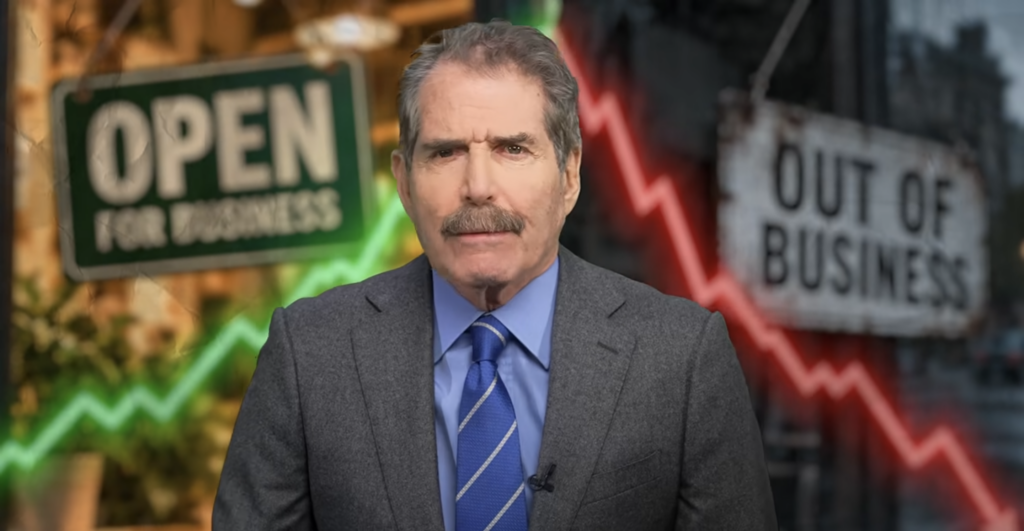
Government-imposed risk aversion may shield people in some respects, but it also carries a price.
Some businesses fail, and workers lose their jobs. Politicians respond, declaring, “We must safeguard workers!” Some states broadened the Worker Adjustment and Retraining Notification Act (WARN) to make layoffs harder. Yet economist Allison Schrager warns that protection comes with a downside.
There is no prosperity, no growth… no “upside” without taking on risk, she argues in her new book, Worth the Risk. The book contends that current government protections leave us less safe and less prosperous because the rules deter the risk-takers who drive better innovations.
Tightrope walker Nik Wallenda rose to fame by strolling high above cities, the Grand Canyon, and even an erupting volcano. But in a recent video, he confides that his real fear now is government regulation. He worries that endless rules could bankrupt his circus.
“It’s just unbelievable! They tell us who we have to hire to haul away our trash… We now must have three sheriffs on staff around the clock. Government has its hands in everything,” he says. Because of that, he adds, “Spending the money that it took to take over the Big Apple Circus was scarier than crossing the Grand Canyon without safety devices.”
And, he notes, government continually imposes more rules. “We feel that we are doing the right thing by creating these regulations,” Wallenda says, “but the reality is: We’re handcuffing our freedom.”
Many young people today seem to favor that protection.
Schrager spoke with college students and asked, “The American dream used to involve taking risks. It was never a guarantee.” One student raised his hand and shot back, “Your American dream is my nightmare!”
Why would he say that?
“They were told that if you did everything right, followed the rules, obtained the right schooling, you would get ahead. That’s not true. It has never been true.”
A recent Gallup Poll shows that since 2010, the share of young U.S. adults who describe themselves as “thriving” has fallen from 64 percent to 44 percent. Schrager observes, “We shouldn’t be surprised they’re also less satisfied, feeling as though they can’t move forward. If you ensure everyone’s safety and protection, you deprive them of realizing their fullest potential.”
The European Union, with a larger population than the United States, once boasted an economy bigger than America’s. Yet over the last two decades, Europe has fallen behind, and today the U.S. economy is about 40 percent larger.
One driver is Europe’s regulator-heavy approach, marked by a continual expansion of rules designed to shield workers. There are examples, such as a rule that compelled a German firm to hire back an employee who had stolen from them. Workers appreciate that level of protection, but the rules also make firms reluctant to hire or experiment with new ideas, leaving Europe’s labor market far less flexible.
“Europeans say they’re happy with the system,” I tell Schrager. “Are they?…They’re running out of money! They carry enormous debts they can’t repay. They have an aging population they can’t finance, and they lack growth.”
Another factor behind America’s stronger performance, Schrager contends, is its bankruptcy framework. It’s easier for risk-takers to fail and try again. Donald Trump’s businesses, for instance, filed for bankruptcy six times. “I can’t imagine bankruptcy feels good,” Schrager concedes, “but it doesn’t stop you from trying again.”
Henry Ford’s and Milton Hershey’s earliest ventures also failed before they succeeded. “In other countries, you go bankrupt and you can never try again?” I ask. “It’s very difficult. They may seize your personal assets, and there’s a heavy social stigma. It’s much harder to regain capital,” she explains.
Now, sadly, America is increasingly resembling Europe.
Socialists advocate guaranteed jobs; Senator Bernie Sanders (I–Vt.) argues that everyone should have “the right to a decent job that pays a living wage.” Schrager responds that the essence of socialism is the same lie that fuels most financial scams: “You will have everything guaranteed. But you’ll also have growth and prosperity.” It simply doesn’t work that way. Capitalism, she says, is brutal. It makes no guarantees—bad things happen, money can be lost, but there remains the potential for growth and opportunity.
As Wallenda puts it, “We can become so safe that it becomes dangerous again.”
COPYRIGHT 2026 BY JFS PRODUCTIONS INC.
