
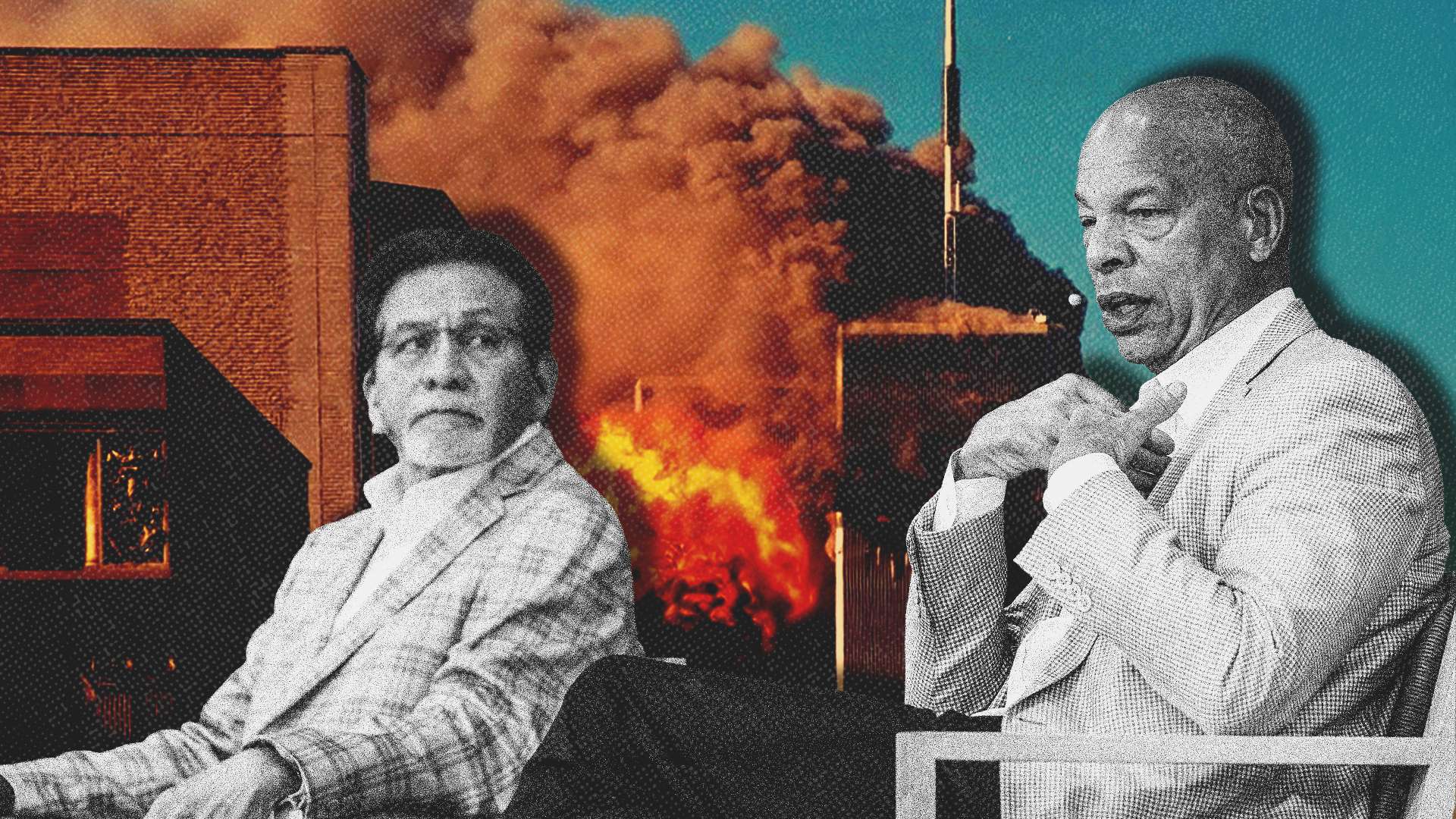
In a rare display of candor, former Attorney General Alberto Gonzales and former Homeland Security chief Jeh Johnson discussed torture, Guantanamo Bay, and the 2001 Authorization for Use of Military Force.
ASPEN, Colorado—The senior U.S. figures who oversaw and executed the response to the 9/11 attacks have since left public service. Yet the legal framework created in the wake of those attacks endures, and in many respects it is more resilient today than it was at the outset.
What are their thoughts now?
Alberto Gonzales—then White House counsel on September 11, 2001—and Jeh Johnson—who served as general counsel of the Department of Defense and later as secretary of Homeland Security under Barack Obama—exchanged views at the Aspen Ideas Festival late last month, addressing the 2001 Authorization for Use of Military Force (AUMF), interrogation methods, and the situation at Guantanamo Bay.
“I think President Bush and I were surprised that the AUMF has persisted and has been relied upon,” Gonzales noted. That resolution—granting the president authority to use force against those responsible for 9/11—has been repeatedly invoked to justify counterterrorism actions across a multitude of countries, even when those missions bear little clear link to the events of nearly a quarter-century ago.
“We never anticipated that it would extend beyond addressing the specific threat that existed in 2001,” Gonzalez continued. “I believe all of us have a duty to ensure that our government branches are checked when they wield power, especially the executive branch, even in wartime.”
This topic is especially pertinent today amid the conflict with Iran. “I spoke with a number of Congress members who voted for the 2001 and 2002 authorizations,” Johnson said. “One of them told me that once authority is granted, it’s almost impossible to retract.” (This is largely true.) “The way the 2001 authorization is interpreted has gone far beyond what any member of Congress in 2001 could have imagined….So in principle, a sunset makes sense.” Gonzales offered a more direct view: “I believe it should sunset. If a new threat emerges, approach Congress, present a case, and Congress can grant another authorization or a declaration of war.”
On the topic of torture, Gonzales attempted to distinguish between the Bush administration’s “enhanced interrogation techniques” and the widely condemned abuses at Abu Ghraib during the Iraq War. Regarding waterboarding, he said he found some reassurance in sworn testimony from the CIA director, the NSA director, and his successor at the Department of Justice that information obtained through these interrogations contributed to America’s safety. In response to Mary Louise Kelly’s question about whether this breached the Geneva Conventions, he replied: “That was certainly not the position of the Department of Justice.”
Johnson, meanwhile, weighed one of timeless dilemmas: should the emphasis be on liberty or on safety? “There’s a pendulum effect between what Americans will tolerate in terms of civil liberties during periods of high anxiety and what they accept in the name of greater security,” he observed. “By 2009, the pendulum had swung toward change… I believe the major challenge for Americans is to recognize fear that is manufactured and stoked by our leaders.”
Yet the conversation grew especially heated when the subject turned to Guantanamo Bay, the Cuban base and detention facility that has held numerous detainees—some cleared for release for years—without charges or trials.
“That was never intended to be a long-term fix,” Gonzales argued. “It was meant as a temporary solution to an immediate problem.” On the question of why some detainees were not transferred to the United States for trial, he conceded there might be a fundamental rule-of-law issue, but argued that there are opponents who prefer not to bring them here, even though the core principle of due process is not subject to a vote.
Johnson, for his part, admitted to being the Obama administration’s strongest advocate for preserving the system, but he added that he would not have supported it “if you had told me there hadn’t been a single trial.”
Johnson’s most notable function, as head of the Department of Homeland Security, grew out of the response to 9/11. “The thinking that spawned DHS in 2002 is now outdated. The idea then was that we didn’t need a separate interior ministry or a DHS because two oceans stood between us and the rest of the world. Everything changed after 9/11,” he said. “And if we merge all border-related controls—across land, sea, and air—under a single cabinet department, including TSA, the Coast Guard, Border Patrol, and Customs—we believed we could keep the bad actors out. That line of thinking is now obsolete.”
So where do they stand now? “Frankly, I think we should scrap the current arrangement and start from scratch,” Johnson concluded.
