
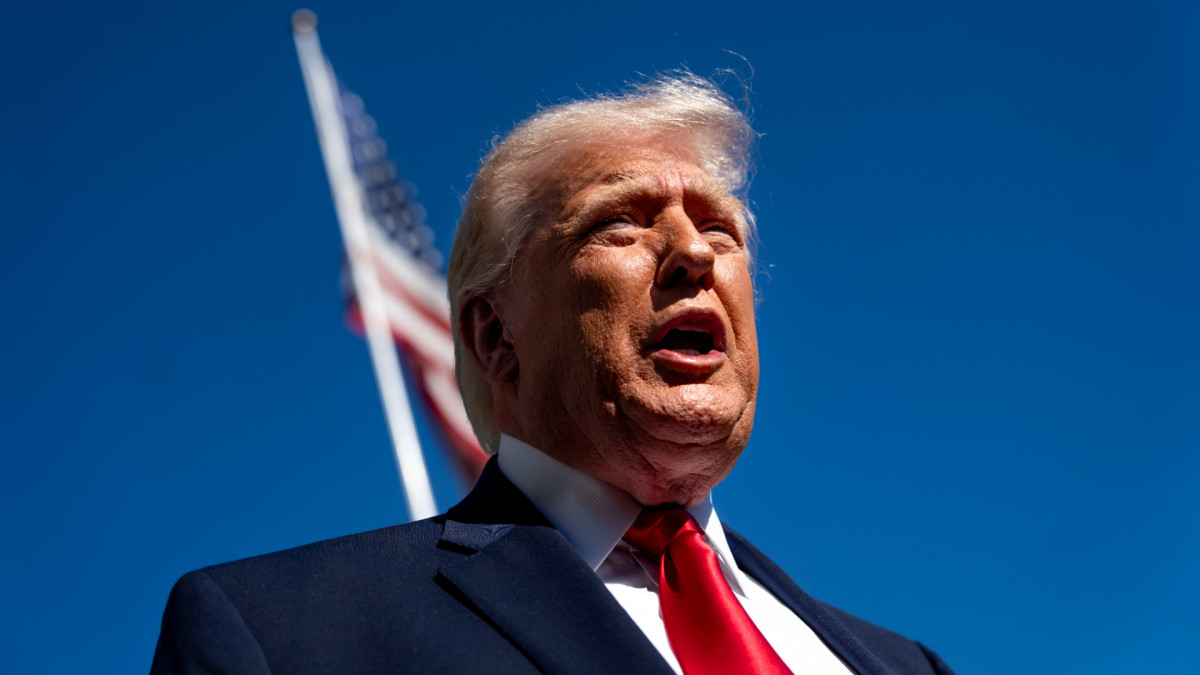
Like a bull in a china shop: this is how the war in Iran burst into US domestic politics. It shook the certainties of that country on the eve of its midterm elections. And, as happens, at least once every decade, violence in the Middle East leaked back into the news, social networks, and late-night discussions. This war has become a harsh mirror for the Trump Administration, and reality has appeared discordant: there is no link between the president’s discourse, as pompous as it is celebratory, and the images of bombings, devastation, and global inflation. In short, Washington is once again confronted with the fragility of a conflict that refuses to be domesticated.
Like a thermometer of presidential power. This is how the US midterm elections unfold (to be held on November 3), something that goes far beyond a mere legislative formality. Every two years, voters decide how the House of Representatives will be composed and a third of the Senate: roughly speaking, this determines whether the remainder of the president’s term will be backed or opposed. In recent history, this electoral rite has functioned as a punishment or a reward; in other words, it is an indirect plebiscite on the figure occupying the White House. In the current context, and depending on the results, for Trump it will be a crossroads: either he maintains his swaggering rhetoric, backing his controversial current project, or he pivots toward a path that undermines the presidential figure less, as the ongoing war in Iran is already doing.
Because this latest international conflict (or “the latest whim” of Trump, as many voices opposing the current US regime claim) has become a kind of wild, out-of-control bull that already charges at electoral expectations. On the one hand, Republicans try to capitalize on fear and the need for security. On the other, Democrats highlight the human and economic cost of what they view as improvised foreign policy. But, moreover, there is significant dissent within the MAGA movement and within the Republican Party itself that does not align at all with Trump’s geopolitical maneuvers, much less with his approach to Benjamin Netanyahu. And the war, at rallies on both sides, appears as a backdrop: some use it to claim the leadership of a tempestuous yet pragmatic figure, while others use it to denounce the irresponsibility of a swaggering president and a government dragging the country toward a dangerous abyss.
“Midterms are that long-awaited referendum on the war — and its effects on the economy and international security — and on the narrative of strength that sustains it”
Thus, the most likely scenarios, as one might expect, diverge: if the Iran war could be perceived as a legitimate act of self-defense —the least likely option—, Trump could maintain control of the House and strengthen his Senate majority; conversely, if the sense of weariness and chaos takes hold, Democrats would have an opportunity to regain legislative space and curb the president’s room for maneuver, acting as a check against the current Trump-style authoritarianism. In other words, the midterms are that awaited referendum on the war — and its effects on the economy and international security — and on the narrative of strength that sustains it.
But, as is typical in politics, nothing is written in stone. If we recall the sensational Roger Ailes case (the founder of Fox News), we cannot overlook that media manipulation plays a fundamental role whenever there is a call to vote. It is also worth recalling that, on the eve of the 2024 presidential elections, surveys did not favor Donald Trump as strongly, and he ultimately managed to win a surprising majority. Time remains, but there are already clear indications that the current war in Iran could define the rest of Trump’s second term: either it halts the impetuous belligerence that day by day generates more detractors—even within his own camp—or it becomes an indicator that the second half of this term will continue the line of force, impunity, and an unrestrained appetite for resources from other countries.
The post by Donald Trump on his social network in which he likened himself to Jesus Christ, later removed by himself.
From the discontent over the Messianic Trump to cracks in MAGA
A picture worth a thousand words. At the start of this week, headlines from all the international outlets opened with the same story: “Trump is perceived as Jesus Christ.” And, to make matters worse, it happened in the month of April.
Many voices are already denouncing the deterioration of the president’s mental state and personality. Countless videos from psychologists and mental health experts fill the networks, warning, above all, about the negative effects of Donald Trump’s narcissistic personality disorder on geopolitics. One of the most recent pieces supporting that argument was the AI-generated image that Trump himself shared on his networks, depicting him as a messianic healer, surrounded by white, nationalist iconography. After the controversy, the president stated that it wasn’t a religious matter, but that he saw himself as a doctor. He then deleted the image from his networks. He followed by unleashing a sharp tirade against Pope Leo XIV.
“The author demonstrates how fissures within the MAGA movement are advancing rapidly. One of the most emblematic cases is Nick Fuentes”
Now then, what relevance does this have for the midterms and the Iran war? The answer to this question can be very complex and lengthy, but a crucial clue lies in the latest piece by Antonia Hitchens, published in The New Yorker, entitled No enemies to the right (“No enemies to the right”). In it, the author shows how the fractures within the MAGA movement are widening rapidly. One emblematic case is Nick Fuentes — an ultra-right activist and American white supremacist who originally supported the Trump cause — and his groypers (the name of his loyal followers), who claim that Trump “has betrayed” the cause of true Americans and, worse still, that his government is illegitimate.
Another indicator of the times and of how the midterms might be foretold is the testimony of the central figure in Hitchens’s report, a thirty-something born into a progressive Californian family but who has joined the groyper movement and who embodies the generalized discontent of the more conservative US youth, whom she identifies under the pseudonym G. “We have, literally, nothing to live for. We are ready to die. (Politicians) have stolen our innocence,” declares the young man. For him, the current state of the world — his perception of the world — is bleak, and he constantly compares how the United States and Europe looked two hundred years ago with what exists now. By his standard — or fantasy —, the present is nothing but the product of abandonment, of trade betrayal (principally by the “billionaire Zionist mafia”). G extols Hitler and is one more among those who think the current president serves the interests of elites and global mafias more than the American people. He is yet another who accuses him of being “timid” or “soft.”
“One of the great fissures within MAGA is the split between those who have bet on ‘traditional values’ and Christianity, and those who lean toward pro-Israel positions”
With all of the above in mind, how might this phenomenon reflect in the midterms? Well, another point from Hitchens’s work is the significance that the Turning Point movement — founded by Charlie Kirk, the ultraconservative evangelical who was killed in September 2025 — assumed among young people like G. One of the great fissures within MAGA is the split between those who have bet on “traditional values” and Christianity, and those who lean toward pro-Israel positions. The The New Yorker piece highlights that voices like Megyn Kelly, Tucker Carlson, and Steve Bannon, from the outset of the current administration, criticized that the government was leaning more toward what they dismissively call MIGA (Make Israel Great Again).
What began as a rumor now has megaphones. In politics, Ilhan Omar (Democratic congresswoman from Minnesota and the first Somali-born Muslim woman to serve in the U.S. House) has repeatedly claimed that U.S. foreign policy is “too aligned with Israel” and, regarding the current Iran conflict, has argued that “this is a war that does not serve American interests”. She has also suggested investigating Israel’s influence on the White House. Rashida Tlaib (Democratic congresswoman from Michigan, also Muslim, of Palestinian origin) is another voice who has denounced “Israel’s genocide of Iranians” and has called for a congressional debate on U.S. military intervention in Iran. And Rand Paul (Kentucky Republican senator) has said that the war, which does not benefit his country, is clearly driven by external interests.
Even tougher has been Tucker Carlson himself, who stated: “This happened because Israel wanted it to happen. This is Israel’s war, not America’s.” Megyn Kelly has also openly claimed that Washington was dragged into this conflict by Tel Aviv.
To the point: what will happen in the midterms? Perhaps it is too soon for a precise forecast, but the fact remains that the controversial second term of Donald Trump is polarizing not only international opinion but also generating what some—like G himself—now call “a civil war” within the Republican Party. And the Iran war could mark the beginning of the decline of an empire that every decade revs up the military-industrial machine to assert its hegemony. Or, conversely, it could, despite the disaster, serve as the raw material for building the interventionist, ultranationalist narrative that hardline conservative voters demand of Trump. For now, we only know that time will provide the answers.
