
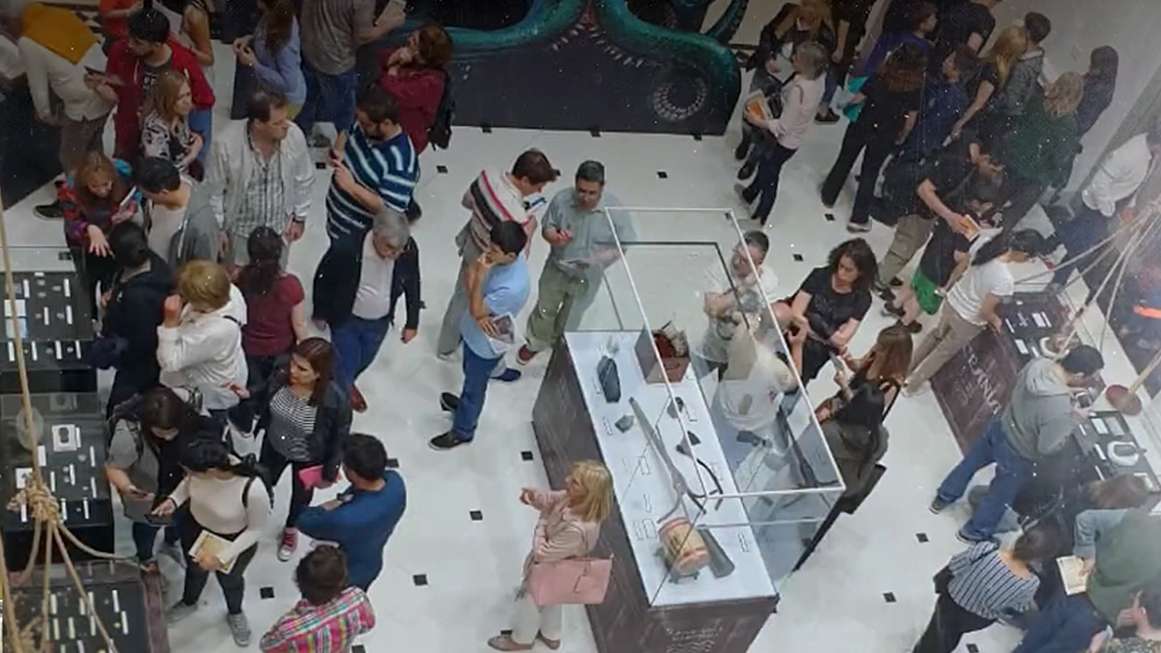
The Central Bank Museum in Buenos Aires traces the journey from cocoa beans to volatile pesos.
Located just a short distance from the Central Bank of Argentina in Buenos Aires, the Museo Histórico y Numismático Héctor Carlos Janson, commonly referred to as the Central Bank Museum, chronicles the tale of a nation shadowed by runaway inflation.
The permanent display resides on the building’s first floor, where six rooms showcase Argentine currency through the ages, alongside the instruments once employed to mint it. The exhibition opens with the pre-Columbian economy, where indigenous communities exchanged goods using cocoa beans, cowrie shells, and modest metal fragments. Colonial-era coins were struck in Bolivia. One example bears the inscription “VTRAQUE VNUM” on its face, meaning “Both Are One,” alluding to Spain and its empire.
As the collection proceeds through the 19th and 20th centuries, the scenes of economic disarray become evident: there are notes in denominations of 1 peso, 10 pesos, and 50 pesos, progressing all the way to the hyperinflation-era 1,000-peso notes. Under President Juan Perón, state spending surged markedly, and deficits were increasingly financed by the Central Bank, which amplified the money supply and accelerated inflation.
In 1970, the Argentine military government substituted the peso moneda nacional with the peso ley. A museum sign, translated from Spanish, explains that this system “fue acompañada de un enorme incremento de la oferta monetaria basada en préstamos exteriores para cubrir las reservas requeridas,” leading to “una gran crisis financiera.”
In 1983, the country abandoned the peso ley and introduced the peso argentino. Two years later, Argentina replaced the peso argentino with the austral. In 1992, the austral gave way to a new peso that the government tied, on a one-to-one basis, to the U.S. dollar for the following decade. As the monetary units—names, designs, and values—continued to evolve, Argentina persisted in spending beyond its means and in expanding the money supply.
Although governments declare their currency as legal tender, Argentina’s monetary history serves as a reminder that money is simply a means of exchange—and that governments are not particularly adept at keeping it under control.
