
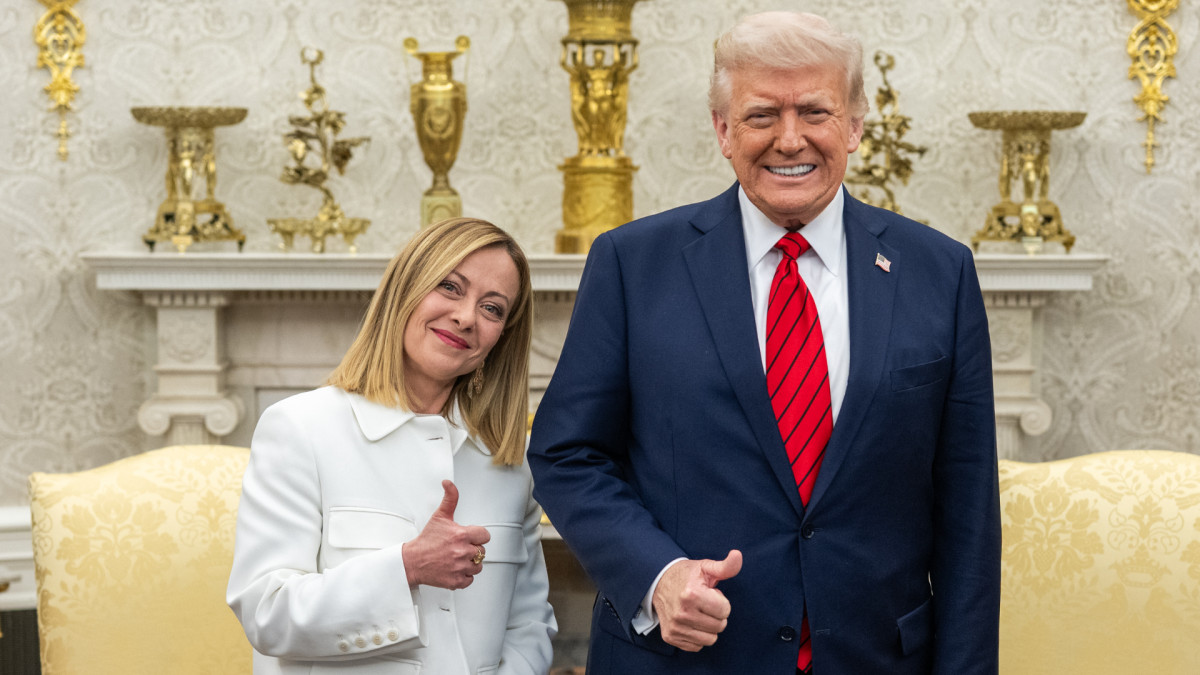
It is well known that Donald Trump demands unconditional and unwavering allegiance to his policies in order not to be the target of his demeaning remarks: his obsession with Pedro Sánchez and his criticisms of Keir Starmer, Emmanuel Macron, or Friedrich Merz were known, but the surprise has arrived after his break with Giorgia Meloni, despite the traditional ideological alignment they shared. Trump only respects Xi Jinping and Vladimir Putin, autocrats with whose political style he identifies and with whom he claims to get along better than with his European allies in theory. And he only fears Benjamin Netanyahu, who, in fact, has dragged him into the reckless Iran war. Trump has even stated that NATO today is nothing more than a “paper tiger” (Mao Zedong would have agreed), despite having at the helm a servile flatterer like Mark Rutte, a politician, in fact, irrelevant to the American president, and his current drift shows him increasingly isolated and disconnected from reality.
In the interview of Viviana Mazza in the Corriere della Sera on April 14, through a six-minute telephone conversation, Trump drives a frontal attack on Meloni, once a solid and reliable ally. Now he says he feels disappointed; he has stopped considering her brave, as he believed she would help him in the Iran war, she seems ungrateful and is no longer the admirable conservative leader he had known. It should be recalled that Meloni tried to be the privileged interlocutor from Europe with Trump precisely because they shared essentially the ideology of Western ultraconservatism on the right, but now it turns out that she seems unacceptable. He has used this expression because Meloni deemed Trump’s words against Pope Leo XIV unacceptable and this criticism was joined by J. D. Vance, who even felt entitled to lecture the supreme pontifical authority on theology, astonishing as it may seem.
Attacking the Pope has probably been one of Trump’s greatest mistakes. First, because in the United States of America most Catholics have not understood their president, and second, because in Italy it is unthinkable not to close ranks with the pontiff over something like this, hence Meloni defended him immediately.
“All of this forms part of the Trumpist discourse against the European Union, which, from his point of view, would have disastrous migration policies”
The arguments Trump uses to criticize Meloni are essentially of two types: the first objection from Trump is ridiculous for how implausible it is, since, in his view, Italy would not have realized that if Iran possessed the atomic bomb, the country would not last more than two minutes; the second obviously concerns oil, as Trump proclaims that Italians will be left without this resource for not cooperating, something related to the existence of the European Union. All these statements are, once again, contradictory: Trump announced last year that Iran’s nuclear facilities had been completely destroyed, while if NATO is useless, it is not understood why he asks for help, only to add that he does not need it either. All this forms part of the Trumpist discourse against the European Union which, from his standpoint, would have disastrous migration policies (despite the overall tightening, except in the case of Spain, of reception and regularization!) and disastrous energy policies (due to his supposed “green fundamentalism”).
Therefore, Trump announces a new kind of relationship with Italy and with Meloni, becoming much more distant as he declares himself shocked by her attitude. For the Italian government of the right, the matter has proven somewhat delicate, as they have had to balance the obvious, unwavering support for Meloni with the underlying backing of the alliance with the United States: Ignazio La Russa or Antonio Tajani have clarified that being loyal allies does not mean simply accepting any decision of a friendly government and that, in this case, they could not coincide with Trump. The opposition has expressed its solidarity with Meloni (something like this would be unimaginable in Spain) and with the Pope, since the priority is to defend Italy’s national sovereignty, while also recalling that the Italian Constitution repudiates war. Elly Schlein (Partito Democratico), Angelo Bonelli (Alleanza Verdi Sinistra), Matteo Renzi (Italia Viva), Carlo Calenda (Azione) and Giuseppe Conte (Movimento 5 Stelle), all of them, with slight nuances, have rejected Trump’s attacks on Meloni and the Pope. As a consequence of these unfortunate Trump statements, Meloni has decided not to renew the defense memorandum with Israel that was automatically renewed every five years, another sign of the broader distancing in Italy from Netanyahu’s aggressive and genocidal policies.
“Meloni has perfectly understood the meaning of the crucial Hungarian elections, the most serious setback for the ultras most reactionary”
The question, therefore, is to wonder why Meloni has shifted, something that is also explained by Viktor Orbán’s defeat in Hungary. Meloni has understood perfectly the meaning of the crucial Hungarian elections, the most serious setback for the ultras most reactionary, a sign that her seemingly unstoppable ascent everywhere is far from written. Meloni has realized that getting too close to Trump is now increasingly counterproductive and that, moreover, her hegemonistic imperial vocation clashes with the national sovereignties of European states like Italy. Therefore, Meloni once again proves to be the most intelligent leader of the radical right, whose group in the European Parliament (European Conservatives and Reformists) is the one taking the most steps to try to “normalize” (Santiago Abascal’s unilateral decision to leave this group to go with Orbán has been a serious strategic error, as Espinosa de los Monteros himself has noted).
In short, Meloni has gained ground in Italy —something that suited her after losing the judicial referendum— by defending national sovereignty, reaffirming a parity-atlantist stance and betting on aligning with the European Union in the sense that Trump’s war is not ours.
