
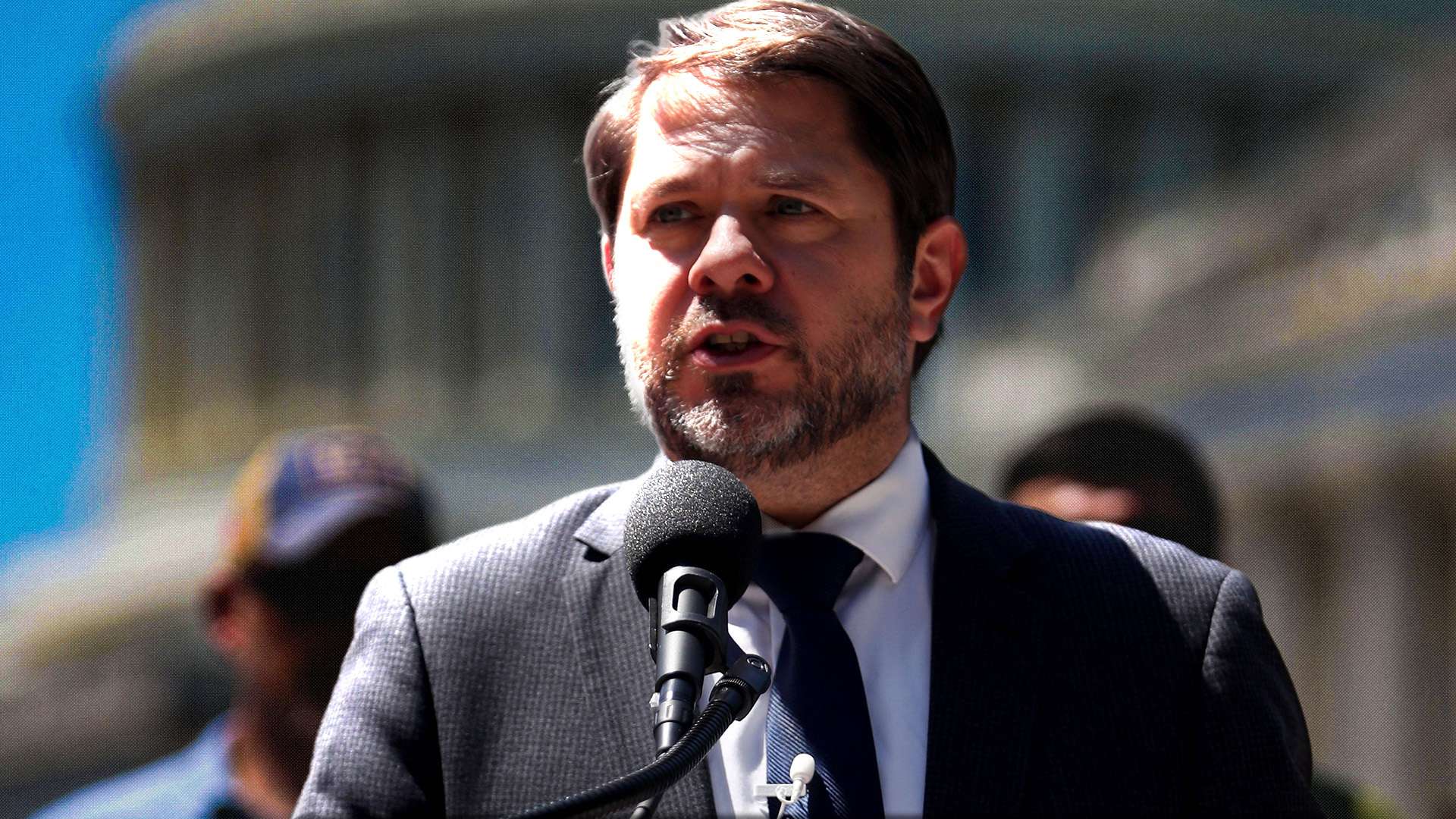
The senator aims to boost union density threefold by 2035 and finance a wide range of social welfare programs through new taxes on data centers and AI companies.
In a 32-page blueprint released on Wednesday, Sen. Ruben Gallego (D–Ariz.) contends that the American dream is being hindered by policymakers who have “allowed billionaires and giant corporations to shape our skewed economic order.” To “rebuild” America’s middle class, Gallego advocates a New Deal–era public service jobs program that would “fund roles enabling workers displaced by AI to support families and strengthen communities.”
And that may be the most modest element within this expansive populist platform. It is unlikely that any of Gallego’s proposals will become law in the near term. But the ideas provide a glimpse into the kinds of policies progressive candidates could push in 2028.
The plan urges the government to mandate higher pay for overtime and holiday hours, expand unemployment insurance, and broaden sick, vacation, and family leave protections. It also calls for steeper capital gains taxes, along with a new “robot” tax on corporations to curb automation. Additionally, it would require a concerted negotiation between employers and workers over the use of workplace technology, effectively giving employees a voice on the direction of a private company.
Indeed, in the name of protecting workers, Gallego would entertain prohibiting full automation, imposing hard limits on how quickly technology can be deployed, and introducing mandates for human operators. While these measures could shield jobs in the short term, they risk crippling firms that rely on automation—think autonomous ride-hailing and delivery services, as well as autonomous manufacturing companies vital to aerospace, healthcare, software, and defense sectors.
Under his approach, mergers involving firms valued over $100 billion would be prohibited, the tax code would be used to discourage large-scale mergers, and antitrust rules would be broadened to scrutinize repeated small merger rollups. Such steps could have the opposite of the intended effect: rather than keeping firms solvent, companies might cut jobs to cover taxes and even close shop altogether.
Gallego also proposes a federal minimum wage of $20 per hour. In 2023, when Sen. Bernie Sanders (I–Vt.) and a cohort of progressive lawmakers floated raising the minimum to $17 within five years, the Congressional Budget Office (CBO) found that the plan would widen deficits, push up prices for goods and services, increase social-welfare spending, and result in about 700,000 fewer jobs by 2029. With Gallego pressing for a higher federal minimum in a shorter timeframe (three years, not five), the potential effects could be more pronounced.
Existing unions would stand to gain substantially under Gallego’s plan. He aims to triple union density by 2035 by automatically certifying a union when more than half of workers sign authorization cards, banning captive-audience union meetings, granting all workers the right to bargain collectively, and expanding pathways into union careers. By current federal labor law, employees can form unions if 30 percent sign on, and workers can bypass elections by seeking voluntary recognition if over 50 percent sign.
To support these unions, his proposal would create new bureaucracies such as a “Worker Empowerment Corps” and an “Office of Worker Advocacy,” along with “whole-of-government labor enforcement collaborations” intended to marshal several federal agencies against employers who violate labor rules. Ironically given his concerns about data centers and AI, Gallego also envisions incorporating AI into systems that monitor compliance with workers’ rights laws.
Beyond higher taxes on capital gains, foreign profits, and stock buybacks, Gallego would consider a new 10 percent excise tax on data centers and a levy on the revenues of large AI firms to fund his programs. It should be noted that many data centers currently generate revenue in nontraditional ways; by November 2025, leading AI companies had invested about 16 times more than they earned in revenue.
The initiative is titled “Saving the Middle Class and Restoring the American Dream.” Yet for many Americans, the American Dream is defined as having freedom of choice in how to live. Gallego, however, would give the government greater control over people’s lives.
