
Sabino Cassese (Atripalda, 1935) is one of the leading figures in public law in Europe. A former minister in the government of Carlo Azeglio Ciampi, a former judge of the Italian Constitutional Court and emeritus professor at the Scuola Normale Superiore di Pisa, he has devoted more than half a century to the study of administration, the institutions, and the functioning of the modern state. His work, deeply influential, has been key to understanding the limits and transformations of public power in the contemporary era.
At nearly ninety, Cassese continues to contribute with lucidity and authority to the Italian and European public debate. In this interview, conducted in his Rome office by Marc López Plana, editor and director of Agenda Pública, Cassese tackles with frankness and precision some of the most controversial topics of the moment: judicial independence, the self-government of judges, the deterioration of public administrations, the advancement of corruption, and the evolution of the Italian political system under Giorgia Meloni’s government. His diagnosis, sharp and uncompromising, offers valuable keys not only for Italy but also for understanding the trends affecting other European democracies, including Spain.
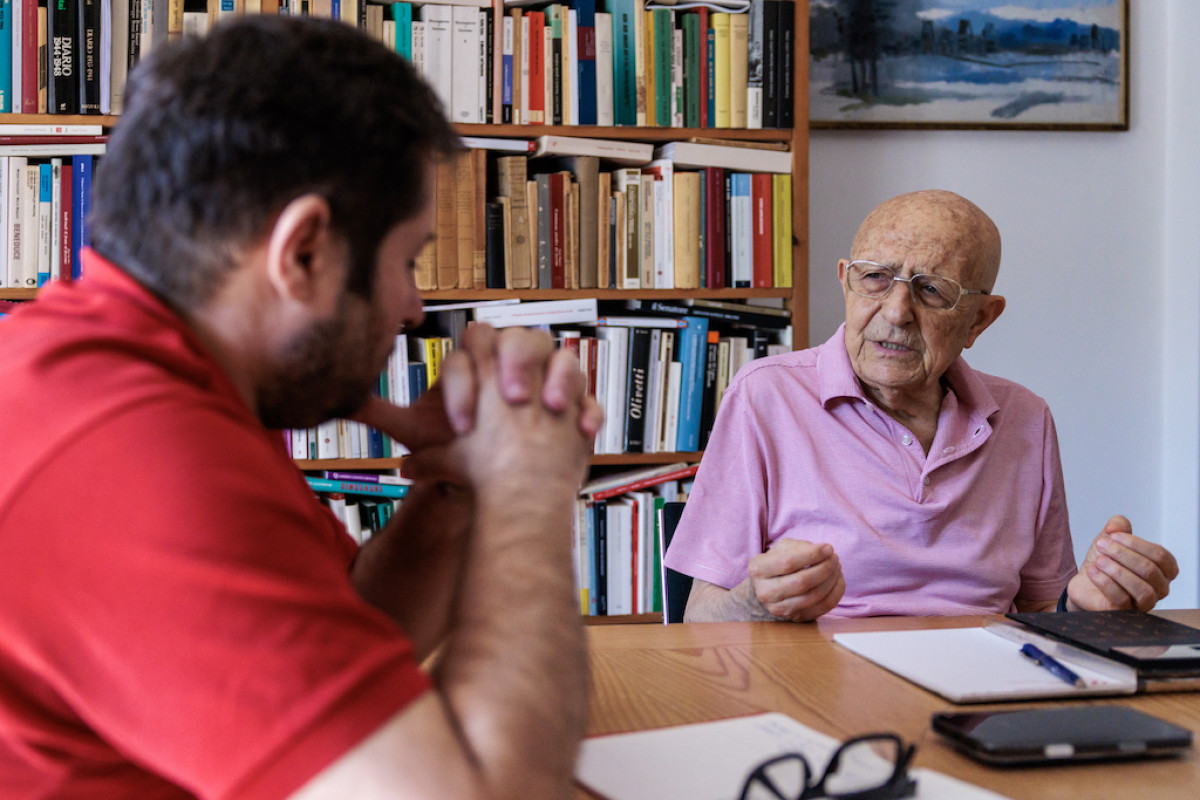
Sabino Cassese during the conversation. Photo: Agenda Pública / Francesco Fotia
You are an expert in what you have called “the government of judges.” Why are the councils of magistracy places of power? Today in Spain and in Italy, for example, they are battlegrounds of politics.
Two reasons. The first is physiological and the second is pathological. First, all modern constitutions attribute autonomy and independence to the councils of the magistracy, constituting what the great political scientist Giandomenico Magione called, twenty years ago, “non-majoritarian institutions.” Non-majoritarian means that they do not form part of the political system in the strict sense. And that is the physiological reason. Then there is the pathological reason: autonomy and independence have been transformed by the legal systems of many countries — France, Italy, Spain among them — into self-government, which is something else. And self-government, in nineteenth-century England, meant that the people governed themselves. This concept, applied to the judiciary, is unworkable. And that is why it is a pathology.
Can a Supreme Court ruling be annulled by an act of Parliament? This is the case in Spain with the amnesty law that annulled a Supreme Court decision.
There are two issues. First, in all modern systems there exists a punitive power of the state exercised by judges, but there is also a softer side of power, represented by the power of amnesty and pardon.
“In all modern legal systems, it is recognized that there can be a safety valve, a softer power, alongside the harsh power”
Thus, in all modern legal systems there is recognition that there can be a safety valve, a softer power, alongside the severe power. Here is where the conflict between the legislative and the judicial powers enters. But there is also a Constitutional Court that has the last word in the constitutional review of an ordinary law.
In the United States, Judge Jackson —who was also the prosecutor at Nuremberg— wrote in a ruling: “We are not final because we are infallible, but on the contrary, we are infallible because we are final”. What it means: “We do not have the last word because we are infallible, but rather we are infallible because we have the last word.” The solution is this: in a legal system there must be a closing clause, someone who closes the circle. The one who closes the circle has the last power. Carl Schmitt said: “He who decides on the state of exception is the one who sets the norm.”
Do you agree that judges should appoint themselves as members of the Superior Council of the Magistracy?
A premise. In Italy, the Superior Council of the Magistracy is formed by a few ex officio members: the President of the Republic, who is its president, the Attorney General of the Supreme Court, and a majority of judges elected by their peers and a minority elected by Parliament.
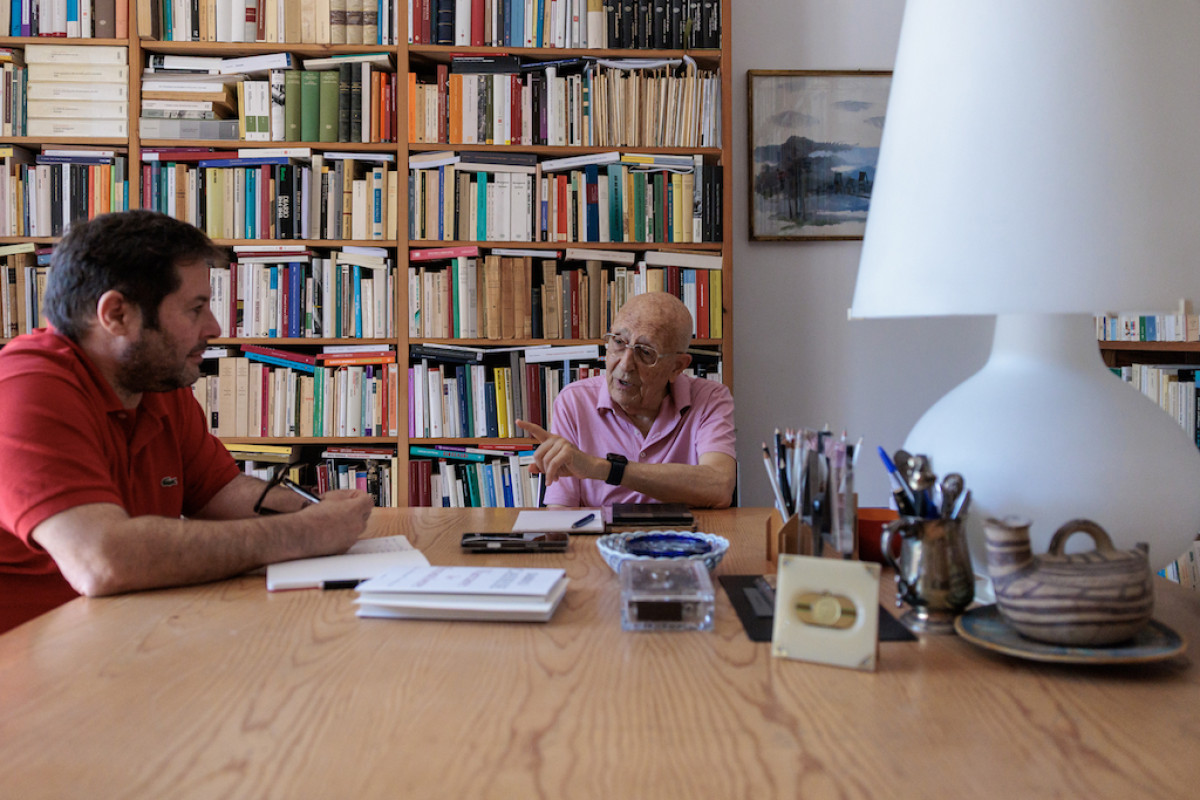
Sabino Cassese and Marc López Plana during the conversation. Photo: Agenda Pública / Francesco Fotia
Is the President of the Republic a member of the council?
He is the president. However, he does not really exercise power; he delegates it to the vice president, who is usually one of those chosen by Parliament. This, in my view, is a flaw in the system, because Presidents of the Republic should always chair the council. The council is a shield, a defense. It is not meant to decide on judicial matters. It is to ensure that there is no private influence in the administration of justice. So promotions, assignments, and disciplinary measures of judges are within its remit. I have joked that the council is a chief of staff multiplied by thirty people.
“The Superior Council of the Magistracy serves to guarantee that there is no private influence in the administration of justice”
The problem is that when the election of members is left in the hands of the judges themselves, ties are quickly created between judges and those chosen. As in: “I was born in Palermo, I was a magistrate in Milan, now in Udine, but my wife works in Palermo and I want to return to Palermo.” Or: “I have been a magistrate for twenty years, I want to become president of the court.” A bond is created and what is technically called a corporation. The corporation self-manages. And that is the greatest problem in Italy. We have a system of factions within the judiciary, and the factions serve to organize a guild. So it is not wrong that judges choose; it is wrong that a chain so strong is created. In Italy there are 9,000 magistrates and each one has its interlocutor in the Superior Council of the Magistracy.
If judges become a corporation, do they acquire political power?
That judges express themselves on political matters is physiological. Take an administrative judge: a law entrusts a city with urban planning authority, the city approves a master plan, a judge intervenes and says the plan was not adopted with due regard to those affected. The judge questions a political decision, but if he is right, politics has violated the law. So it is correct that politics be controlled by the law.
“That judges express themselves on political questions is physiological. The problem is when the judge does not limit himself to controlling, but creates the law”
The problem arises when the American idea of judge-made law enters Italian or French culture. It means that the law is not made by Parliament, but by the judge. In this way, the judge not only controls but creates the law to be applied.
At that moment, the judge is practically an unelected politician.
Exactly.
And does that lead judges to think they have a significant political role?
Of course.

The jurist Sabino Cassese during the conversation with Agenda Pública. Photo: Agenda Pública / Francesco Fotia
And what happens when judges investigate politicians? In Italy, for example, Renzi and his family have been investigated seven times without any convictions.
I call it overreach. It is a problem that arises when, due to a misinterpretation of autonomy as self-government, militant magistrates emerge. A militant magistrate is convinced that he has a mission to fulfill.
“Militant judges are convinced that they have a mission to fulfill”
That is why it is crucial to establish that the Superior Council of the Magistracy serves to defend the judiciary from external pressures, and not the other way around. The council is a shield, not a weapon to be used against other powers. If the judiciary influences politics through the council, it betrays its function.
In his book The Power he talks about power and the power of influence. What is the relationship between the two?
Traditionally, power was command, domination. But today, power is increasingly the power of influence, of hegemony. Tocqueville already hinted at it when speaking of paternal power, seemingly benevolent, yet exerting influence. This power is less visible and harder to control. As Galbraith said, there is a lack of compensatory power. This power of influence is new in modern legal systems. As communication shifts from “one to many” (newspapers, TV) to “many to many” (the internet), the conception of power changes.
“Power today is increasingly the power of influence. It is less visible and harder to control”
The landmark book in this vein is Ruling the Void by Peter Mair. Today, parties no longer exist. They could exist when there was a center that spoke to others. But in a culture where everyone speaks, parties no longer have any role.
But then, how does a democracy function without parties?
Article 49 of the Constitution says: “All citizens are free to associate in parties to democratically participate in the determination of national policy.” It is also reiterated in Article 18 (the right to association) to underscore its importance.
“Political parties no longer have any role. Fifty years ago 8% of Italians were members of a party; today 2%”
Do you know how many Italians were party members fifty years ago? 8% of the electorate. Today less than 2%. The PCI and DC had 20,000 sections. Italy has 8,000 municipalities. This means they were rooted everywhere.
Today no one complains if a party secretary-general oversteps his mandate. Some parties have gone eight years without holding a congress. The secretary-general decides everything. And since he has the power to draw up lists, everyone obeys.

Sabino Cassese conversing with Marc López Plana. Photo: Agenda Pública / Francesco Fotia
Let’s talk about power in public administration.
A few years ago the book Yes, Minister was published, which ironically explained how the one who says “Yes, Minister” is the one who makes the decisions, even while letting the minister think that he is the one making the decisions. Undoubtedly, this was another phenomenon Tocqueville had already clearly seen in the nineteenth century with the growth of bureaucratic agencies. In Italy, the state employs 3.6 million people. An enormous machine.
“When bureaucracy has greater capacity to impose decisions, a democratic problem arises”
The politics can no longer lead it. What does it do? It negotiates. Today everything is negotiation. It is useful: both worlds learn something. A British prime minister told me that, before a vote of confidence, he had his staff draft the parliamentary speech. But it was the top civil servant who delivered it first, and it was perfect.
But when the bureaucracy has greater capacity to impose decisions, then a democratic problem arises. There are instruments to correct it: cabinets, the politische Beamte (political civil servants) in Germany, the internal division of powers, the duplication of tasks by comparison. The hierarchy remains subject to political decisions, but it can also condition them.
Let’s talk about corruption. Does corruption change if there are no parties?
Of course. In China, where it has been studied longer, corruption is divided into two kinds: the one that serves the system (petty corruption) and the one that harms it (grand corruption).
Can you give an example of petty corruption?
A small sum given to a official to expedite a file.
“If parties are no longer interpreters of society, who mediates today between the state and society?”
Now, speaking of grand corruption: if parties are no longer interpreters of society, what mediates today between the state and society? Organized interests. The government must dialogue with society, even if authoritarian. And these organized interests provide demand, but also support, feedback.
But in a world where communication is ‘many-to-many,’ do these interests really represent the majority of the population?
No. And here arises the single-issue politics. Organized interests focus on specific issues. But they do not address the relationships between environment, employment, education, etc.
What does Mani pulite (Clean Hands) reveal about contemporary Italian politics?
Almost nothing. It marked an important moment in the relationship between politics and justice. It brought down the Christian Democracy, the Socialist Party (PSI), and the Communist Party (PCI): the three pillars of the Republic. From there, a democracy of alternation was born. Previously we had a ‘not ordinary’ democracy, like Japan. For fifty years, many governments, but a single pivot party. Now there is alternation: Prodi, Amato, Berlusconi…

Marc López Plana conversing with Professor Sabino Cassese. Photo: Agenda Pública / Francesco Fotia
What do you think about Meloni’s two years as Prime Minister?
She has understood that domestic policy is conducted through foreign policy. She handles criticism very well. She is following a Europeanist, Atlanticist, and prudent line, like Monti, like the more rational part of the country.
Has Draghi also helped you?
Yes. He is the first government that, midterm, has maintained the same electoral support. It has no internal enemies. It is capable of keeping Salvini and Tajani united. He is a great student of Andreotti: if he sees a mine, he avoids it.
Thank you, professor.
