
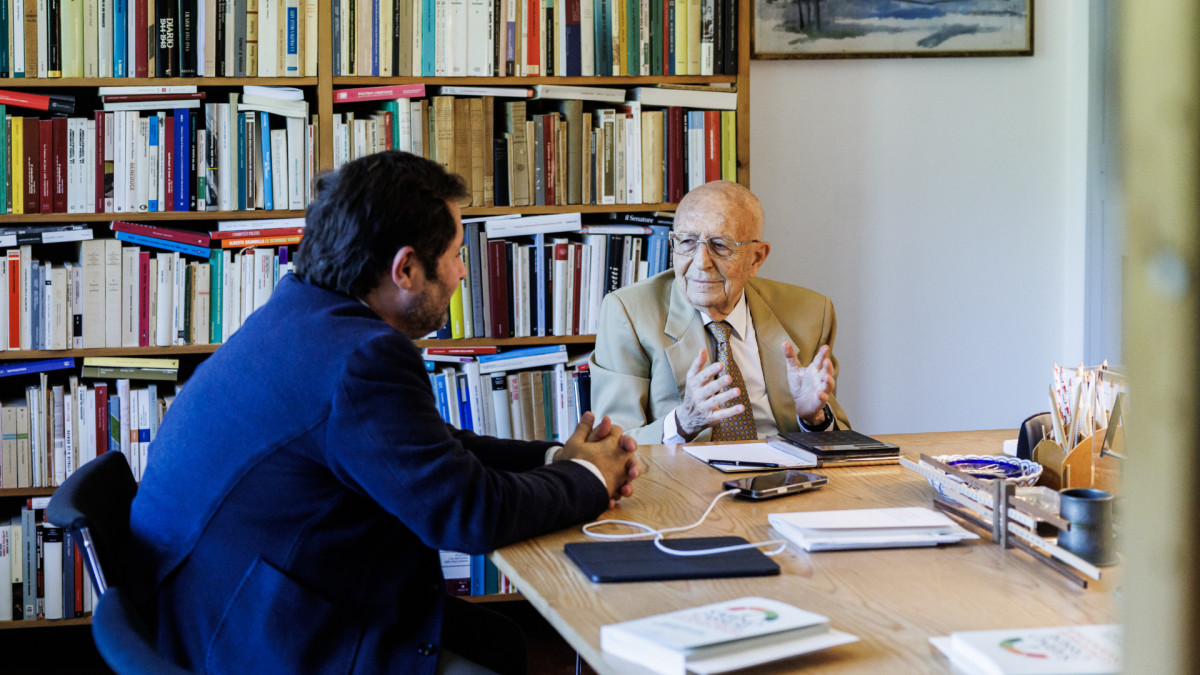
A t ninety years old, Sabino Cassese (Atripalda, 1935) remains in full shape. The former judge of the Italian Constitutional Court and emeritus professor at the Scuola Normale Superiore di Pisa welcomed me again in Rome almost a year after our first conversation. Since then, many things have changed, but Cassese continues to apply his experience with lucidity and to interpret the present with accuracy.
Today, the relationship between politics and justice is going through a turbulent and precarious phase, in both Italy and Spain. In this regard, Cassese, who also has political experience having served as a minister in the government of Carlo Azeglio Ciampi, notes that “if the judiciary develops an orientation predominantly against the government, it ends up becoming an obstacle to government action”.
Regarding the judicialization of politics and the politicization of justice, he stresses that “there is an influence between both spheres”, but “that influence should be tenfold and today it becomes a hundred”“. In this sense, asked about the figure of popular accusation —so debated in Spain, but non-existent in Italy—, he is blunt: “In a sense, it constitutes a call for judges to engage in politics. From my point of view, that is an important defect of the system”, says.
The jurist Sabino Cassese was awarded the Order of Merit of the Italian Republic. Photo: Agenda Pública / Francesco Fotia
We live in a historic moment in which investigating someone has immediate consequences. When it is announced that a person is being investigated, the media and social networks cause many people to treat that person as guilty.
The response, in my view, requires distinguishing three aspects. The first is the “whether,” the second is the “how,” and the third is the “how much.”
To the “whether” one answers simply. Naturally, judges have the possibility of interpreting the rules and must apply the laws. If they consider that there is enough evidence —in the case of criminal judges, for example, of corruption or other crimes—, they must intervene.
“Judges have the possibility to interpret the rules and must apply the laws. If they consider that there is enough evidence […] they must intervene”
The “how” is the fundamental point. In Italy, and I think also in Spain, the action of investigators with respect to politicians is known immediately; accusations tend to occur in the media. Thus, the accusation becomes a trial. However, an accusation is not a trial.
The accused person appears in newspapers as a corrupt person or responsible for a crime. In addition, overheard conversations are published out of context. Wiretaps have become the usual way of obtaining evidence. This is a fundamental part of the “how.”
The investigative instruments are many, but, in general, the method preferred by Italian prosecutors — virtually the only one — is telephone interception. A person can be subjected to it without knowing it, without even knowing that they are being investigated and that their privacy has been violated.
Therefore, the “how” affects two issues: what types of evidence are used and how they are used. There are other instruments, such as police surveillance, banking investigations, or the analysis of financial documentation. However, among the full range of evidentiary means, the main resource is usually telephone interception.
“Telephone taps are published out of context; telephone interceptions have become the usual way of obtaining evidence.”
There is also a second aspect of the “how”: the accusation and the evidence are made public immediately. In this way, a person who has not yet been judged is subjected to the judgment of public opinion. On occasion I have written that this is what Max Weber would have called “cadis’ justice.”
And then there is the “how much.” That is, how many times a given subject or a given matter becomes the target of an investigation. When this happens repeatedly in a systematic way, it can amount to genuine persecution.
Therefore, in the Italian experience of the last thirty years, the problem has not been so much the “whether,” but mainly the “how” and the “how much.”
That dividing line is very clear in the majority of cases, probably in 80%, 90% or even 95% of them.
Problems arise when it concerns matters with strong political consequences. In those cases, even before a final decision, the mere fact of opening an investigation already has important political effects. And today more than in the past, because politics is faster, more personalized and more leadership-centered. Personalization requires projecting strength and makes it harder to endure a state of permanent suspicion.
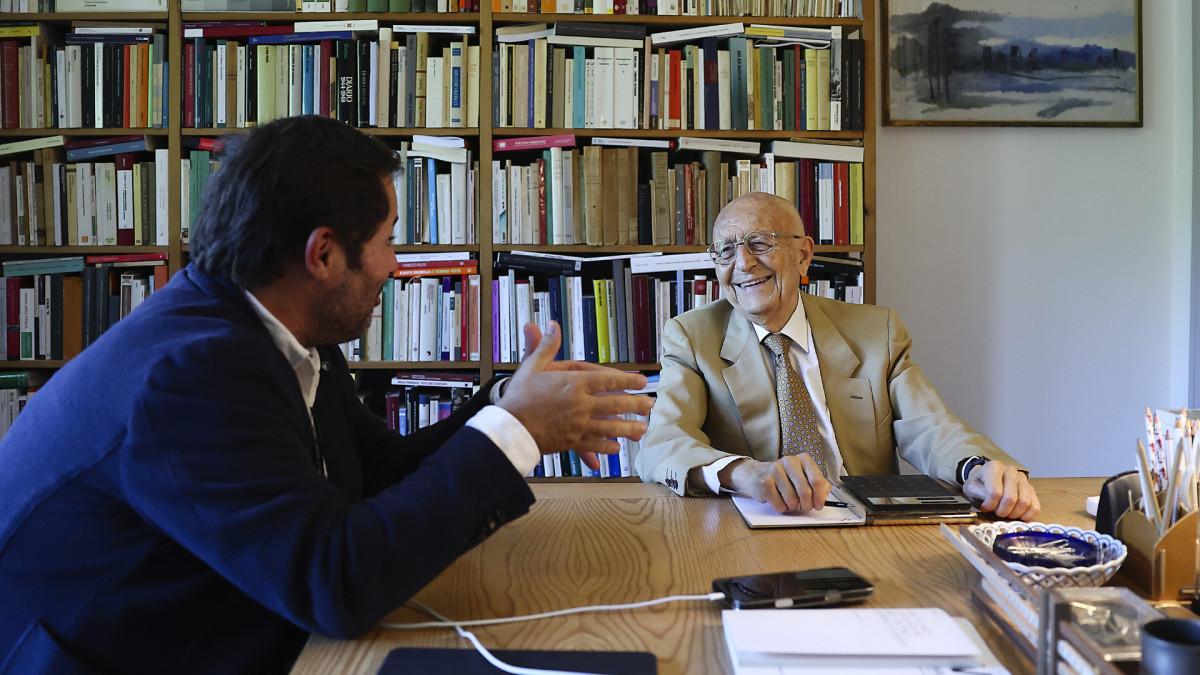
Cassese analyzes how an accusation can become a public trial before a verdict exists. Photo: Agenda Pública / Francesco Fotia
In this context, is it easier for judges to have the capacity to interrupt or alter political processes?
That depends on the scope we are talking about. Let us take an example. Italian prosecutors have developed numerous investigations related to immigration. The judiciary argues that it does so because there may be human rights violations. Politics responds that no, that the government’s line — for example, the one defended by Salvini — is to limit irregular immigration and that, therefore, certain investigations end up directed against policies promoted by the government itself.
It is a difficult question to define. In any case, the issue of quantity reappears. The question becomes relevant when a prosecutor’s office concentrates a very large part of its investigative activity in areas especially sensitive to the government’s action.
The judiciary usually defends itself by appealing to a constitutional article that establishes the obligation of penal action. In my view, it is a rather weak defense.
Because what exactly does it mean that penal action is obligatory? It means, in theory, that if a prosecutor reads a news article and believes there might be a crime, they are obliged to act. Or that if they receive a complaint, they must initiate proceedings.
But this explanation is insufficient. In many countries there are priority scales. In the United States, for example, prosecutors establish priorities of action: certain crimes receive more attention than others.
“What does it exactly mean that penal action is obligatory? In theory, if a prosecutor reads a newspaper article and believes there may be a crime, they are obliged to act”
If penal action is obligatory for any type of crime and news about possible crimes can reach prosecutors by thousands of avenues — and even be actively sought by prosecutors themselves —, in practice that gives a wide margin of discretion to decide what to investigate.
That is why, in my three criteria —the “whether,” the “how,” and the “how much”— one could add a fourth: the “what.” In other words, what matters is which matters are chosen to act upon. And this is politically relevant.
Imagine a prosecutor’s office that concentrates its activity mainly on a particular category of crimes or a particular category of people. It is evident that it is making a selection that can have political consequences.
In Italy it is difficult to know comprehensively all investigations initiated by a prosecutor’s office because much of that information is not public. However, the question you raise is important because it affects the possible overlap between the government’s priorities and the judiciary’s priorities.
If the judiciary develops a predominantly anti-government orientation, it ends up becoming an obstacle to government action.
How can that responsibility be defined today when they decide to open an investigation? Many people argue that anyone has the right to be investigated if there are sufficient indications. I agree. But I also wonder whether a judge should not reflect especially when it concerns opening an investigation against someone who has held the helm of government. How should we understand that judge’s responsibility?
It is a very difficult question. It should be part of the professional culture of judges and prosecutors the awareness that when investigating a person who has held significant public responsibilities one must act with particular care and respect for the function that person has exercised.
I will give you a personal example. During my time at the Constitutional Court I was rapporteur on numerous issues related to Berlusconi. In one of them, the decision had to be made a few months before general elections.
I spoke with the president of the Court and with other colleagues to propose that the matter be resolved after the elections. Not because we had already decided what the ruling would be, but because any decision taken would inevitably have political consequences.
Therefore, I am convinced that judges and prosecutors must possess a certain political sensitivity. It does not mean they must engage in politics. It means they must understand the context in which they live. They must know, and they know perfectly well, what the impact of their decisions can be when these are made public. And, in fact, their decisions always end up being made public.
“Judges and prosecutors must possess a certain political sensitivity. It does not mean they should perform politics”
That is why they must be aware of their effects. Because, in certain circumstances, they can alter the course of elections. And this happens whether the investigation benefits a candidate or harms them. If it harms them, they are marked by the accusation. If they are ultimately exonerated, they may present themselves as a victim of an unjust investigation.
That is why I think the ability to distinguish between the legal action and its political effects should be part of the training and professional education of those who exercise these functions.

The jurist reflects on the responsibility of judges and prosecutors in the face of decisions with political effects. Photo: Agenda Pública / Francesco Fotia
And then there is the question of effectiveness. If we think of Mani Pulite, for example, many investigations were opened. An entire political system collapsed. Yet, if we look at the final result, the number of convictions or people who ended up in prison was far smaller than one might have imagined during those years. How do we assess the effectiveness of those investigations? Should responsibilities be assumed in these cases?
Indeed there was a disproportion between the media and political impact of those investigations and their strictly juridical consequences. That seems quite evident. Now, it is also true that if the political system was not able to resist that impact, there were probably weaknesses inherent in the political system itself.
Not everything can be attributed to the actions of the magistrates. There were many factors. The attitude of certain leaders, how the political system reacted, and other circumstances contributed to the final result.
Undoubtedly there is a portion of responsibility attributable to the Mani Pulite team. The difficulty lies in how to measure it. Because the problem exists, but there is no easy solution to resolve it.
Judicial independence remains a fundamental value. What matters is to understand correctly what independence means.
When a person who is not a judge wants to approach the Superior Council of the Magistracy to file a complaint about a judge’s conduct, I wonder: what happens to those complaints? How does it work?
I understand the question, but I would have many doubts about the possibility that the Superior Council of the Magistracy interfere in concrete judicial decisions.
“Judicial independence remains a fundamental value. The important thing is to understand correctly what independence means”
The function of the Superior Council of the Magistracy is to ensure that judges and prosecutors are capable, independent, balanced and also capable of practicing self-restraint, self-limitation. But it should not intervene in decisions taken by particular judges. The fundamental problem consists in ensuring ex ante the quality and independence of those who exercise the judicial function.
If the Council intervenes in concrete decisions, it ceases to be a governing body of the judiciary and becomes, itself, a court. And the Superior Council of the Magistracy should not be a court.
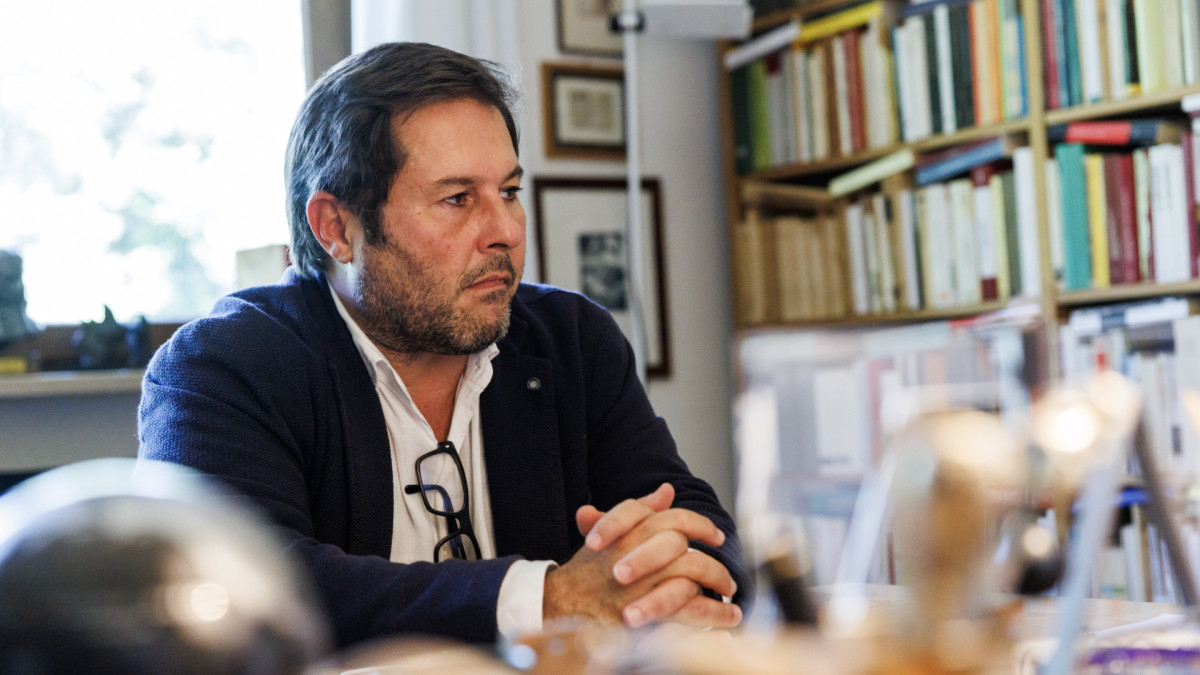
Marc López Plana questions the legitimacy and representativeness of judicial elites. Photo: Agenda Pública / Francesco Fotia
I am interested in the representativeness of those who govern the judiciary. For a long time the judiciary has been understood as a counter-majoritarian institution, tasked with limiting political majorities. But today citizens demand more legitimacy also from non-elected institutions. Is there a problem of lack of political or ideological representativeness among the judicial elites when they decide on politically sensitive issues?
The question you raise is fundamental. If one reads Democracy in America, by Alexis de Tocqueville, one finds a very interesting observation: American democracy relied heavily on the election of judges. Although that is a major difference between the United States and Europe. In the United States many state judges are elected, but federal judges are appointed by the president and remain in office for life. It does not necessarily constitute an ideal model.
The relevant point is that the American democratic tradition preserves direct popular participation in the judicial function. Judges are elected and juries are also elected from among citizens. In this way, the judicial function remains, to some extent, linked to popular sovereignty.
“The legitimacy of judges rests precisely on merit: they are selected and promoted according to meritocratic criteria”
We have abandoned that model. We trust more in a professional judiciary that acts as a counterpower. Our systems have evolved toward a counter-majoritarian organization based on merit-based selection. The legitimacy of judges rests precisely on merit: they are selected and promoted according to meritocratic criteria. That is the foundation that allows us to entrust them with a checks and balances function.
When we speak about these problems we tend to do so as if they affect the entire judiciary. And that is not the case. First, we are mainly talking about the criminal bench, not the civil bench. And the criminal bench represents a relatively small part of the entire Italian judiciary.
Second, we are mainly talking about militant judges. Well, the majority of judges are not militants. The goal remains the same: to maintain a merit-based system, but avoiding it from turning into a closed corporation.
We constantly talk about the judicialization of politics and the politicization of justice. How do you explain these phenomena?
The function of justice is to resolve specific cases. The function of politics is to address issues of collective interest. Justice protects rights in specific situations. Politics operates on a more general plane. If we accept the confusion between both spheres, we end up mixing two completely different functions.
Let us consider a concrete example. In Italy there is currently a magistrate who even hosts a television program. He regularly expresses opinions, weekly. If I am a citizen and one day I must appear before that magistrate, how can I fully trust his impartiality?
Allow me to offer a personal example. During the 1970s I regularly wrote in newspapers, in addition to publishing academic works. However, when I joined the Constitutional Court, where I stayed from 2005 to 2014, I stopped writing newspaper articles. And, from an academic point of view, I limited myself to writing about globalization topics, precisely to stay away from any debate related to Italian domestic law.
I considered it a basic rule. If one performs jurisdictional functions one should not express public opinions about matters on which one might have to rule in the future.
“In Italy there is a magistrate who even hosts a television program. He expresses opinions regularly, weekly […] as a citizen, how can I fully trust his impartiality?”
Because I can write today about a matter and in three years be obliged to decide judicially on it. And then my opinion would already be known in advance. It would not be evaluated solely in light of the evidence of the specific case. That is why the English use a very apt expression: self-restraint, self-limitation. I did not even speak with journalists. Many would call me and I would always respond with the same thing: “I cannot say what I think.” In my view, that is a fundamental rule if we want to avoid certain problems.
And I sincerely believe that the Superior Council of the Magistracy should establish much clearer criteria on this matter.
Public statements by judges should be severely limited. A judge must judge. They must be impartial and independent. And, moreover, they must appear to be impartial and independent. Because there is an important difference between being impartial and appearing to be so.
The citizenry should not perceive the judge as just another actor in the conflict. They should perceive them as someone above the parties.
At the moment a judge appears as a political or ideological actor, that perception disappears. And when the perception of impartiality disappears, public trust in justice also deteriorates.

Cassese defends judges’ self-restraint and the need to preserve the appearance of impartiality. Photo: Agenda Pública / Francesco Fotia
Today we know that when a judge or a prosecutor makes a decision, sometimes even before formally adopting it, information appears in newspapers. Investigations, leaks, phone taps… Everything ends up being published. How can citizens’ trust in judicial independence be maintained when decisions or even the content of investigations constantly appear in the media? How can a fair trial be guaranteed? How can a properly informed public opinion be built in these circumstances?
The answer is already in the Italian Constitution. Article 111 states that the accused must be informed of the accusation in a confidential manner. The key word is precisely that: confidential.
If the accused must be informed in a confidential way, that means they cannot learn at the same time as millions of people through television or newspapers. And yet, that happens frequently.
“A judge must judge. They must be impartial and independent. And, moreover, they must appear impartial and independent”
Therefore, there is an evident contradiction between the constitutional principle and certain real practices. Also, I must say something that may be delicate. The current Italian government has spoken a lot about this problem, but has done relatively little to solve it.
Because the word “confidentially” should translate into precise legislation that would establish concrete mechanisms to protect confidentiality.
Thank you very much.
