
The libertarian firebrand who helped spark the American Revolution
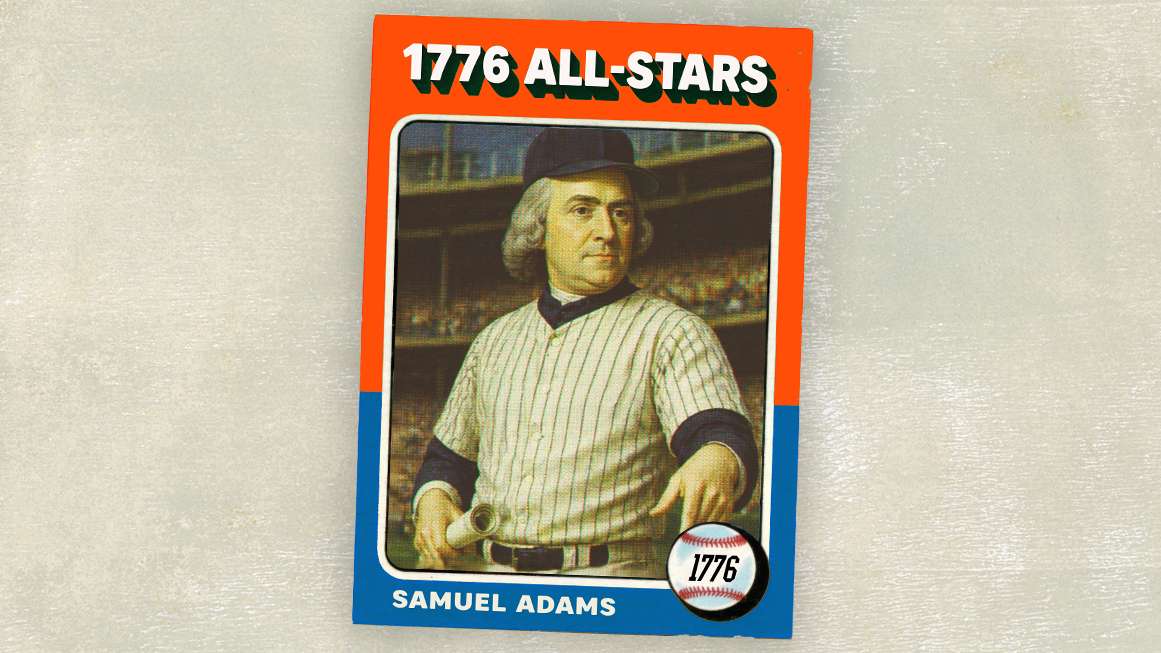
This piece is part of 1776 All-Stars, a series highlighting Reason’s preferred American Founders. Learn more here.

The American Battlefield Trust characterizes Samuel Adams as “a provocateur and propagandist” for American independence. His tireless advocacy and organization for liberty, his relatively brief periods in major political office, and his disdain for hereditary aristocracy render him the most libertarian of the Founding Fathers.
You may encounter a handful of libertarian-leaning legislators roaming the corridors of the Capitol, but libertarians frequently operate outside of elective office, primarily as rabble-rousers and propagandists. Albert Jay Nock captured this reality succinctly in his 1936 essay “Isaiah’s Job.” The libertarian’s standard role is to rekindle the flame of liberty and hand it on to the next generation of solitary liberty lovers so that the world may become a bit freer with each passing era.
Yet Samuel Adams did more than keep liberty alive in a minority’s heart and mind. He fed the flame with so much oxygen that it erupted into the conflagration we know as the American Revolution.
Adams displayed precocity: he entered Harvard at just fourteen. There, he encountered and absorbed the political and moral philosophy of the natural-rights theorist John Locke. Adams’s philosophical formation reinforced his opposition to hereditary aristocracy, as demonstrated by his contempt for Massachusetts’s nepotistic governor, Thomas Hutchinson. Eight years after leaving Harvard, Adams founded The Independent Advertiser, a publication devoted to “defend[ing] the rights and liberties of mankind.”
Adams was far more than a mere agitator. He actively engaged in patriot politics. Before the break with Britain, he served in the Massachusetts General Court, was a delegate to the First and Second Continental Congresses, the Confederation Congress, and the Constitutional Convention. He held the offices of lieutenant governor and later governor of Massachusetts. He also spent time as a Boston tax collector. While that last role might not scream “most libertarian founder,” his conduct while in office did: the National Constitution Center notes that he “often did not collect the taxes, especially when his fellow townsmen could not meet their bill.”
James Otis Jr., the Massachusetts lawyer credited with coining the slogan “no taxation without representation,” acted as Adams’s political mentor. When the Stamp Act was imposed without colonial consent in 1765, Adams led protests that culminated in the Stamp Act Riots. After London responded with the Townshend Acts and stationed 2,000 British regulars in Boston, Adams penned an argument defending the right to bear arms and the right of rebellion. Citing the jurist William Blackstone, Adams asserted “the right of having and using arms for self-preservation and defence…to protect and maintain inviolate the three great and primary rights of personal security, personal liberty and private property.”
A year later, a customs officer shot and killed 11-year-old Christopher Seider. Adams answered by leading a massive funeral procession in tribute to the young patriot, galvanizing opposition to the British presence. The Boston Massacre would occur less than two weeks later.
Adams referenced “Mr. Locke” by name in his 1772 essay “The Rights of the Colonists,” but he hardly needed to: Adams’s essay stood as a quintessential example of minarchism. Anticipating the Declaration of Independence, Adams identified the rights to life, liberty, and property, and the means to defend them, as natural and inalienable. “The grand end of civil government,” he wrote, “is for the support, protection, and defence of those very rights.” He added that men may not renounce these rights, for they are “the gift of God Almighty” and “it is not in the power of man to alienate this gift and voluntarily become a slave.”
On a related note: unlike George Washington and Thomas Jefferson, Adams never owned enslaved people. When confronted with an enslaved girl in 1765, he freed her immediately.
In response to the Tea Act of 1773, which granted the British East India Company a monopoly on colonial tea, Adams mobilized the Boston Committee of Correspondence to coordinate resistance to taxation and trade restrictions. This coordinated effort culminated in the Boston Tea Party, where roughly 60–90 members of the Sons of Liberty—allegedly acting on Adams’s signal—hurled 42 tons of British tea into Boston Harbor.
Adams was a prolific polemicist and a deft organizer. Without his persuasive prose and relentless rabble-rousing, the American Revolution might never have occurred.
1776 All-Stars, a feature on Reason’s preferred American Founders:
- Benjamin Franklin
- Samuel Adams
- Thomas Jefferson
- George Mason
- A Farmer
- George Washington
- Patrick Henry
