
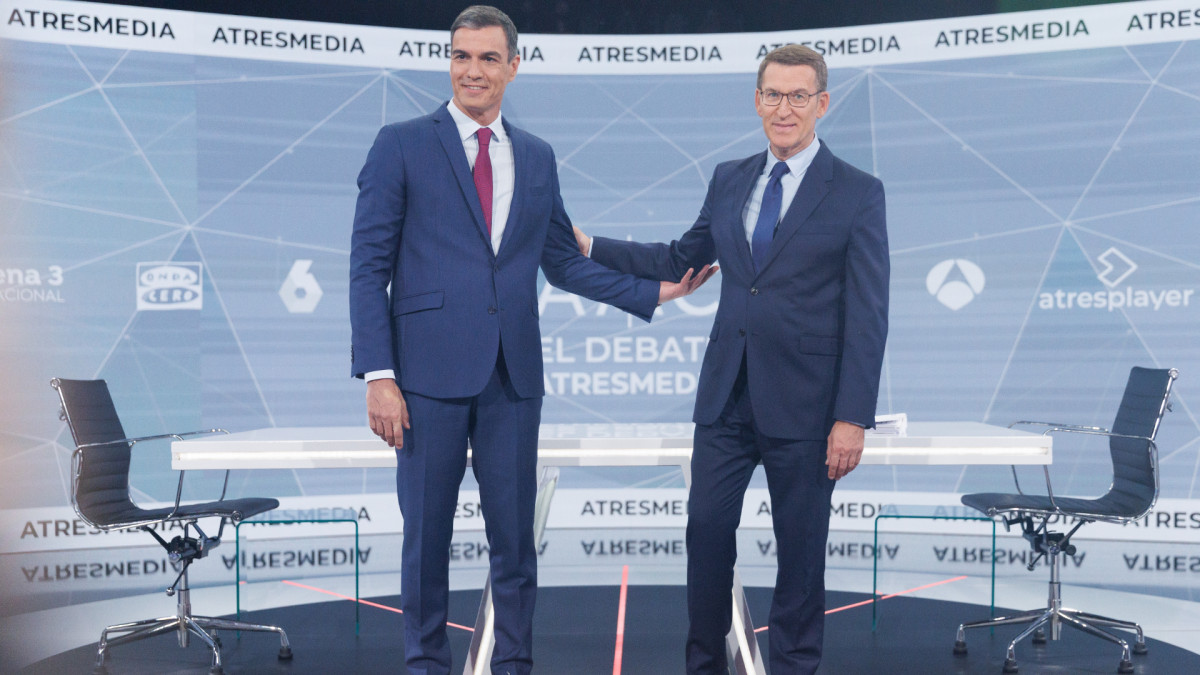
ttttThe first face-to-face between Zapatero and Rajoy, on February 25, 2008, drew about 13 million viewers, and the Sánchez–Feijóo duel of July 10, 2023 remained at 5.9 million. In those fifteen years the internet-enabled phone entered our lives, and with it the idea that the citizen’s perception of reality has split into what is perceived on the screen and what is experienced firsthand. The philosopher Luciano Floridi proposed for that condition the word onlife, the notion of a life in which it no longer makes sense to ask whether one is connected or disconnected. Spanish politics has been observing that within that single life two worlds coexist that often do not coincide.
On Thursday the 19th, at ten o’clock at night and ten days before the polls, Pedro Sánchez and Alberto Núñez Feijóo will debate in a format organized by the Academy of Television, moderated by journalist María Casado and arranged in five blocks, the first of them focusing on housing. The most plausible scenario is that this debate will be decided off the set, in the thirty-second cuts that will arrive during the nine days following to the phone of whoever has not watched it. Who looked better on camera will be decided that same night by quick polls, while here what matters is who can reach the debate and by what route.
From the cultural battle to cognitive warfare
We spend 34 hours and 17 minutes online each week, according to the Digital 2026 report, which has shifted the old cultural battle to what Iván Redondo, head of Sánchez’s cabinet between 2018 and 2021, has called in La Vanguardia a cognitive war. It is fought over attention and over each person’s perception on their own device, and the time that attention lasts before the same screen has shortened wherever it has been measured. The researcher Gloria Mark, from the University of California, Irvine, recorded in 2004 an average of about two and a half minutes and in her more recent work places it at 47 seconds, a margin in which lengthy arguments and in-depth debates fit poorly.
“Who looked better on camera will be decided that same night by quick polls, while here what matters is who can reach the debate and by which route”
The individualistic Spanish society associates itself poorly. In January 2024, according to the CIS, 22.3% belonged to some association and eight out of ten young people aged 18 to 24 had never belonged to any. What has weakened is the other mediation, the big editorial pages and TV networks of the 1990s and 2000s, which gathered broad segments of public opinion under a single editorial line, sometimes with opposing ideas. Instead a hybrid system has remained in which our beliefs are formed halfway between the physical environment and a digital world that the algorithm tailors to each person. That favors a tunnel vision of what surrounds us and allows the voter to come to think that what they see on their screen is what everyone sees.
The voter and his algorithm
We move in echo chambers, in concentric circles that reinforce a confirmation bias for which no one prepared us and that feeds on each like and every reshared piece of content that passes through the filter of our mind without verification, because it comes to confirm that the external world is like the inner world. That dynamic is attributed to the formation of hard-core voting niches around major issues, immigration or rights, very difficult to move, and the terrain is unequally distributed. According to the CIS pre-electoral, social networks are cited as the first or second way to inform oneself about politics by 64.1% of those who voted for Vox in 2023 and 50% of those who voted for Sumar, compared with 39.7% of PSOE voters and 35.3% of PP voters, two electorates in which networks weigh much less.
“We move in echo chambers, in concentric circles that reinforce a confirmation bias for which no one prepared us”
The distance between the two worlds has a measurable hint. In the CIS September barometer, the first after the Ceuta crisis, immigration was the third problem in Spain, cited by 19.7%, and the fifth among those personally affecting the respondent, at 12.6%. A plausible explanation is that the consensus about what the country’s problems are forms in part when each person compares their screen with similar ones, at a distance from what they actually live. In October housing already headed both lists, indicated as the country’s problem by 55.7% and as a personal problem by 33.8%.
One hundred twenty pieces of thirty seconds
In a digital democracy, Thursday’s debate is both an opportunity and a risk for the voter who does not leave their cave to explore. Each hour of airtime equals one hundred twenty pieces of thirty seconds, which is the unit in which the debate will then circulate to attack the opposing vote or to reinforce one’s own, and the week has already given a preview. Of the interviews the two candidates gave to the YouTuber Jordi Wild, published Friday the 13th, the cuts most picked up by the press are in negative terms. One is Feijóo’s admission that a president should know English and that is not the case for him, and the other is the moment when the interviewer reminded Sánchez of a June 2014 post in which he praised Koldo García.
“Each hour of airtime equals one hundred twenty pieces of thirty seconds, which is the unit in which the debate will circulate afterward to attack the opposing vote or reinforce the own”
For parties with less digital muscle than Vox, which by late October hovered around 1.1 million followers on both TikTok and Instagram, between three and six times those of PP and PSOE, the importance of the debate lies in the positive cut and in the negative cut. The PSOE also tests a path that does not depend on the algorithm.
The WhatsApp channel “La fuerza de la gente”, which Ferraz attributes to militants, surpasses 60,000 followers, and through it Sánchez urged from the start of the campaign presence “in every WhatsApp group.” In a country where that app reaches 89%, according to the same report, the channel opens the possibility of a twenty’s-era “pass it on” heredity of SMS chains from March 2004 and of those that circulated via WhatsApp, against the PSOE itself, in November 2023. It is the logic that Elihu Katz and Paul Lazarsfeld formalized in the fifties as two-step communication, the one where the message convinces when forwarded by a trusted sender, although the number of subscribers does not indicate how many people outside the party end up receiving it. It would be interesting for the governing party to use the debate to tension the real world with the imagined reality of those who still plan to vote for them.
The measure that still cannot be touched
The Government’s measures are not getting through. The loans of up to €50,000 interest-free for the entry into the first home, the answer to the country’s top problem, have been in the BOE since October 7, in Royal Decree-law 29/2026, which covers up to 20% of the home’s value with that maximum. The Permanent Deputation validated it on November 12 by 35 votes to 34, but its Article 19 leaves to a later agreement of the Council of Ministers who can benefit and with what limits, and by mid-November the loan was still not able to be applied.
The measure responds to the problem that heads both the country’s and the personal list and for now exists only in the perceived world, the world of the announcement, without having penetrated as something possible and close to someone who would need to see it as a vote detonator. The amount does not resolve what those who think of using it need to know, which is whether they can access it, when, and where it is applied.
“The amount does not resolve what those who intend to use it need to know, which is whether they can access it, when and where it is applied”
The Socialist campaign of the smile and the sticker, the banner “Leftists and Proud,” makes sense to restore morale of victory to their own, but the debate should serve something else. Sánchez is required to present the legislature he is asking for as the culmination of a project with tangible measures. Feijóo is required to specify “the necessary change” to his slogan and gives him an early advantage, because he opens the debate by draw and the first cut of the night on the country’s first problem could be his. In his electorate, however, networks weigh less and the terrain where the cuts will circulate is dominated by a right-wing competitor, so the video that wears down Sánchez on those networks could be capitalized first by Abascal’s party than by his own.
What a debate moves
Post-electoral CIS studies help bound expectations. In 2011, among those who watched the Rajoy–Rubalcaba debate or had references to it, 68.9% said it did not influence them at all, 12.5% said it reinforced the decision they already had, and only 1.3% said it encouraged them to vote for another party. 8.7% were encouraged to vote, and 2.8% to abstain. In 2008, 7.3% were encouraged to vote, according to a study deposited at the University of Murcia, so in both occasions around 8% is the proportion attributing to the debate the impulse to go vote. This is a meaningful percentage in elections like 2023, in which 26% decided their vote in the last week or later and 27.8% of those who voted had considered staying home during the campaign.
The most serious objection comes from research on echo chambers. The experiment by Brendan Nyhan and colleagues published in Nature in 2023 found that the content from like-minded sources is predominant in what is seen on Facebook. It reduced this by about a third among 23,377 users in the 2020 United States campaign and did not find appreciable changes in polarization or in beliefs.
The finding belies the idea that the algorithm by itself fabricates the hard vote and warns that a cut that enters the adversary’s circuit is unlikely to convert anyone. What a cut can do is more modest and aligns with postelection studies: give a concrete reason to go vote to the soft voter, whose decision pace, as written in these pages, can weigh almost as much as the sense of their vote.
A debate prepared by cuts
A one-on-one that will circulate in fragments is not prepared like the previous ones and requires arriving with one piece per block, with a single idea and a single figure, built to be understood outside the studio and with subtitles, which applies to both candidates. For the Government party, which has a measure with no window and an allied distribution channel, the format obliges them to explain the real state of the loan and the missing steps, with an access date they can meet. A link that allows checking whether the measure helps someone is forwarded to the most convinced family group more than it is to a promise.
“A face-to-face that will circulate in fragments is not prepared as the previous ones and forces you to arrive with one piece per block, with a single idea and a single figure”
There remains the gambit, the sacrifice of a pawn in exchange for position. It would not hurt to drop in the debate some phrase designed so that it is the opponent’s networks that reproduce it, a concession the adversary will want to share as a mistake and that carries inside, inseparable, the data that matters to reach the swing voter who would never open a party channel.
The most immediate example is with the Government, because admitting that the housing response arrived late and linking in the same sentence the figure and the date of the loan would open a spigot in a terrain—the cognitive warfare arena—where Vox’s ecosystem currently holds the edge in terms of audience. The risk is that the opponent keeps the admission and trims the response, so the concession must stand on its own, and the limit is the truth of what it contains, since a false figure can be dismantled by the opponent in an hour.
The result will not be measured on Friday as with previous debates, by the audience and by the poll of who won. We will have to look at how many cuts from each candidate circulate outside their own community and for how many days, and in the case of the Government the most demanding test will be that someone receives a cut, checks the measure and can use it. The debate will end on Thursday night and its second life will begin on Friday the 20th on phones, with nine days ahead until the polls.
