
The process of digitalization in Portuguese- and Spanish-speaking societies has been significant. Despite uneven development in internet deployment that has generated power asymmetries, the penetration rate of social networks across the Iberian-American space has been notable, making the Iberian-American region one of the world’s leading communities for daily internet and social media use.
In the informational layer, disinformation is, according to the Department of Homeland Security, a “action or strategy that consists of the intentional diffusion of false or misleading information, decontextualized or partial, with the aim of confusing, persuading and manipulating people”. With the digitization of societies, the quantity and diversity of actors have multiplied, which has caused a modification in political relations. Actors organized on the internet can project their interests through networks, competing or allying with other agents, both locally and internationally.
“Disinformation is «a action or strategy consisting of the intentional diffusion of false or misleading information, decontextualized or partial, with the aim of confusing, persuading and manipulating people»”
This second article of the series analyzes that informational layer, that is to say, who competes for the Spanish-speaking space, with what strategies and with what reach. It also incorporates Kartex’s analysis of the internal documents leaked from “the Company”, which allow an inside view for the first time of a Russian influence operation in Latin America.
The Spanish Information Space, in Dispute
The Spanish information space is the object of a contest among different international interests. The informational influence in a linguistic space carries significant weight in shaping geopolitical representations. This diffusion forms the first layer where formal communications of States, institutions, media, NGOs, journalists and influencers converge. These constitute the main content-production agents, whose activity directly affects the generation of opinions and broad-scale representations about global events, potentially even contributing to destabilization campaigns. In the Spanish-speaking sphere, a transformation of the landscape is observed, with a growing interest from various States in influencing the informational space through diverse influence strategies.
We have produced a graphic (Figure 1) showing the impact of some of the main news outlets with a particular focus on the Spanish-speaking domain and with substantial activity on X. This comparison makes clear that the interests of different agencies and channels, as well as their levels of impact, vary and reflect trends and behaviors that differ. Six agencies or media outlets from different States with regional interests that use the Spanish language and stand out for their high influence were selected: EFE Noticias (Spanish public agency), Actualidad RT (Spanish section of Russia Today), CNN en Español (American private channel), HispanTV-Nexo Latino (Iranian public television in Spanish), DW en Español (Spanish service of the German public broadcaster Deutsche Welle) and CGTN en Español (Chinese public television in Spanish). The graphic shows the daily impact volume of each account — measured by tweets, retweets, mentions and replies on X — between January 1, 2024 and November 3, 2026, on the eve of the Madrid Summit, and notes the events that explain their main spikes. It is not intended to be an exhaustive representation of the impact of all foreign media competing in the Spanish-speaking arena, but to make visible the multiplicity of interests that converge in it, where Russian actors in particular, but also American, Iranian, Chinese, German, Qatari and, to a lesser extent, Turkish actors, maintain a significant struggle for informational influence.
Figure 1. Daily impact on X of six international media in Spanish, from January 2024 to November 2026. Compiled by Kartex.
It is worth highlighting the substantial informational impact of Actualidad RT, which leads the period by a wide margin, with 12.2 million impacts, almost triple that of DW en Español (4.5 million) and EFE Noticias (4.4 million), and which led the daily volume on 97% of the days in 2024 and 95% of the days in 2025. This impact is even more noteworthy considering that since March 2022 sanctions have been imposed on the diffusion of this account in the European Union, so its official consumption does not exist in Spain. It is followed by CNN en Español, with 3.4 million impacts, and HispanTV (Nexo Latino), with 2.9 million, and, far behind, CGTN en Español, with 355,000.
“It is noteworthy to highlight the substantial informational impact of Actualidad RT, which leads the period by a wide margin, with 12.2 million impacts, almost triple DW en Español (4.5 million) and EFE Noticias (4.4 million)”
The long run reveals, however, a shift in trend. The RT volume collapses from spring 2026, from an average of 27,000 daily impacts in March to about 4,200 in October, and in that month EFE (5,600) and DW (4,900) exceed it for the first time on a monthly average. Since October, RT only leads on six of the 34 days recorded, with the data not allowing attribution of the decline to a specific cause. CNN en Español also loses impact steadily, from an average of 4,600 daily impacts in 2024 to about 2,000 in 2026, while HispanTV experiences its peak during the Iran conflict, with an average of 17,600 daily impacts in March 2026, ahead of EFE and DW.
Other pan-regional Latin American media outlets, such as teleSUR —funded by ALBA member countries—, NTN24 (of Colombian origin) or Canal 26 Internacional (Argentine origin), are left out of this selection because they do not achieve the same level of success. In an earlier Kartex measurement, between August 2024 and August 2025, teleSUR gathered 1.34 million mentions, less than a third of RT in the same period.
Regarding the general behavior of the impact of the different agencies, several interesting patterns emerge. EFE Noticias is very followed during major Spain-moving events, such as Valencia’s DANA (October 2024), the April 2025 blackout, or the government’s request to exclude Israel from Eurovision, and reaches its peak, with around 23,000 impacts, on the day of the US and Israel attack on Iran, February 28, 2026. The other agencies show behavior tied to major international and especially Latin American events. CNN en Español records its highest peak with the Venezuelan elections of July 2024 (35,000 impacts on the 29th), and RT, the highest single-account peak in the entire series, with the capture of Nicolás Maduro by the United States (65,600 impacts on January 3, 2026). HispanTV, for its part, spikes with each escalation between Israel, the United States and Iran (April and October 2024, June 2025 and March 2026), in line with its role as a spokesman for the Iranian position in Spanish. Venezuela and the Iran war thus concentrate the days of greatest joint impact of the period, underscoring the capacity of both conflicts to generate tensions in the informational space of Spanish and how these are exploited by foreign agencies.
Russia and China, Two Styles of Influence
The narrative features of Russian informational incidence, through Actualidad RT (among other outlets), are not the same as those of China and have marked traits. Russian agencies show a more direct and unabashed willingness to influence the informational realm, applying multiple narrative strategies and deploying media tied directly or indirectly to the Kremlin (such as RT or Sputnik) with strong social media impact. Narratively, Russian actors have deployed in recent years an anti-colonial and anti-imperialist discourse as a tool to influence opposition sectors, such as Catalan and Basque independence movements, left and radical left in Latin America, or conspiracy groups. That repertoire, however, is not aimed only at the left. Russian media adapt their frames to the rise of the radical right, which is already a potential consumer of Kremlin narratives, with sovereigntist messages, anti-elite and anti-Brussels sentiment, and rejection of aid to Ukraine. These narratives seek to discredit Spain and Western powers, exalt their adversaries and foster social polarization, often amplified by bots, trolls and media aligned with Russian foreign policy.
“The Russian media adapt their frames to the rise of the radical right, which is already a potential consumer of the Kremlin narratives”
A recent example is provided by a column in RIA Novosti that Sputnik reproduced on October 30, 2026 in its Russian edition for Kazakhstan with the title “Spanish Tragedy. Europeans Begin Paying for Ukraine with Their Lives.” The text links the rail collision near Toledo two days earlier, which killed more than sixty people, to the liberalization of railways attributed to Brussels and to funds sent to Kyiv (“these victims died, if not for Ukraine, certainly because of Ukraine”). It also attacks the Government and a supposed “Basque oligarchy,” and presents Vox as the party that “does not want Spaniards to die for Ukraine,” with a favorable assessment of its willingness to negotiate with Moscow. The piece does not prove any connection to that party, but shows how, in the midst of the pre-campaign for the general elections of November 29, the Russian narrative addresses an audience that is no longer only left-leaning.
In the Catalan case, these strategies found fertile ground after the 2017 political conflict, when radical independence framed Spain as a colonial state. Expressions such as “Spanish colonists” spread in the discourse, even reinterpreting internal migrations as forms of colonization. Reports and programs from Russian media reinforced this narrative, portraying the Spanish Government as a hypocritical actor in its defense of democracy. The core of these narratives rests on the manipulation of the concept of self-determination of peoples, presented as an absolute right without considering international legal frameworks. This approach undermines the rule of law, weakens institutional cohesion, and fuels populist dynamics that idealize the “people” against institutions. In Catalonia, this contributed to political destabilization and growing social polarization.
On June 16, 2025, the Russian state broadcaster RT en Español began broadcasting on open television in Chile via Telecanal, replacing their usual programming and opening the debate about informational pluralism, disinformation, and regulatory gaps. Local coverage documented that the operation was organized as almost continuous retransmission of content produced in Moscow and could be framed as a broader regional strategy to legitimate RT in the Southern Cone despite its ban in the European Union and sanctions in the United States. In response to complaints and parliamentary inquiries, the National Television Council (CNTV) opened an investigation to determine the legality of the broadcast and possible blocking measures, while questions persisted about contractual opacity and financing of the initiative. The case, followed by journalist Marc Marginedas in El Periódico from the start of the broadcasts, illustrates the outsourcing of media capabilities by a state actor from outside the region and its insertion in national ecosystems with regulatory weaknesses, a pattern consistent with hybrid influence logics in the Spanish-speaking space.
The outcome confirms both the risk and the regulatory body’s capacity to respond. The CNTV sanctioned Telecanal for ceding almost all of its programming to a third party under a leasing contract with a Mexican advertising company, which cost seven days without broadcasting, from April 18 to 24, 2026; the concessionaire subsequently announced the end of RT retransmission and, in May, the Council declared the expiry of its digital concessions for non-compliance with coverage. The door closed in Chile opens in other places. After the agreement signed in June 2025 to bring RT en Español to open TV in Nicaragua, Daniel Ortega’s regime granted an open frequency to the Russian channel in September 2026.
By contrast, Chinese informational strategies tend to limit criticism of their adversaries and adhere to deploying discourses that praise China as a legitimate partner. It is crucial to understand that China is a centralized organized state, so its informational strategies originate within the Communist Party’s Propaganda Department, where the narrative is controlled. Other strategies, such as signing deals with media outlets, paying stays for journalists to train in China on a technological and digital level, or deploying influencers in Spanish, form part of the softer Chinese influence arsenal. Nevertheless, more aggressive strategies have also been discovered, with the use of bots to counter U.S. discourse.
Internal, External, and Transnational Dynamics
In cyberspace, the distinction between “internal” and “external” campaigns is useful for analysis only if a third dimension is added, the transnationality of phenomena. Spanish (and to a lesser extent Portuguese) functions as a continuous informational territory that crosses state borders and connects publics, media and militant communities. This linguistic geography allows agenda- and frame-making strategies—born in national conflicts—to spill over into other countries in the same space, while state interference operations can be “localized” with relative ease in preexisting cultural and political codes. From a geopolitical perspective, this interweaving produces feedback effects, so that the internal enables the external and vice versa, with coupling nodes on platforms, newsrooms, diasporas and militant networks.
“The Spanish (and, to a lesser extent, the Portuguese) functions as a continuous informational territory that crosses state borders and connects publics, media and militant communities”
Disinformation is not limited to deliberate spreads of falsehoods; it also implies the capacity to articulate an effective strategy in cyberspace, particularly in its informational layer, through the use of narrative and organizational tools aimed at obtaining — or preserving — positions of power, which can generate significant informational asymmetries in cyberspace. This strategy may include bot automation, the use of trolls or proxies, the use of fake sites, the systematic organization of networks (dense network, echo chamber), as well as the use of media outlets with biased or manipulative narratives aimed at undermining political equilibria, giving these strategies a strong disruptive character. Consequently, these processes can lead to dynamics of radicalization, polarization and even violence, as well as be accompanied by parallel hybrid strategies.
As for actors, they can have different natures, though campaigns developed by political parties in power as well as in opposition stand out. Among States, Mexico constitutes a paradigmatic case of political and governmental instrumentalization of the digital conversation. Since the 2018 general elections, the use of “farms” and coordinated accounts to smear the political opponent became normalized. The Mexican pre-campaign witnessed the Institutional Revolutionary Party (PRI) employing strategies such as creating websites and anonymous pages dedicated to discrediting the candidate Andrés Manuel López Obrador (AMLO), who, despite the anti-campaign against him, would become president on December 1, 2018. However, accusations were also directed at AMLO’s circle.
The Mexican case, where, as Marc Marginedas has told, Russian propaganda gains space and extends its presence across the country, offers a layered regional doctrine snapshot. In addition to the television distribution of RT en Español —with a presence in millions of homes and multiple states— a 2023 public advertising campaign with QR codes was added that connected directly to the live broadcast, without clear contractual traceability, which generated local political controversy. All of this seems to have coexisted with reinforcements in Russian public diplomacy in Mexico City and with symbolic cooptation initiatives (awards, forums, affinity networks). This set makes Mexico a geopolitical hinge to radiate messages toward Latin America and Spanish-speaking audiences in the United States, and returns to the European discussion the question of the effectiveness of vetoes and labels when distribution operates outside the European Union’s regulatory perimeter.
“This set makes Mexico a geopolitical hinge to radiate messages toward Latin America and Hispanic audiences in the United States”
In Brazil, encrypted messaging (WhatsApp) consolidated in 2018 as a vector of low traceability for mass diffusion and political microtargeting, though the Superior Electoral Court found no sufficient evidence to sanction specific cases. The episode set a structural vulnerability of Brazil’s informational sphere that has been extensively documented. In Spain, there was also deliberate use of 2,882 suspicious accounts originating in Venezuela that amplified Islamistophobic labels, links and content in favor of Vox between 2017 and 2019, illustrating how campaigns with domestic political objectives in Spain rely on transnational information-service infrastructures.
The transnational dynamic is also visible when militant communities and diasporas reconfigure ties between countries. The Bolivarian networks aligned with chavismo and castrismo have consolidated as influential actors on various platforms—with high self-organization, coordination and creation of large echo chambers—acting as amplifiers in European controversies (for example, during the climax of the Catalan procés) and supporting independence while challenging the legitimacy of the Spanish State (2017–2020). At the same time, the Cuban diaspora in Florida activated in 2021 a transnational public sphere (#SOSCuba) that combined denunciation, counter-narratives and also spread of disinformation, triggering governmental responses on the island and temporary interruptions of network access. These episodes illustrate the capacity of platforms to amplify protest and, at the same time, accelerate the appearance of disinformation and access restrictions.
A Modular and Distributed Model of Interference
In the layer of interference and hybrid strategies, Russia has perfected a modular and distributed model that combines parastatal media (RT/Sputnik), “white labels” and domain cloning (the Doppelgänger ecosystem), with industrialized production of “attack lines” and multi-format components. Spanish appears as a stable target language in European reports and in the EU Disinformation Lab repositories, where the logic of saturation rather than piecemeal persuasion is emphasized. In the Russian informational sphere, one observes the articulation between a Russian institutional axis (embassies, Ministry of Foreign Affairs, TASS, RT, Sputnik) and a constellation of Spanish-language channels, mostly radical left but increasingly also radical right, that translate and legitimize Kremlin narratives, acting as bridges to Iberian and Latin American audiences. That network makes visible the linguistic territorialization of operations and their coupling to existing ideological communities.
“That network makes visible the territorialization by language of the operations and their coupling to existing ideological communities”
Spain and other Spanish-speaking countries today face a cognitive dispute scenario in the Spanish space, with clear consequences for national sovereignties due to Russia’s growing ability to execute digital and on-the-ground operations within a hybrid warfare framework. In November 2024, the newspaper El Mundo reported the detention in Lithuania of two Basque citizens —one with Spanish and Russian dual nationality— who, according to Lithuanian authorities, were recruited via Telegram in order to spark a fire at a company producing radio and television broadcasting equipment for the Ukrainian market. In addition, the release of journalist Pablo González in Poland, after espionage accusations, and his subsequent exchange in the largest prisoner swap between Russia and Western powers since the Cold War show another vector of interference.
These actions share a common thread: the capacity of Russia to infiltrate communities, recruit citizens from other countries and establish strategic ties — also in Spain — that directly threaten sovereignty. Recruiting militiamen for the Ukraine war in Colombia or other Spanish-speaking countries, or alleged pro-Russian terrorists detained in Barcelona for allegedly planning attacks in Europe, require a prior process of informational radicalization. Russian informational strategies respond mainly to complex and aggressive operations that articulate their discourses in the linguistic and cultural space where they are embedded, such as in Spanish, and they tend to have fairly clear counter-power objectives with evident impact. According to the Georgia-based research by geographer Kevin Limonier on the Social Design Agency (SDA), Moscow coordinates a modular and distributed model to saturate the informational space — rather than persuading case by case — with Spanish as a stable target language.
The ‘Company’ Leak, from the Sahel to the Andes
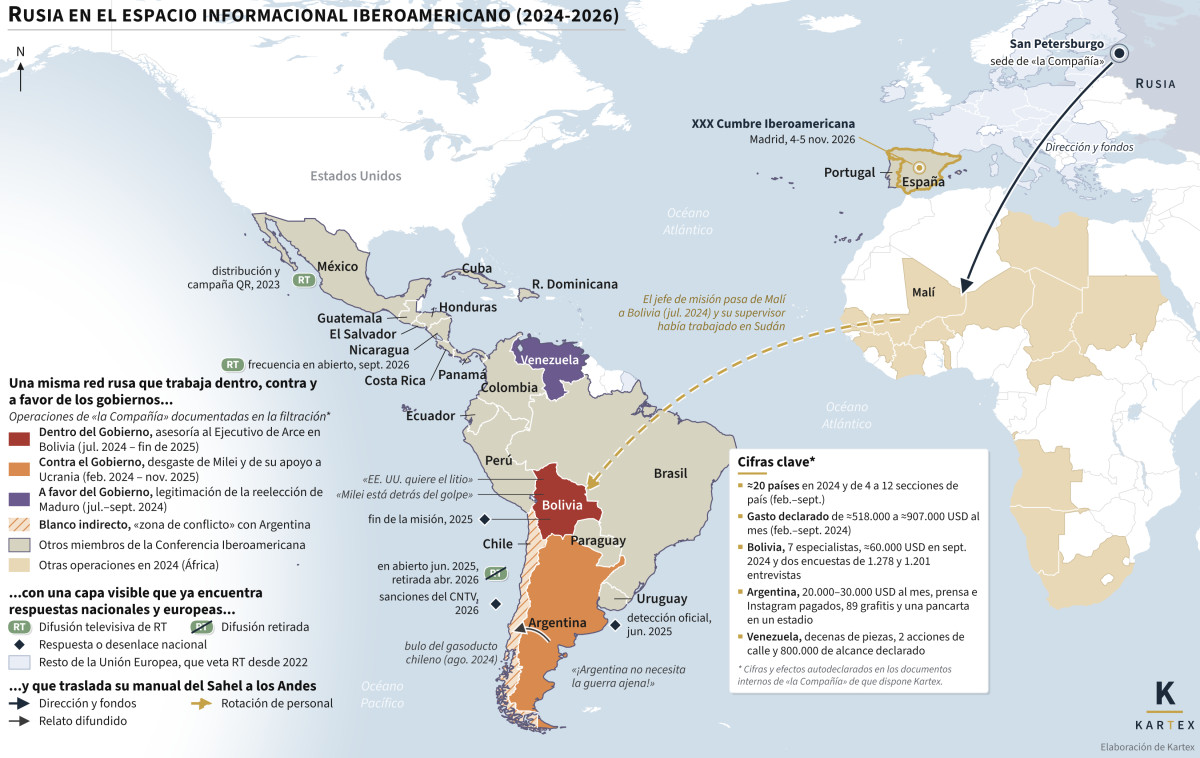
Figure 2. The visible and the covert of Russia in the Iberian-American informational space (2024-2026).
A recent leak allows us to glimpse another piece of that machinery from within. In 2025, an anonymous source shared with Kartex a multitude of documents —1,431 pages in Russian— from “the Company,” also called “Politology,” the network of political consultants that Yevgeny Prigozhin deployed in Africa and which, according to various journalistic investigations, oversees and funds from December 2023 the Russian Foreign Intelligence Service (SVR), although the documents do not name it. The figures that follow come from them and should be read as internal reports intended to justify budget to the sponsor, authentic according to the outlets that have verified them, but self-promotional in how effects are attributed. They describe what the European External Action Service calls information manipulation and foreign interference (FIMI), a pattern of intentional and coordinated conduct by foreign actors, state or non-state, that threatens values, procedures and political processes.
In 2024 the Company reported operations in about twenty countries. Its declared monthly expenditure rose from about $518,000 in February to about $907,000 in September, as its country-by-country sections grew from four to twelve. Bolivia cost about $60,000 in September 2024 and Argentina, between $20,000 and $30,000 per month, according to Kartex’s documents. With less than a million dollars a month, Moscow has an instrument that turns political consulting into a lever of foreign policy. In Bolivia, the Company worked from within the Government. Seven specialists arrived in La Paz on July 16, 2024, three weeks after General Juan José Zúñiga’s attempted coup, with the dual remit of disarming the narrative of the “self-c coup” and preparing Luis Arce’s reelection in 2025. The documents describe telephone surveys of 1,278 and 1,201 interviews, focus groups planned in seven cities, the rewriting of presidential speeches, a rapid-response group in the Ministry of Communications and three campaign lines focused on the coup, a “positive agenda” and discrediting the opposition. Among the narratives planned were that Javier Milei was behind the coup — due to his supposed desire for a “Pan-Latin disintegration” — and that the United States sought Bolivian lithium. In October and November 2024, at the president’s circle’s request, the network designed an offensive against Evo Morales including a campaign under the slogan “Morales is a rapist,” the staging of “false Evo supporters,” and a roadmap to “block the legal possibility” of his candidacy, according to documents analyzed by Kartex.
“With less than a million dollars monthly, Moscow has an instrument that turns political consulting into a lever of foreign policy”
In Argentina, however, the network acted against the Government. Since February 2024, the network sought to erode Milei’s support and curb his alignment with the United States, NATO and Ukraine. Its objectives were to reduce the president’s electoral support ahead of the 2025 legislative elections and to oppose his backing of the Ramstein Group. The Kartex documents record the placement of articles in Argentine media, meme pages on Instagram, 89 anti-war graffiti in central Buenos Aires, a twenty-meter banner with the slogan “Argentina does not need another country’s war!” in a soccer stadium, and more than twenty placards against Milei in five areas of the capital. Just because a media outlet is mentioned in them does not prove it was paid. The October 2024 work plan went further and proposed supporting Peronist lawmakers because if they won, “the question of removal” of the president could be raised.
In Venezuela, finally, the network worked to legitimize Nicolás Maduro. After the July 2024 elections, according to its reports, it published dozens of materials in Latin American media and networks, organized two street actions in support of Nicolás Maduro and criticized the opposition and governments of countries that did not recognize the vote as legitimate; it is attributed an outreach of over 800,000 users with only two pieces and a “decrease in protest activity.” The campaign coincides with 2024’s day of greatest joint impact in Figure 1, the Venezuelan elections, and with the debate in Spain about recognizing Edmundo González. This convergence between the visible and covert layers does not prove coordination, but it does show that both operate on the same fractures. A third target, Chile, is also present. A 2024 work plan proposed creating “a conflict zone in America” by inciting a clash between Argentina and Chile, and the network disseminated in August of that year the hoax of a supposed Argentine sabotage team against a Chilean gas pipeline, according to the same documents.
“That convergence between the visible and covert layers does not prove coordination, but it does show that both operate on the same fractures”
The documents reveal seven types of narratives that appear in every country where the network operates. They seem predesigned and are only adapted to each scenario, so the proper names change but not the message. In the Sahel, after Tuareg rebels and jihadists defeated the Malian Army and Wagner in July 2024, the network spread that Ukraine supported the terrorists. In Argentina, that same message against Kyiv became “Argentina does not need another country’s war!”, the slogan of a banner unfolded in a football stadium against Milei’s support for Ukraine. With resource looting, the same thing happens. In Angola, the network presented the Lobito corridor—the railway that the United States and the European Union are promoting to export Congo’s and Zambia’s copper and cobalt—as a plunder, and in Niger it circulated a false abusive contract between the previous government and the French Orano to exploit uranium. In Bolivia, which possesses some of the world’s largest lithium deposits, the narrative translated into “The United States Wants the Lithium.” And conspiracy abroad also travels. In Chad, the network circulated that Washington was preparing a drone attack against President Mahamat Déby, and in Bolivia, after General Zúñiga’s coup attempt in June 2024, it prepared the narrative “Milei behind the coup.” The personnel also rotates. According to Kartex’s documents, the head of the Bolivian mission came from the Mali mission, and his supervisor had worked in Sudan. The data has a direct reading for this series, because the Company organizes its work by linguistic areas (French in West Africa, Arabic in Sudan and Libya, Portuguese in Angola and Spanish in Latin America), with regional media as amplifiers. Language is, for Moscow, the operational unit of interference.
The leak also shows the limits of the model. The effects the Company attributes to itself — the fall in mentions of the “self-coup,” the demobilization of protests — lack a baseline and respond to budget-justification logic. And its two major Latin American theaters ended badly for it. In Argentina, the documents themselves note in September 2024 that the recreation of the SIDE “seriously limits” its activists; on June 18, 2025, the Government announced the detection of members of “The Company,” and the network had left the country in November of that year. In Bolivia, Arce resigned to seek reelection in May 2025, Rodrigo Paz won the presidency in October and the mission closed at year-end; the former president was arrested in December in the Indigenous Fund case.
Finally, it is useful to add a nuance. Lithium does not appear as a target of the Bolivian mission, only as a narrative against the United States. Moscow’s material interest —the lithium exploitation contracts with Russian and Chinese companies, which the Paz government has re-evaluated— appears in other public sources.
Conclusions
The Spanish informational space is not a blank board on which external powers act, but a dense ecosystem in which foreign state media, parties, proxies, diasporas and militant communities compete and feed off one another. Russia combines in it a visible layer —RT and Sputnik, with impacts on X exceeding those of reference agencies despite European sanctions, though retreating since spring 2026, and a presence on open television in Latin America that closes in Chile and opens in Nicaragua— and a covert layer that the Company’s leak finally documents. It is cheap, modular, language-organized and can work both inside a government and against it.
“It is cheap, modular, organized by languages and can work both inside a government and against it”
Its logic is saturation, not persuasion case by case. It seeks to install frames such as anti-colonialism, foreign conspiracy, the “foreign war” or regional disintegration, which it adapts to both left-wing audiences and a rising radical right, and which then produce and amplify legitimate local actors. The XXX Ibero-American Summit is held on that terrain. The fractures that the Company exploited in Bolivia, Argentina and Venezuela —Milei’s position in the region, Maduro’s recognition, Latin American integration— will be present in Madrid, and they will not require a new operation to be activated.
