
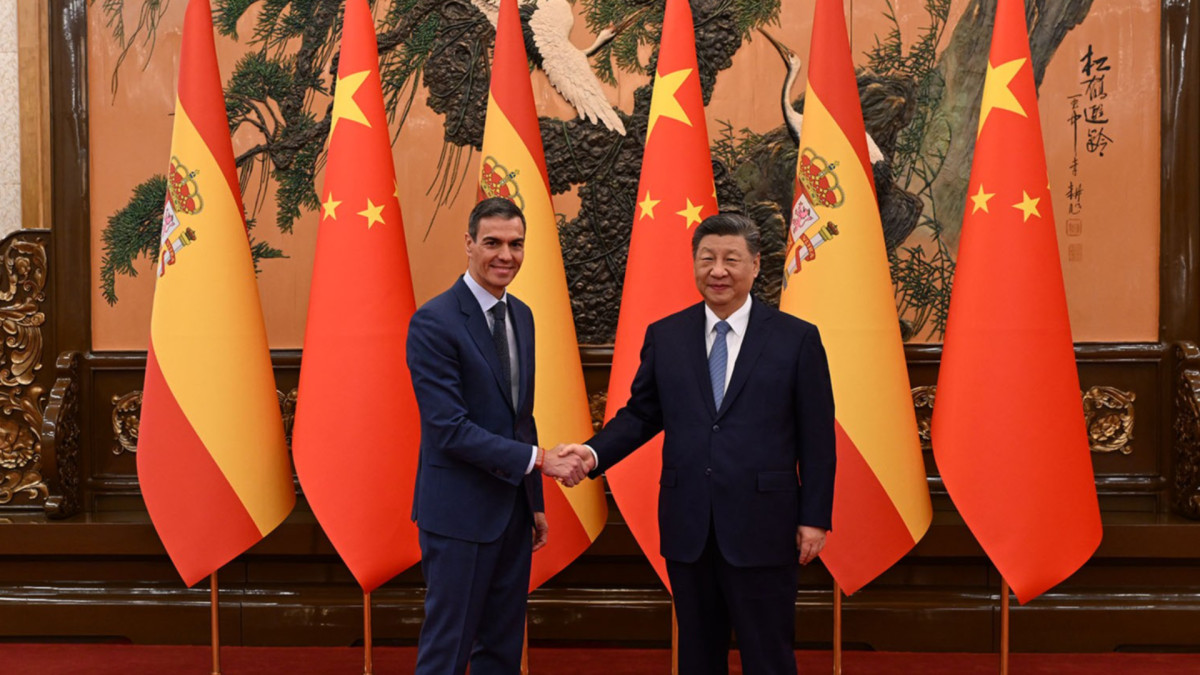
Pedro Sánchez’s statements in China about the need for the West to cede part of its share of representation in international institutions have sparked a debate about who really leads the multilateral system and with what legitimacy. The issue clearly affects the place Spain seeks to occupy in a context defined by the rivalry between the United States and China, the war in Europe, and the growing weight of the so-called Global South.
To understand Spain’s positioning, Agenda Pública has spoken with three analysts who have agreed to share their thoughts on the matter. Ruth Ferrero-Turrión, a professor at the Complutense University, argues that reforming the system is “probably inevitable” and that Spain can project itself as a more receptive interlocutor toward the Global South. Juan Luis Manfredi, a professor at the University of Castilla-La Mancha, warns that the problem is “the timing and the scenario” and that Madrid may gain symbolic prominence but at the cost of losing real influence. In this line, Antonio Tintoré Vicent, a former EU youth delegate to the G20 and international analyst in Washington, D.C., contendst that only a deep reform of international institutions can prevent the total rupture of the current order, though he stresses that Spain will only be able to project real influence if it does so from a stronger, more cohesive Europe.
Pedro Sánchez has argued in China that the West should relinquish part of its representation quotas in international institutions. Is this a realistic assessment? And, especially, is it timely in the current context?
Ruth Ferrero-Turrión (R. F.-T.): From a global governance perspective, the proposal points to a reality hardly contestable and one that has long been a fact, since the order of international relations established after World War II no longer reflects the current balance of power. Actors such as China, India, or Brazil have been demanding a greater weight globally, a demand that has not been heard from the Global North. Without full integration of these countries according to their real weight, the legitimacy of the institutions erodes. In that sense, recognizing the need to reform quotas of representation is not only realistic but probably inevitable if one wants to preserve a functional multilateral system.
The proposal by Pedro Sánchez can be read as an adaptation to that transformation in a context where the United States systematically questions multilateral frameworks, something that forces a rethinking of the global architecture. If the traditional guarantor of the liberal order introduces elements of retreat or selectivity, the system can only be sustained by more effectively integrating emerging powers. Ignoring the weight of actors like China is not only unrealistic, but undermines the ability of multilateralism to tackle global challenges such as climate change, security, or economic governance.
“The incorporation of China and other emerging powers also entails demanding accountability and commitment to shared norms”
However, this reordering is a negotiated reconfiguration, so it should not be interpreted as a concession. The inclusion of China and other emerging powers also implies demanding accountability and commitment to shared norms. The key is to move toward a more inclusive, but also more demanding multilateralism, capable of reflecting the new balance of power without diluting the basic principles of the international system.
Juan Luis Manfredi (J. L. M.): The diagnosis, in structural terms, is correct: the international governance system reflects a postwar power balance and, in some cases, the end of the Cold War. The demographic, economic and political weight of the so‑called Global South does not match its representation in institutions such as the IMF, the World Bank, or the United Nations Security Council. From that viewpoint, it is a finding broadly shared by academics and diplomats.
“Placing in Beijing a concession of quotas by the West can be read less as reformist reflection and more as a politically ambiguous gesture”
The most delicate question, therefore, is the timing and the scenario. In a context of growing strategic rivalry between the United States and China, and with an open war in Europe, proposing in Beijing a concession of quotas by the West can be read less as reformist reflection and more as a politically ambiguous gesture. Global governance reforms require broad consensus and an environment of minimal strategic trust, something that today clearly does not exist between the parties.
Antonio Tintoré Vicent (A. T. V.): At first glance it might seem that Spain’s bet on a comprehensive reform of international institutions, reducing the relative weight of “the West” against the “rest,” goes against our own interests and betrays naivety. However, only such a reform can prevent the total breakdown of the international order.
It is evident that the distribution of global power has changed substantially in the last decades. Emerging powers such as India, Brazil, Turkey, or Indonesia now claim protagonism commensurate with their economic, demographic and political weight. In the current context, ignoring these demands only erodes the legitimacy of our global governance system, making it increasingly irrelevant.
For these actors to be willing to bear costs in defense of the international order it is essential to offer them a greater voice and decision-making capacity. And in this, Europe cannot play defensively.
Does this positioning place Spain in a singular space —especially in Europe— or are there already more voices calling for this rebalancing?
J. L. M.: Spain is not alone in this approach, but it adopts a more explicit tone than most of its European partners. France, Germany, or even the United States have acknowledged in various fora the need to reform international institutions. The process is gradual and conditional.
The president Sánchez vocalizes in Beijing something that many European leaders discuss in private or in strategic documents. That places Spain in a distinctive space within the EU: that of a country that aspires to represent a sensibility more open toward the Global South and less automatically aligned with the traditional Franco-German axis consensus.
Now, that singularity has clear limits. Spain does not lead a European coalition in favor of an immediate redistribution of institutional power, nor does it have enough weight to push that debate onto the Community agenda. More than charting a path, Madrid is testing a distinct discursive positioning, coherent with its Mediterranean and Latin American projection, but still without solid European backing behind it.
A. T. V.: Spain is not alone in defending this rebalancing of the international order. Alexander Stubb, who together with Mark Carney is becoming the leading exponent of the doctrine of middle powers, is a firm advocate of these reform efforts.
“The EU understands that its own trajectory as a political project is intimately linked to the health of global multilateralism”
Beyond the Finnish position, this reformist impulse resonates with increasing force in Brussels. And indeed, aside from Von der Leyen’s slips, the EU understands that its own trajectory as a political project is intimately linked to the health of global multilateralism. By proposing this rebalancing, Spain and its partners seek to defuse the trap of bipolarity, enabling North-South coalitions that can transcend the framework of the rivalry between great powers.
R. F.-T.: She does not place it in a singular space, but puts it in a relatively distinctive place within the European debate. Traditionally, the European Union has swung between defending the liberal multilateral order and a growing awareness of the need to reform it. In that sense, the idea of rebalancing international institutions to give greater room to emerging powers is not new, nor exclusive to Spain.
However, what is more specific is the moment and the emphasis. Some member states, such as France, have long argued for European “strategic autonomy,” which includes rethinking global governance. Germany, for its part, has also acknowledged the importance of integrating actors like China, albeit with greater caution. Even in multilateral forums, there is growing consensus on the need to reform institutions such as the IMF or the United Nations Security Council.
Likewise, the Spanish stance has introduced substantial nuances in the European context, such as in addressing the Gaza crisis, where the EU has shown difficulties in articulating a cohesive position in the face of this conflict, revealing internal tensions and a certain loss of influence in key southern arenas. In this sense, the call for a rebalancing of the international order also connects with how many regions, including the Middle East, perceive a double standard by the West. The Gaza War has intensified these perceptions, weakening the legitimacy of the Western discourse on norms, rights and global governance.
Nevertheless, this is not exclusive to Spain. There are other voices in Europe recognizing the need to adapt the international order and to rebuild bridges with the Global South, especially after Gaza. The difference again lies in emphasis and explicitness. Spain does not inaugurate a debate, but accelerates and projects it at a particularly delicate moment, where the normative fractures of the international system are more visible than ever.
What does Spain gain and what does it risk by projecting itself in this way in Beijing? Is it a path to playing its own role as a bridge between Europe, China and the Global South?
Antonio Tintoré Vicent (A. T. V.): By openly challenging the United States, Spain is certainly gaining support in the Global South, albeit it is also raising suspicions among European partners with a stronger Atlanticist vocation. The impulse is understandable. The problem is one of strategic depth.
If the Spanish government, beyond electoral gains, wants to position itself as a constructive actor in defending multilateralism and as a bridge between very different actors, the starting point must always be Europe. From there, and only from there, does a pragmatic relationship with China make sense: useful insofar as it expands our margin of action, but never at the cost of unity.
“If we keep buying record amounts of Russian gas, it will be hard to demand solidarity from Poland in the face of Trump’s threats”
And it is in that field that tensions arise. No matter how brave Spain may be in opposing this war, it will be hard to lead in Europe if we do not contribute more constructively to the debate and to the practice of military buildup. If we continue buying record amounts of Russian gas, we will hardly be able to demand solidarity from Poland against Trump’s threats. And if, in order to attract Chinese investment, we weaken the Commission’s efforts to carry out the de-risking, our stance toward China will hardly find resonance among our partners.
R. F.-T.: Spain projects, with this kind of positioning, an image of a player that wants to go beyond a strictly follower role within the EU and who aspires to have its own voice in redefining the international order. In terms of gains, this allows it to reinforce its profile as a valid interlocutor with the Global South and as a partner capable of dialoguing with China without renouncing, at least in principle, its European and Atlantic anchor. Moreover, it can help position Spain in spaces of mediation or facilitation in an increasingly fragmented international context.
If we focus on the idea of “bridge,” Spain does have some differentiating assets that are not minor, especially in its relationship with Latin America. There is a historic, cultural, linguistic, and also economic density there that no other European country possesses to the same extent. This allows it to act as a translator, in political and economic terms, of Latin American demands and sensitivities within the European Union, and vice versa. In a context where the Global South is gaining weight, this relational capital is strategic. Likewise, in the Mediterranean, Spain also has a unique position due to geographic proximity and very specific interdependencies, especially on migration, energy, and security. This gives it the capacity to influence the European agenda toward the South, though here it competes with other actors such as France or Italy.
In Asia, by contrast, its role is more limited, but precisely for that reason it can project itself as an interlocutor less constrained by historical or strategic rivalries. This opens some room for dialogue, including with China.
That said, turning these assets into a true bridge role requires consistency, continuity, and, above all, a sustained strategy. It is not just a matter of rhetoric, but of long-term political and diplomatic investment.
J. L. M.: Spain gains visibility and narrative coherence. This discourse reinforces the image of a country that defends multilateralism, the reform of the international order, and a less hierarchical relationship between the North and the South. In diplomatic terms, that facilitates dialogue with China and with many Global South countries that perceive Europe as a normative actor, but not very willing to share real power.
However, I see other risks. The first is overestimating mediation capacity. Being a bridge depends on will, but also on recognition by others. Neither China nor the United States has shown special interest in European intermediaries in their strategic rivalry. The second risk is creating suspicion within the EU and NATO, especially if this discourse is not anticipated with key partners.
“Spain can gain symbolic space, but runs the risk of losing real influence”
Furthermore, projecting Beijing with this message may dilute the European common position at a moment when unity is a strategic asset. Spain can gain symbolic space, but it runs the risk of losing real influence if that positioning does not translate into concrete and shared proposals. In short, it is a bet on its own profile, rather than on structural power.
From the perspective of the United States and the strategic rivalry with China, what implications does it have that a European head of government raises in Beijing a redistribution of global institutional power?
J. L. M.: The Trump administration is not interested in the liberal international order, its institutions, or allocations. It has moved to another diplomatic phase. There will be no substantial redistribution, but rather a dismantling.
However, in full strategic competition, the U.S. expects from its European allies a net contribution. In Marco Rubio’s words, it wants partners, not allies. Sánchez’s visit will not break alliances, but it adds more friction. It reinforces the perception that Europe, and Spain in particular, seeks strategic autonomy also on the narrative plane.
R. F.-T.: From the U.S. perspective, this kind of positioning is read clearly as a matter of strategic rivalry with China, but also within the framework of an extremely volatile international context, marked not only by Gaza but, particularly, by the confrontation with Iran. Both scenarios have intensified the perception of fragmentation of the international order and have tested the coherence and credibility of the Western bloc.
In that context, a European head of government proposing in Beijing a redistribution of global institutional power introduces a complex signal. Not so much because Washington denies the need to reform international institutions, an idea that also exists in certain American circles, but because of the geopolitical moment and the place from which it is formulated. Doing so from China can be interpreted as a gesture that reinforces its narrative of revising the international order, precisely when the United States seeks to contain its influence.
Moreover, the Gaza crisis and the escalation with Iran have amplified the Global South’s criticisms of what is perceived as a selective application of norms by the West and, therefore, of its growing loss of credibility. In that sense, messages like Spain’s can be read as attempts to reposition in light of those criticisms, but also as signs of a lack of strategic cohesion.
A. T. V.: Sánchez’s call to reform international institutions does not pose, for a United States administration that frankly ignores them, a very big problem. But for him to do it from the Great Hall of the People in Beijing, weeks after delivering a clear “no to war” to Trump, is not something that will go unnoticed.
The attention and the anger of Trump come and go. But what should worry Madrid is whether that animosity ends up infiltrating the U.S. bureaucracy and its famous interagency. Beyond the trade relationship, which Trump has already threatened to undo, it is worth asking what consequences this distancing could have in other areas, for example, in the delicate balance with Morocco, in the significant investment presence of Spanish companies in the United States, or in terms of energy dependencies.
Thus, for Spain to project itself with independence and real influence, without fearing costs, it needs a cushion: a more strengthened Europe with greater global weight. Alone, it is all vulnerabilities.
