
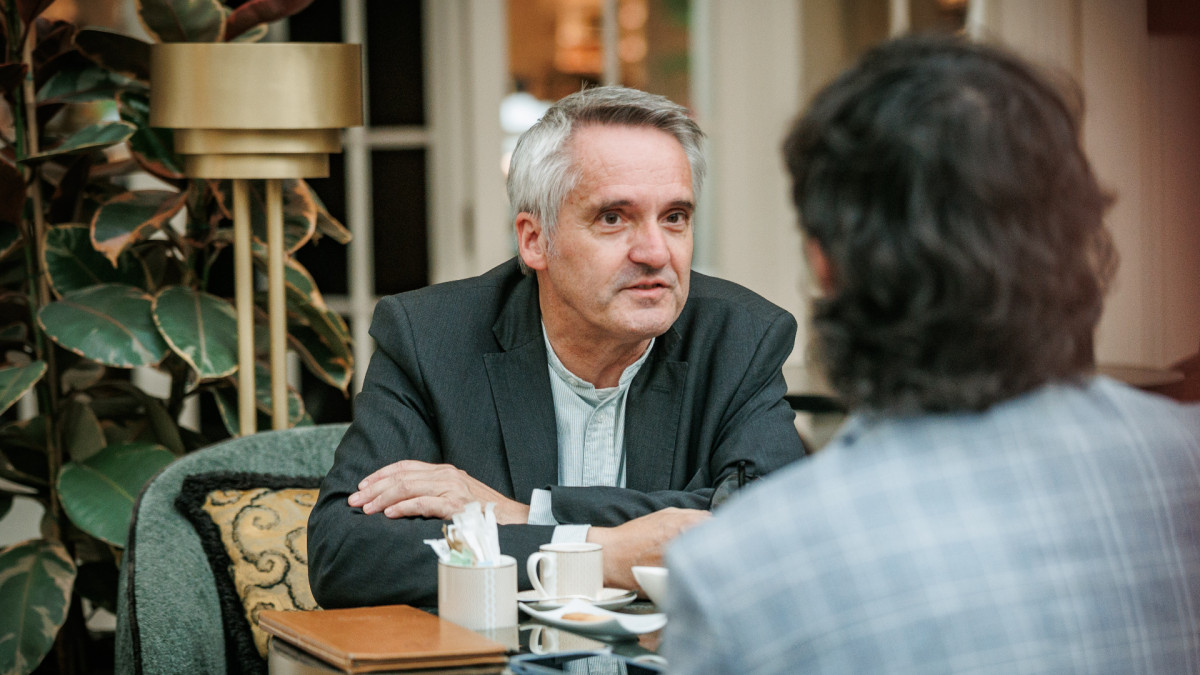
The problems Germany faces are widely recognized: an unpopular government, a radical right steadily growing in opposition, and the loss of its once privileged economic position. Yet it isn’t entirely clear how the country arrived at this point or how Germans, in their own best interest and in the interest of Europe, can escape the impasse. Although Frank Decker, a professor at the University of Bonn, did not come to Madrid bearing an anti-crisis manual under his arm, he did offer several pertinent answers.
In this conversation, he broadens the diagnosis of the “crisis of social democracy” to reflect the inner workings of Germany’s party system. On one side stands the SPD, where there is a leadership problem. On the other, the Christian Democrats of the Union, led by Chancellor Merz — “a somewhat old-fashioned conservative politician” — and a government that “functions poorly in a technical sense”. To make matters worse, popular discontent is being captured by the AfD. Among the consequences of the rise of the radical right, Decker notes that “democracy also depends on having a strong democratic opposition”.
There are also major economic challenges to address. Asked about the reasons for the country’s weak economic performance, Decker, who is visiting Spain at the invitation of the Friedrich Ebert Foundation, flips the question: if we want to understand the current fragility, it is better first to ask why the German economy functioned so well five, six, or seven years ago. His answer points to cheap energy from Russia, security advantages courtesy of the United States, and privileged access to the Chinese market, which made Germany the strongest economy in the eurozone. Today, all these elements have disappeared or are on the verge of doing so. As the scholar explains, this dynamic is affecting the population sociologically as well, with a substantial distrust of democracy and a growing pessimism about the future.
Frank Decker analyzes the state of German politics in Madrid. Photo: Agenda Pública / Tania Sieira
Professor Decker, my first question is about the SPD. It is one of Germany’s major political parties, yet the polls aren’t favorable today. It gives the impression of a crisis deeper than European social democracy, and specifically in Germany. How do you understand this crisis: ideologically, in terms of leadership…?
Probably it is all of the above. And it is a very deep crisis. But it began after the SPD formed a coalition with the Greens. When the party returned to power in 1998 and Gerhard Schröder became chancellor, the SPD exceeded 40 percent in votes. When Schröder finally lost the 2005 elections after seven years in office, the SPD still had about 35 percent. From that point, the decline really started.
The 2021 elections were an exception. Olaf Scholz reached the Chancellery with only 25 percent of the votes. The campaign was nearly flawless, but the victory owed much to the complete failure of his rivals, especially the CDU/CSU, and also to the Greens’ weakness. The SPD won the Chancellery by a margin of barely 1.4 points.
Thus it was an exception within a long-term trend that can only be described as a decline. And of course, this fits the broader trajectory of European social democracy. There are differences among countries, but if you look at Germany, France, Austria, or even the Nordic countries, social democracy as a political family has been in crisis for more than twenty years. Spain could be the exception.
Specifically in Germany, why is the SPD having such a hard time? Olaf Scholz was chancellor and the party suffered. Now the SPD remains part of the government, though it no longer holds the chancellorship, but it isn’t performing well in the polls or in regional elections. Why?
There’s a leadership problem. After Andrea Nahles resigned as party chair, the SPD had to elect a new leadership. For the first time it chose a dual leadership structure: a man and a woman as co-chairs. It was the same organizational principle that the Greens had adopted from the outset when the party was founded in 1980.
At that time it was a good decision, because the SPD was the junior partner in the CDU/CSU coalition. We saw three large coalitions under Angela Merkel’s leadership. That was a big problem for the SPD because even the measures the party managed to push, such as the introduction of a minimum wage, were credited to Merkel. Merkel remained highly popular after twelve, thirteen, or fourteen years in office. So the SPD found itself in a losing position.
The new leadership then decided that Olaf Scholz, who had served as Finance Minister in Merkel’s last government, should be the SPD’s candidate for chancellor. That proved to be the right call. Norbert Walter-Borjans, Saskia Esken, and the secretary-general, Lars Klingbeil, prepared a very solid electoral campaign. The slogan was “respect”: respect for ordinary people, for those who work hard every day. It was a very apt campaign choice.
“If elections were held today, the CDU/CSU and the SPD would not have a majority together, and the Greens would also have to be part of the coalition”
But now the dual leadership structure is a problem, particularly because the two party leaders, Lars Klingbeil and Bärbel Bas, are also part of the government. Klingbeil is the finance minister and Bas is the labor minister. She has to implement reforms that require compromises with the conservatives. It would have been better if at least one of the SPD leaders had stayed out of government.
That complicates the SPD’s ability to explain to voters what its ideas are, what its identity is, and what distinguishes it from the Christian Democrats. The party is imprisoned by this coalition. That is also the difference with the Spanish situation: in Germany there is no alternative within the party system to this coalition.
If elections were held today, the CDU/CSU and the SPD would not have a majority together and the Greens would also have to be part of the coalition. So we would have a coalition of democratic parties in government and two fringe parties in opposition. That is not good for democracy. It may be an advantage for the party holding the Chancellery, the Christian Democrats, but it remains a losing situation for the SPD.
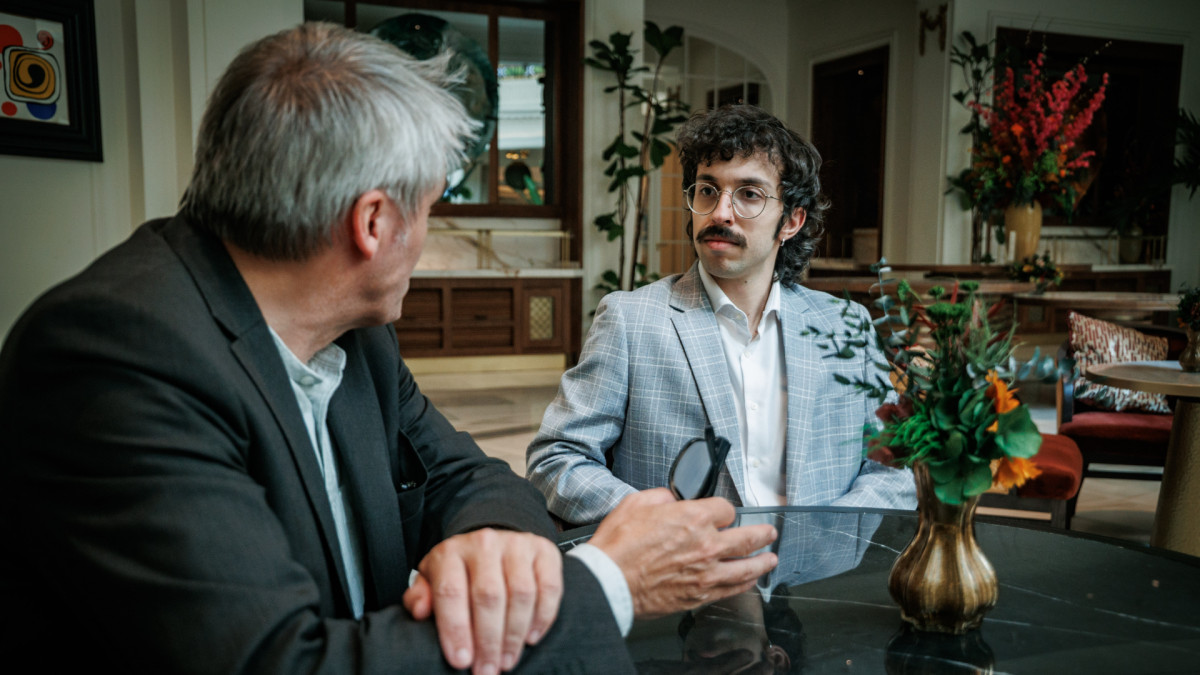
Decker explains the SPD’s difficulties in distinguishing itself from the CDU/CSU within the grand coalition. Photo: Agenda Pública / Tania Sieira
He has said something interesting about Angela Merkel: how she managed to keep her popularity high. The CDU/CSU’s data are striking: 43% of their voters don’t believe they can fix the economy. We have discussed why the SPD isn’t competing well, but what about the CDU/CSU?
The Chancellor Merz is very unpopular. He is a conservative politician somewhat out of date. Merkel avoided reforms. There were no major reforms to the pension system or to health insurance because she knew reforms are unpopular and voters punish those who are too ambitious.
Now the situation is different, because Germany needs those reforms. But the concept of what a welfare-state reform should look like differs greatly between the two big parties. That is one reason.
The other reason is that Merkel understood how the media system works in a democracy. She had experience and knew how to govern. She had already been a minister in Helmut Kohl’s government, in various portfolios, including Environment and Women. Neither Merz nor Klingbeil had previously held government roles. So this German government works poorly in a technical sense. Both parties bear responsibility. Public mistrust of the government has grown and it is now as unpopular as the traffic light coalition was in 2023 and 2024.
So far we have described the SPD’s decline and the Union’s decline in different ways, but both converge because they govern together. Do you think Germans could grow tired of this logic of a grand coalition, of seeing the two major parties as interchangeable? This also raises the question of the AfD as a party that can construct a message against the central bloc.
In Germany we have the cordon sanitaire, the Brandmauer. This means there will be no cooperation between any of the democratic parties—especially the conservatives—and the radical right of the AfD, neither at regional nor at national level.
I’ve heard that in Spain there are autonomous governments formed by conservatives with Vox. That will not happen in Germany. It’s simply not possible. Of course, there are some politicians in the Christian Democrats, especially in the eastern part of the country, who wonder: why not? But if that happened, the Christian Democrats would split. The party would not survive a decision to form a coalition with the radical right.
“Democracy means that voters have the ability to remove a government and replace it”
That is why I call it a real dilemma. The parties are prisoners of the coalition. Yet there are differences between the federal level and the states. We have different government compositions in the länder. There are left-leaning coalitions in city-states like Hamburg and Bremen, and it could happen again in Berlin. There are conservative coalitions in Bavaria. And there are coalitions between conservatives and greens in two of the most important states: Baden-Württemberg and North Rhine-Westphalia.
Democracy means that voters have the ability to remove a government and replace it. At the regional level there is some alternation. But I fear that’s not the case at the federal level. There, competition centers mainly on which party will be strongest within a coalition. If there is a coalition between Christian Democrats and Social Democrats, the stronger party claims the Chancellery.
That is very important. The party that holds the Chancellery is in a better position than the junior partner. But the SPD’s problem is that in polls the Christian Democrats hover around 25%, while the SPD sits at only about 12%, 13%, or perhaps 14%. The gap between the two parties is widening. The Social Democrats have no real chance of becoming the stronger party again, except in a situation like 2021. However, as I have said, that was an exception and will not be repeated.
That is a real problem because democracy also depends on having a strong opposition. Right now the opposition is made up of the AfD, which is not democratic, and Die Linke. I wouldn’t call Die Linke an anti-democratic party because it accepts the rules of parliamentary democracy. But even the Social Democrats are unwilling to cooperate or form a coalition with Die Linke at the federal level. For example, Die Linke opposes rearmament, and Germany now has to spend more on the Bundeswehr. They would never accept that. So a coalition is not possible.
This is a real problem, and I don’t know the solution. The only solution would be for the two big parties to regain support and trust. But at the moment there are no signs of that.
The political scientist explores the dilemma of the cordon sanitaire amid AfD’s rise in eastern Germany. Photo: Agenda Pública / Tania Sieira
In Saxony-Anhalt there will be elections and polls place the AfD around 40%. To form a government, the Union would have to coalize with nearly all other parties, including Die Linke, with whom it disagrees on fundamental matters. Across Europe there is a debate about how to curb the growth of the radical right. If the cordon sanitaire is not broken in Germany, what does the future hold?
In Saxony-Anhalt we will face very difficult elections. The same goes for Mecklenburg-Vorpommern, where polling is also set for late summer. There could be a candidate from the AfD and a candidate from the democratic camp.
In Mecklenburg-Vorpommern, for instance, that candidate could be the incumbent minister-president, Manuela Schwesig, who is a Social Democrat. CDU voters might choose Schwesig, though they would normally prefer their own party, because they want to prevent the AfD candidate’s victory. It’s a ridiculous situation.
“It is not unlikely that the AfD could win a majority of seats with only 41% or 42% of the vote”
This could also lead to a scenario in which small parties do not reach the 5% threshold required to enter parliament. If they are not represented, the entire democratic field is weakened. It is not unlikely that the AfD could win a majority of seats with only 41% or 42% of the vote. That is what the polls show. It is a very serious situation.
Perhaps some voters, if they really think about what could happen if they vote for the AfD candidate and the AfD as a party, will decide not to do so. But that is only something one might expect. It is not certain. And this situation is also the result of the federal government’s poor performance, where the two parties truly are unable to work together on a basis of trust. They do not trust one another. I am not very optimistic that this will change in the coming months.
Many expected that Germany, after the elections, would lead Europe, especially with Ukraine and Trump, at a moment when Macron also faced problems in France. That leadership has not arrived. From Spain there was sharp criticism of Merz’s performance at the White House. And, at the same time, in Washington there was discontent with what Merz recently said about Iran. Why do you think Merz has had difficulty developing a solid foreign policy agenda?
There is a relatively stable consensus among the democratic parties about what Germany should do in foreign policy. We must support Ukraine. Of course there are differences in the details, for example, how much to spend on defense. There may be disagreements between social democrats and Christian democrats. And, given our history, the German position on Israel differs significantly from that advocated in Spain, even among conservatives and especially among socialists.
But if you look at eastern Germany, the parties opposing military support for Ukraine are not limited to the AfD. Die Linke and the new Sahra Wagenknecht Alliance also oppose it. They are conservative on migration but strongly pro-Putin. This position has substantial support, especially among eastern German voters. That makes it very difficult for democratic parties to use foreign policy issues to gain popularity. They are on the defensive even on these topics.
In any case, for the German public right now, although these matters are interconnected, the main concerns are the economy, labor-market problems, and reforms to health insurance and the pension system.
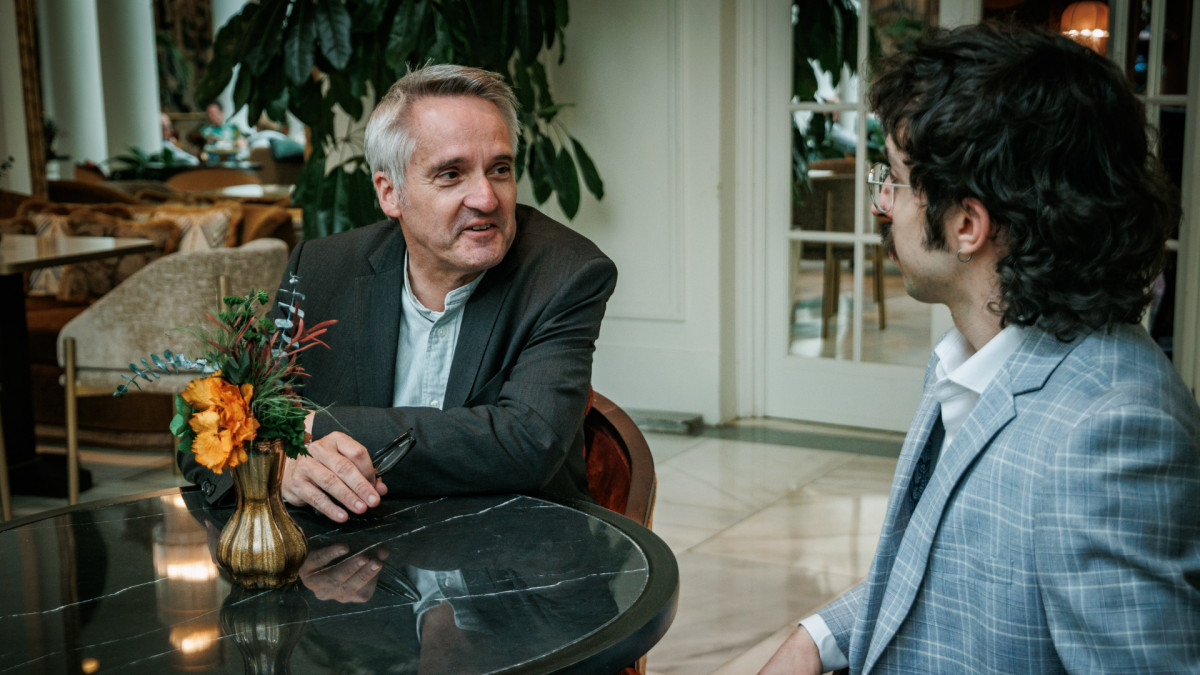
Decker analyzes the causes of the German economy’s weakness, from Russian energy to China’s competition. Photo: Agenda Pública / Tania Sieira
Why has the German economy performed so poorly? What kind of reforms are coming and how will citizens react, especially with elections ahead?
If you pose that question, you should also ask why the German economy worked so well five, six, or seven years ago. We had cheap gas from Russia. We were very successful at selling German products abroad, especially cars to China. And we didn’t have to spend much on security or defense because the United States did that for us.
All these conditions have changed radically for Germany in a short period of time. That itself becomes a problem. It is a matter of time: the German economy must adapt to these new conditions, and that will take time. That is why our current performance is so weak.
“We have lived in peace for many decades and believed that after the Cold War, there would be an era of eternal peace. That has changed dramatically”
You know Bill Clinton’s line: “It’s the economy, stupid.” It all hinges on the economy. In Germany I would say it is security in a broader sense. Security now also means peace. The war in Ukraine is closer to Germany than to Spain. It affects us more. War has returned to Europe. We lived in peace for many decades and assumed that after the Cold War there would be an era of eternal peace. That has changed dramatically. Germany is more affected by this than other countries.
We also have the issue of attacks in Germany. During the campaign there were three attacks carried out by asylum-seekers. So migration is a central theme. Germany also has a problem with Muslim migrants. Then comes the economy. Social policy depends heavily on growth. Everything is interconnected.
This would be a very difficult and challenging situation for any government, and the main question is whether the economic situation in Germany improves. There are no real signs of that, although the government has been quite optimistic that the situation could even change this year. But then came the Iran war and Donald Trump’s tariff policy. Germany is more affected by tariffs than other countries. That is a problem.
And there are always elections. Governments are punished by voters, and regional elections often have the same effect as midterm elections. It is similar to what happened in Andalucía on Sunday: when the socialist government is unpopular, voters swing toward conservatives or right-wing parties.
You began with the SPD and asked about organization. The SPD also has a problem because on many of these issues the party is divided. In many senses, there are two social-democratic parties. Take migration: some in the SPD are not opposed to a more restrictive policy, while others defend asylum seekers’ rights and humanitarian policies, which in Germany we call a welcoming culture.
The same happens with economic and social policy. Some in the SPD say the first task is to improve the conditions for competition, the supply side of the economy. Others say there must be more redistribution, more social justice, and a defense of the pension system.
This is also a problem for voters. If you vote SPD, which SPD are you voting for? The party has to reach compromises not only in government — because it is in a coalition with the conservatives — but also within its own ranks. That is not very attractive to voters. That would be my analysis.
How do German citizens view democracy and how do they imagine the future?
We conducted a survey three years ago in which we asked voters how they looked at the future: whether they thought their children and grandchildren would live better or not.
If you had asked the same question fifty years ago, when Spain was reestablishing democracy and the 1970s were also a decade of crisis — the first oil shock, terrorism, radical left-wing terrorism in Germany — 90 percent would have said the future would be better. They would have been optimistic. Now only 15 percent are.
“Politicians must be able to convince voters that the future can be better”
And it is distributed evenly across age, gender, and occupation. It is quite sad, because that is what politics is about. Politicians must be able to persuade voters that the future can be better. A world powered solely by renewables is better than the world we have today. Even a world with artificial intelligence can, in some respects, be better than today. But politicians are failing to explain it.
We also asked whether people were satisfied with how democracy works in their country. About 50 percent said yes and 50 percent said no. But what does that mean? There are many reasons to say democracy isn’t functioning very well. Confidence in the future says a lot more than confidence in the functioning of the democratic system.
Of course, we must also consider how democracy can be improved. That is part of the problem in Germany. The German discourse on democracy focuses only on defending democracy against its enemies, against the AfD. Yet we must also ask how to improve things: how to improve institutions, the entire political system, and how to create more opportunities for political participation, especially at the local level.
We must ask ourselves these questions, but we don’t, because we are focused on defending democracy. We are on the defensive, and being on the defensive is always a problem.
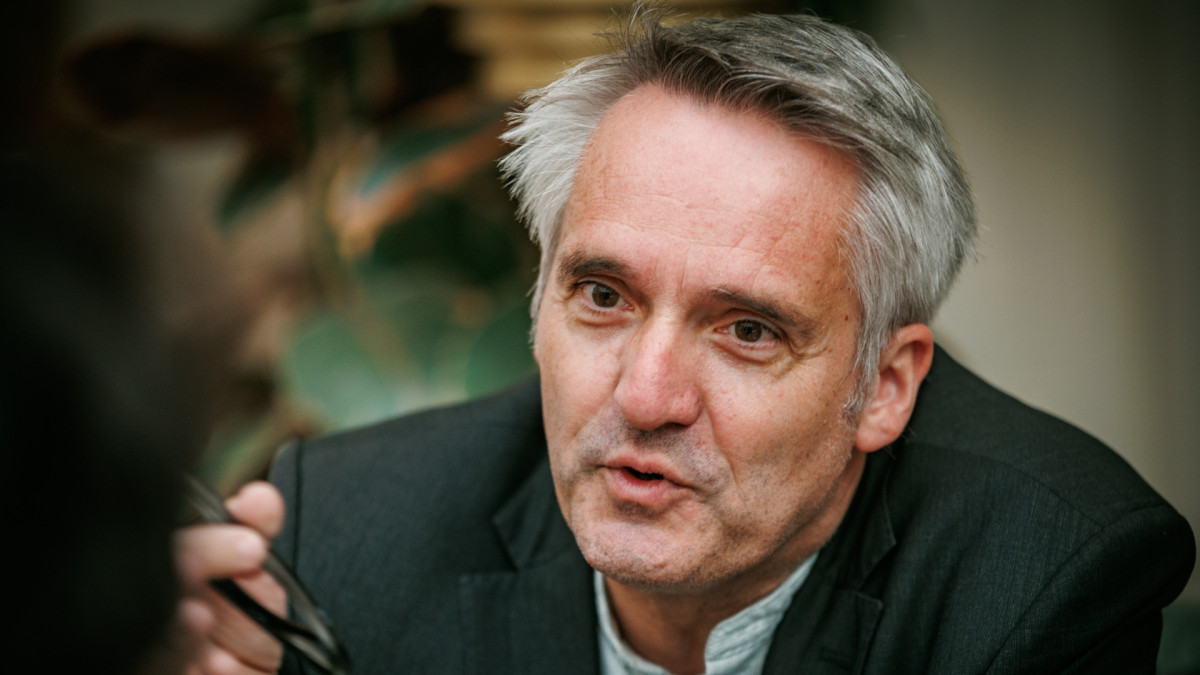
López Plana questions the weight of German pessimism and the lack of compelling futures in European politics. Photo: Agenda Pública / Tania Sieira
In Agenda Pública, writer Andrés Ortega penned an article titled “Nobody Offers Compelling Futures.” I think that is what he is describing. First we must imagine where we want to be and then figure out how to get there. Is that the first step?
Yes. How can we reach those objectives? That, too, is necessary. But first: what are the objectives? What is your vision for the future?
Some say Willy Brandt in Germany was a politician with that kind of vision. His successor, Helmut Schmidt — I don’t think he really said it, but people claim he did — reportedly stated: if you have visions, you should go to the doctor. Brandt probably had more right. We need visions.
Pedro Sánchez, in a sense, is capable of telling people how a better society should look. He is also a charismatic politician. In Germany we lack that kind of leader. Merkel was popular, but she was not at all charismatic. There are times when that type of politician is needed. But you cannot conjure one if they are not there.
Thank you very much.
