
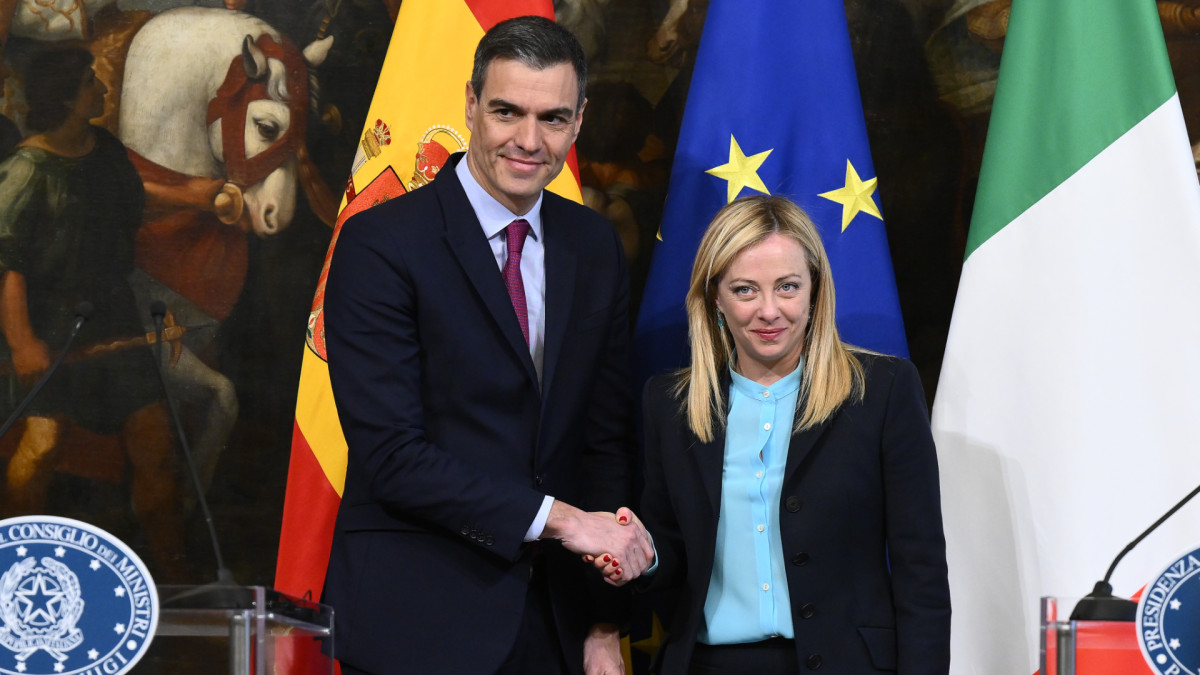
The Ceuta crisis has once again shown just how much the relationship between Spain and Italy combines common interests and an increasingly visible competition in North Africa. The two countries have a great deal to gain from closer cooperation on the southern flank of Europe, but their political and economic priorities overlap more and more and, when a crisis erupts, domestic politics often pushes in another direction.
Madrid regards Ceuta and Melilla as integral parts of the Spanish territory and, therefore, of the European Union. Moroccan claims on both cities, although not part of an officially formulated policy as such, periodically reappear in statements by Moroccan officials. At the same time, effective border control largely depends on Rabat’s cooperation. Spain thus relies on Morocco to manage access to territories whose sovereignty continues to surface in Moroccan political debate.
The Spanish shift in 2022 on Western Sahara allowed rebuilding relations with Morocco and improving migration cooperation, but it also made any new confrontation with Rabat more costly. Relations with Algeria, Morocco’s regional rival and Spain’s essential energy partner, had to be rebuilt after the crisis caused by that policy shift. Madrid today needs to preserve cooperation with Rabat without losing the ground gained with Algeria.
“Spain relies on Morocco to manage access to territories whose sovereignty continues to surface in Moroccan political debate.”
For its part, Morocco has held elections in which Ceuta and Melilla have again occupied space in political debate, and the historical claims on both territories have resurfaced in the mouths of several Moroccan government ministers. But the images of thousands of young Moroccans trying to reach Europe do not help a country that has spent years projecting an image of stability and growing regional influence. It is possible that Rabat has reasons to increase the pressure on Madrid, but the crisis also reveals internal frustrations and difficulties in migrant management. All of this makes a reading of what happened as a simple retaliation designed by the Moroccan state less convincing.
Rome has intensified in recent years its diplomatic and economic relations with Morocco, also through the Plan Mattei, while maintaining with Algeria a historically close energy relationship. A prolonged crisis between Madrid and Rabat could open new opportunities for Italian policy in Morocco. Any move in that direction, however, would have to coexist with the weight Algeria maintains in Italian energy and Mediterranean policy.
“It is possible that Rabat has reasons to increase pressure on Madrid, but the crisis also exposes internal frictions and difficulties in migrant management”
The parallel expansion of Italian and Spanish political and economic interests in Africa is bringing their respective strategies increasingly closer. The Italian Plan Mattei and the Spain-Africa Strategy 2025-2028 have distinct origins and designs, though in practice they are broadening the presence of both countries in many of the same markets and African countries. Migration is only one of the areas where their interests overlap and, at times, compete, within a broader dynamic of coopetition.
For Madrid, Ceuta forms part of the European Union’s external border and its management cannot be detached from the responsibilities of European partners. The Italian decision to impose limited controls on arrivals from Spain shifts part of that pressure toward the interior of Schengen. Over time, it does not seem that other states will follow the same logic, but if they did so through returns or new national controls, a crisis localized at the external border could end up triggering a chain of measures within the European space itself.
“Migration is only one of the areas where their interests overlap and, at times, compete, within a broader dynamic of «cooperative competition»”
In this context, Giorgia Meloni faces growing pressure from the right, where General Roberto Vannacci, leader of the new party Futuro Nazionale, has placed immigration, re-migration and cultural identity at the center of his political platform. Pedro Sánchez, for his part, governs with a fragile parliamentary balance; Vox has obvious reasons to use Ceuta and immigration against the Government, and the People’s Party cannot entirely leave that ground to its right. In these conditions, national responses offer much more immediate political gains than cooperation whose results are usually less visible.
Spain and Italy are already competing in the Mediterranean and in Africa, and they will continue to do so. Their problem is that, when that competition surfaces, it tends to spill over into Schengen, generating a crisis that neither country can fully manage on its own.
