
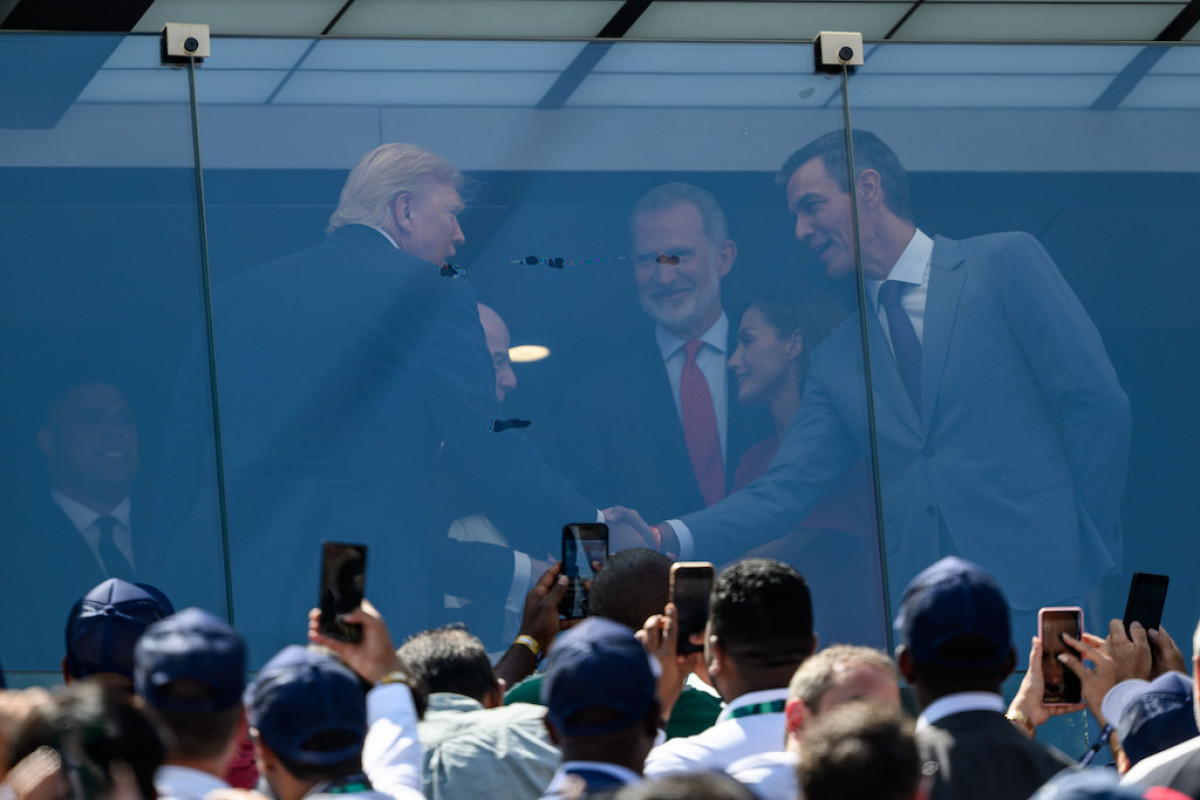
At this juncture of the tournament, we will not apologize for blending politics with sport. As in other episodes, the triumph of the Spanish squad signals a defeat for nationalism and a victory for multiculturalism. The country that Donald Trump dislikes most has won the World Cup, right beneath his nose, with a narrative that stands in stark contrast to Trumpism. In World Cup showdowns, the singing of national anthems gives way to a post-national clash where teams embody the spirit of a secular project.
Spain’s national teams, both women’s and men’s, united by federation, multiculturalism, plurality, and diversity, have become the reigning world champions in football, the most successful and globally connected sport
With their distinctive kits, Spain’s national squads, both women’s and men’s, are now the planet’s top champions in football, the most successful and globalized of sports. They are also Europe’s Under-19 champions, for both genders. And we could hardly claim surprise, for these successes have been building for years and are not new. Unlike its infrastructures, Spain isn’t centralized or ‘radial’ as a sporting phenomenon – the periphery is well represented and even shares the lead role, with a robust presence of athletes from immigrant families, or with several nationalities, and not only of Latin American origin (which the stereotype tends to link more easily, thanks to shared language and faith). And then there are the emigrant footballers who have departed Spain to pursue training abroad. Thanks to the rule that binds players to a single national team, they can bring back to their country of origin (or the one they’ve chosen as home) everything they’ve learned in international competition. And thanks to the institutions of the European Union and the sector in which these athletes operate, they face fewer obstacles than their Spanish forebears who migrated to Germany or Switzerland. Then there are players like Oyarzábal who stay put abroad less often, exercising their right to remain (and to avoid overexposure, loud displays, or grabbing the spotlight).
The team that just clinched the World Cup serves as a vivid example of the best we can be. Mikel Merino’s strike against Portugal or Pedro Porro’s tallies against France and Austria (the latter preceded by a handball) illustrate the essence of ‘tiki-taka’—that blend of hard work and improvisation where those weaving the ball around the goal are as indispensable as the players who don’t touch it but are exactly where they need to be (like Lamine and Cucurella clearing the field for Merino’s goal), or who shift even slightly to create a gap (as Oyarzábal did before Porro’s second). The player visible in the photo is as impactful as those not touching the ball. As Thierry Henry stated, the game isn’t defined by names; any nine-year-old Spanish child has known precisely what to do on a football pitch since the arrival of Johan Cruyff and the successive mutations of the ‘positional game’ through trial-and-error.
Spain’s national team embodies Al Pacino’s maxim about American football (in his pep talk as a coach in ‘Any Given Sunday’) as a living principle in European football: “We either win together as a team, or we falter as individuals.” It’s a straightforward lesson that Kylian Mbappé (in many ways a standout) and his coaches seem reluctant to absorb, which is why they keep racking up personal awards while their teams struggle to rise together.
Trump and his ally Infantino articulate values opposite to Spain’s patient, collective approach. In their world of impatience, rules are merely decorative accoutrements for populism and corruption (which hairs through football at every level), where the welfare of the oligarchy is all that matters.
Yet we shouldn’t indulge in excessive optimism, because in the past we in Spain have occasionally mixed triumph with ugly comments like “negro de mierda,” and the memory of Rubiales is not that distant. Today we have Borja and Lamine to correct Rajoy’s missteps, but that doesn’t mean every football hero has read Eduardo Manzano’s book España diversa. Football’s success and notoriety will always attract corrupt and opportunistic individuals.
The Spain imagined by Javier Bardem, Penélope Cruz, and Rosalía stands behind the goals scored by Oyarzábal, Ferran, and Merino. It also aligns with Europe’s social-democratic milieu we’re part of, where you don’t need to be wealthy or native-born to have a sports facility nearby, as Simon Kuper—the finest sports journalist (and journalist, period)—has noted in his Financial Times columns.
The Spain that George Orwell, Willy Brandt, and Albert Hirschman defended isn’t yet a reality, but its proximity can be sensed in today’s multiracial, multilingual, hardworking, and outstanding collective
In Europe, modern football has found its most effective ecosystem: a vast market supported by government at every level and by regulatory structures—from the Bosman ruling to the eligibility criteria for every national team. The Spain that Orwell, Brandt, and Hirschman fought for isn’t fully realized yet, but its closeness is felt in today’s diverse, multilingual, industrious, and exceptional group. The Spain of theInstitución Libre de Enseñanza that nurtured Dalí and Lorca—combining art with method—has also spread its spirit to North American stadiums, just as Juan Diego Botto, a Spaniard of Argentine origin, brings that same spirit into our theaters.
For once, deliberate planning and patience are unmistakable. I was mistaken about De La Fuente, like many of us were. He may not be as dazzling and emphatic as Luis Enrique, and he isn’t as left-leaning as Borja Iglesias—nor did he rush to distance himself from Rubiales—but he is a serious person who has minimized the usual missteps and remains unscathed by Twitch culture. The coach’s role isn’t the sole determinant, but it matters that he keeps errors to a minimum.
Chance also plays a part, and that must be acknowledged: outcomes could have been different. The fact that Spain carried about a 53% chance to beat Argentina means that, in 100 encounters, Argentina could have won 47 of them. Attaining that 53% has been the fruit of years of labor. The same logic applies to penalties, those formidable uncertainties: commentators still haven’t grasped that even great players tend to strike with a degree of randomness, the only way to remain unpredictable. That doesn’t guarantee success, because keepers can mirror that unpredictability (regardless of what the goalkeeping coach prescribes) – which helps explain why roughly a quarter of penalties miss. These are merely numbers, but in contemporary football, poetry and science can coexist, which is a fortunate development. Nobody wants to reduce football to a mere collection of statistics or to supplant Valdano as the supreme ‘rhapsodist’.
A free, egalitarian, plural, and diverse Spain is indeed possible, but it won’t happen automatically
Spain is a success story not only in football but also in cuisine, life expectancy, and freedom. Not freedom for the wealthy to do as they please, but the freedom for every girl and boy in any neighborhood or village in Spain (such as Rocafonda, the Lamine Yamal district, or Don Benito, Pedro Porro’s hometown) to pursue their dreams, to receive an education, and to access all the tools needed to thrive. Of course, it would be ideal to have better schools alongside football pitches. Freedom means sharing in order to flourish and thriving in order to share.
The fact that Spain projects these values through football doesn’t guarantee their easy transfer to other domains. Yet it points toward that possibility. A free, egalitarian, plural, and diverse Spain is indeed possible, but it won’t happen automatically. The strongest counterexample, where exceptional football doesn’t translate into broader success, is Argentina itself, where many emigrant players are spread across Europe across generations. In earlier times, migratory flows worked in the opposite direction (which helps explain why Argentina’s players often bear Italian, Spanish, or British surnames). What the future holds remains uncertain. Today, Argentina has Scaloni (based in Spain) on the bench, but it also has Milei in government, waving his chainsaw and his memory-eraser. Argentina’s top star arrived in Spain at age 13 and has never returned to live in his birth country. And yet Milei’s supporters proliferate in Spain, led by Isabel Díaz Ayuso, the influential president of the Community of Madrid.
Tomorrow we’ll stop pretending that Spain stands above all and return to topics like the corpses left in the streets by Trump’s ICE, or Trump’s intimidation of journalists, his widespread corruption, his futile wars, his backing of genocides, and his attempts to sway the next round of U.S. elections (if the people allow it). Let us reaffirm our right to remember that another world is possible, and our duty to declare that Europe must lead by example—not only in football but in turning its pledge of equality, democracy, and freedom into a concrete, shared reality.
