
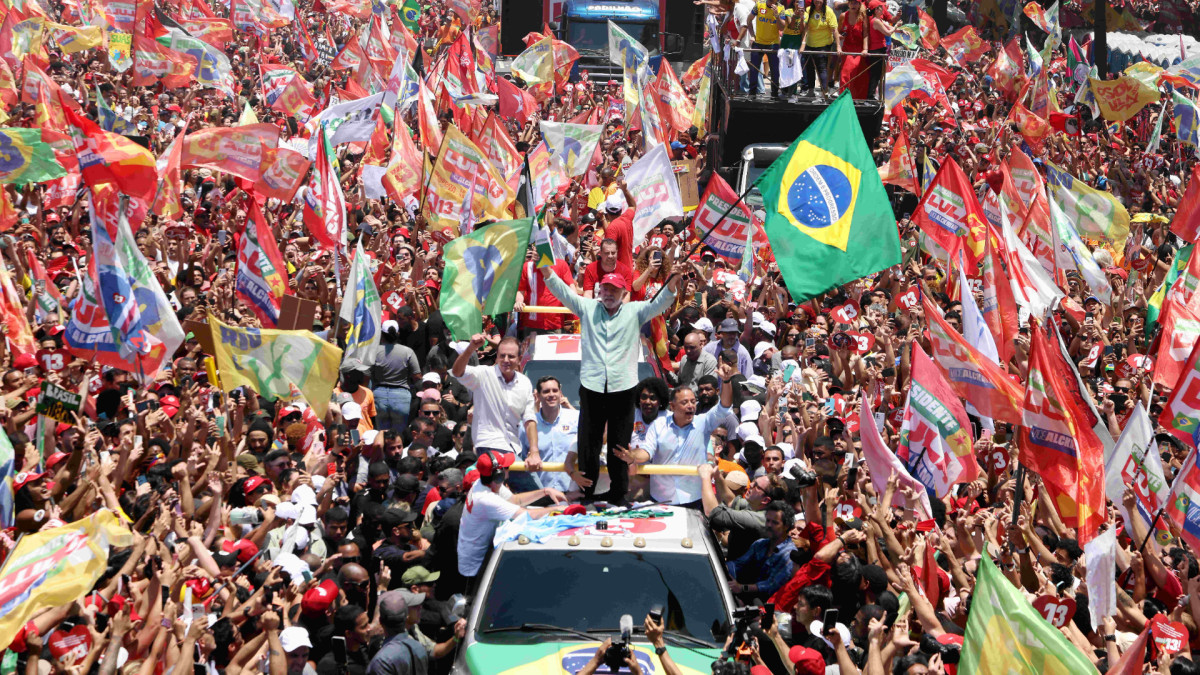
Marc López Plana wrote a few days ago in these pages that Spain must look to Latin America as a matter of power and economic security. There is another view, more domestic, and it concerns campaigns. In 2014, in the midst of the Mexican campaign, I was asked about Spanish politics and whether everything I used there came from my experience in Spanish campaigns. Years later, in Spain, I am asked whether what I do I learned here. Today the answer is the opposite: what I see in this pre-campaign I learned there. Not because Spain has ceased to be a European parliamentary democracy, but because its campaigns have adopted, one by one, dynamics that in Latin America have been working for years. Five of them, and a sixth more recent, explain a good part of November 29.
The candidate above the party. The IMOP poll for El Confidencial (from November 2 to 6) gives the PP 126 seats, the PSOE 106 and Vox 70: 196 for PP and Vox, twenty above the absolute majority. However, at the beginning of October, the 40dB poll for El País and the SER still placed Pedro Sánchez as the preferred choice to preside the Government: 32.2% versus 29.3% for Alberto Núñez Feijóo. In a presidential system, that preference would weigh directly on the outcome. In a parliamentary system, it barely counts. It is the Latin American logic applied to a system that does not reward it: you vote for a person, but you elect a Parliament. A campaign like that can win the conversation and lose the arithmetic.
“It is the Latin American logic applied to a system that does not reward it: you vote for a person, but you elect a Parliament.”
A single frame that orders it all. In Central America, security has become the axis that decides elections: who names it first and with the most credibility fixes the playing field for others. In Spain that role is played by housing. The eviction of Maricarmen Abascal, the protests, the decrees defeated in Congress and the snap election form a single sequence. The Urda rail accident and Óscar Puente’s resignation have shifted the focus, just as the collapse of Mexico City’s Line 12 forced infrastructure discussions in the middle of a campaign in 2021. The risk, well known there, is that the single frame generates promises no government can fulfill in a single legislature. In El Salvador, security ordered an entire election and left the opposition debating on unfamiliar ground. Without judging the model, the campaign lesson is clear: whoever sets the frame wins the conversation, but also inherits the obligation to resolve what they have promised.
The digital outsider. Alvise Pérez will head SALF’s list for Madrid. His path resembles that of Latin American candidates who built an audience before a party, with their own channels, clear enemies, and explicit disdain for media intermediation. Javier Milei reached the presidency of Argentina in 2023 from television and the networks, with a recently created party and a well-defined adversary, and had to govern with a parliamentary minority. There we learned that the outsider measures success in the campaign, and the problem appears afterward: its ceiling depends less on its program than on the wear of others, and its capital on what it can turn into structure.
“The campaign lesson is clear: whoever sets the frame wins the conversation, but also inherits the obligation to resolve what they have promised.”
The judicialization of the electoral process. In Latin America, the electoral arbiter is a central actor in every campaign, and the democracies that best resist suspicion are those that have managed to keep their authority from being questioned every time. Costa Rica, with a long-standing electoral tribunal, or Brazil, with a TSE that acts as an active regulator, are the counterexample. Where that trust is lacking, every election becomes a referendum on the arbiter. We lived it in Honduras in 2025: with the National Electoral Council under constant evaluation, the question of whether it had been won or not reopened every day, and twenty-four days, from November 30 to December 24, elapsed before a president was proclaimed. That uncertainty costs democratic quality, and not only does the loser pay: the winner pays too, as they begin to govern with their legitimacy in doubt. Spain is not there. But this year it stopped having a discreet arbiter: the Supreme Court keeps suspended the vote of about 163,000 naturalized under the grandchildren law unless they prove they descend from exiles, and the Constitutional Court rejected, on October 21, by 10 votes to 2 and for procedural reasons, the Ombudsman’s appeal. The census has become contested ground.
Last-minute coalitions. The alternative left arrives divided into two projects: the Broad Front, with Ada Colau as candidate, and the Podemos-ERC alliance, with Irene Montero and Gabriel Rufián as leaders. Negotiating lists at the last minute, with new acronyms and leaderships to decide, is a Latin American classic. It is also its consequence: in small constituencies, where the D’Hondt formula punishes divided lists, those votes end up without a seat.
“That uncertainty costs democratic quality, and not only does the loser pay: the winner pays too, as they begin to govern with their legitimacy in question.”
Geopolitics enters the campaign. It is the most recent feature. In Latin America, the relationship with Washington already moves votes: the explicit backing of Donald Trump weighed in the latest elections in Honduras and Argentina. In Spain, the Ceuta migrant crisis and the arrival of Moroccan warships into Spanish waters on July 30 and 31, which the government acknowledged in October, have dragged foreign policy into a debate that traditionally ignored it. Whether it was a coercive operation or a crisis that spiraled out of control is today a matter of discussion in this very outlet.
What can Spain learn from those who have already walked this path? Three things.
- Personalize aid to win, but that makes governing harder. A president elected by a personal brand then depends on a Parliament that owes him nothing.
- The single frame is effective and dangerous. It mobilizes, but turns any partial progress into an unfulfilled promise.
- Trust in the electoral arbiter is capital. It takes decades to build and a single campaign to squander. It is protected before the campaign, not during: with a transparent census, public resolution timelines and reasoned decisions.
There is still time to apply the third before November 29: explain with transparency every decision of the arbiter, and not only defend it when a remedy arrives.
