
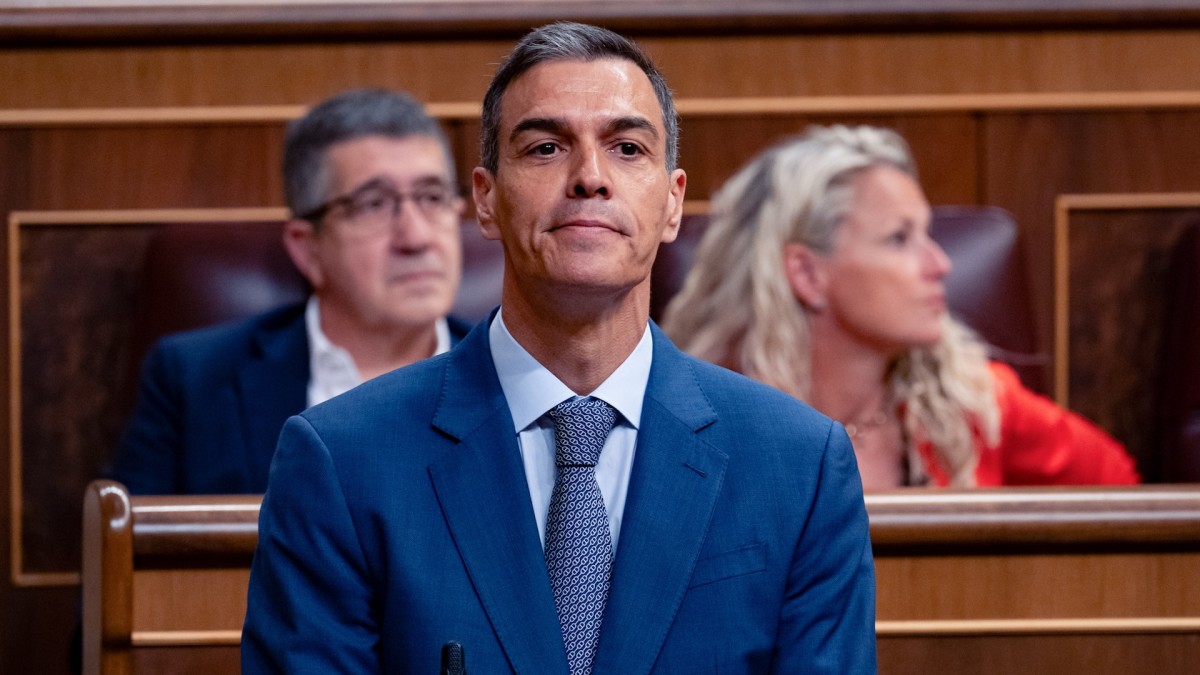
If Pedro Sánchez no longer has the confidence of Parliament, the Government should not see out the remainder of the legislative term. Not only because it would be agonizing for them, but because Spanish democracy deserves something better. There are several ways to resolve this situation, and in Agenda Pública this has been pointed out from the first day after the latest crisis unleashed: confidence vote, motion of censure, or both.
“If Pedro Sánchez no longer has the confidence of Parliament, the Government should not see out the legislature”
Any option that entails trying to resist as if nothing had happened here, as if the purpose and confidence with which Sánchez came to the Government had not been blown apart, as if there were no purpose left in favor of Spaniards, is not responsible. An opposition that eagerly watches from the sidelines the slow degradation of the Government and all that surrounds it, without attempting to activate the mechanisms offered by democratic institutions that could help to resolve or accelerate the resolution of a crisis, increasingly structural, either. To opt to validate that confidence, gathering support, in the middle of this crisis, in a transactional budget negotiation amid governmental weakness, without addressing the necessary regeneration that is required, even less.
Sánchez arrived at the Government with the promise of regenerating Spanish public life and he has not achieved that objective. He may still try, to the extent that the crisis does not structurally affect his organization, yes, but certainly not under these conditions. There is, in fact, a fourth option for resolving the crisis if he or his party, today very weakened, acknowledges his incapacity: a resignation that even entails two possibilities: that the PSOE presents another candidate who has the support of its partners or, alternatively, that Feijóo does the same.
Furthermore, if the PSOE considers that a government alternative to theirs could be more damaging to democracy than the perpetuation in these circumstances of the current one, as has been indicated in recent days, it also has another option: to avoid it with its votes. Between prolonging a period of uncertainty and structural crisis in a European Union country, in a moment of economic growth, in the midst of a geopolitical crisis without precedent since World War II, and the worst scenarios that are considered as worse alternatives, there are numerous options that would safeguard the credibility and survival of a democratic system that is exceptional in our history and in the world.
The degradation of institutions and the accelerated questioning of democracy occur at one of the most decisive geopolitical moments of the last century and while our economy is undergoing transformation at greater speed. The more cooperation is needed among those who built the European Union, the less commitment there is to the agreement in our country. At the moment when more agreements are needed between parties, or between the public and private sectors, distrust conditions everything. Politicians are not corrupt in the vast majority of cases, nor are businessmen inherently corrupt. The Spanish democracy deserves to save itself.
“The more cooperation is needed among those who built the European Union, the less commitment there is to the agreement in our country”
Today, there is a certain disenchantment with democracies, because voters are no longer asked for electoral results, but for results in the permanent emotional satisfaction of people. This dynamic will ultimately kill democracies. There are persistent symptoms. Elisa de la Nuez, who drove Ciudadanos’ institutional regeneration program, Carlos Aragonés, who accompanied José María Aznar as Chief of Staff during his presidency, or Andrés Ortega Klein, who was part of the teams of Presidents Felipe González and José Luis Rodríguez Zapatero, Odón Elorza, a historic deputy and socialist militant, or journalist Lucía Méndez have analyzed in recent days in Agenda Pública with different nuances, but with the same lucidity, the critical moment Spain is living.
Different perspectives at one of the most critical moments for our democracy. At a decisive moment. At a period that requires citizen trust in democratic institutions and in democratic representatives among them. In a phase that demands agreements. In a moment that demands commitment. And in a time that deserves a different public dynamic. The Spanish democracy deserves different politics.
