
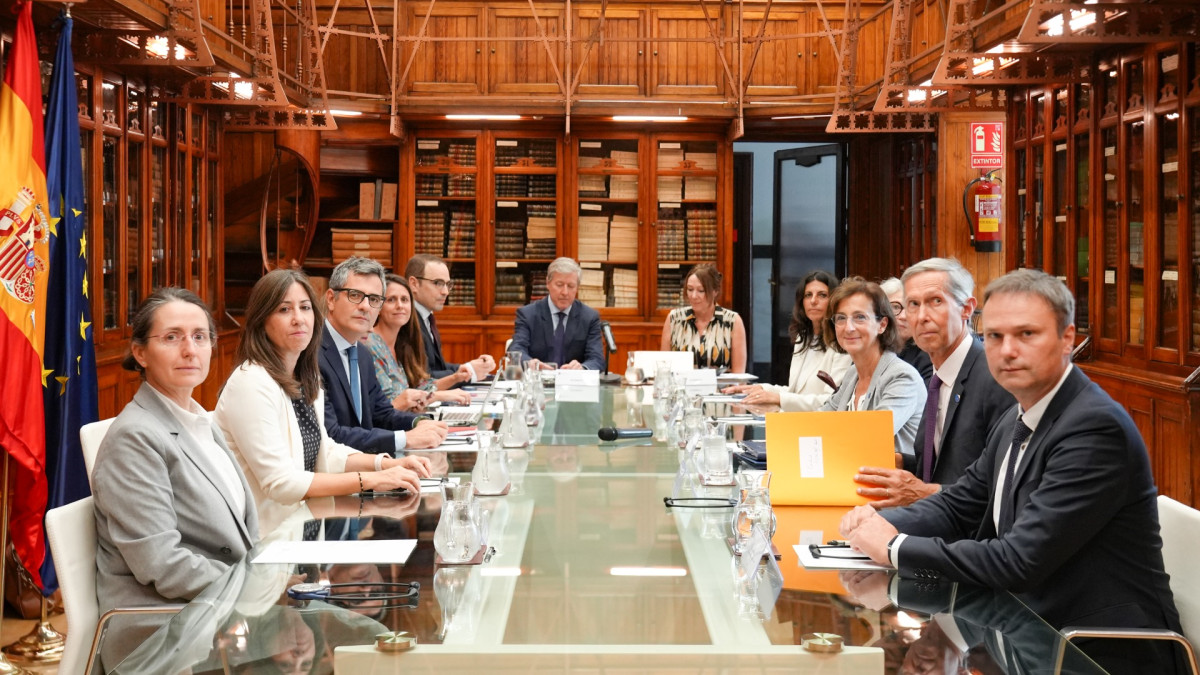
The growing activism of a portion of the judiciary has for years been presenting Spain as a country comparable to Poland under the populists of Law and Justice (PiS) or Viktor Orbán’s Hungary in terms of the separation of powers and judicial independence. This systemic crisis of Spanish democracy, as sketched by three of the four main judicial associations—which have even asked Brussels to sanction Spain by withholding the European funds it is entitled to—has not permeated the international bodies that assess our rule of law. According to The Economist Intelligence Unit, Spain remained in 2024 one of the planet’s 25 “full democracies,” ahead of Italy or Belgium. However, this apocalyptic message obliges the Government to explain itself at every review. This Monday, it did so before the Venice Commission, the consultative body of the Council of Europe, which is to analyze the General Council of the Judiciary (CGPJ). Agenda Pública has managed to view the report presented by the ministry at that meeting last Monday.
The visit of a delegation from the Venice Commission takes place months after the CGPJ fulfilled in February the legal mandate imposed on it by the latest renewal, agreed by PSOE and PP in June 2024. The law that accompanied the appointment of new members incorporated an additional obligation: the new Council had to present within six months from the approval of that law a reform proposal in the procedure for electing the vocales of judicial origin, which had to be submitted to the Government, the Congress and the Senate so that they could draft a reform project or proposal of the system. This legislative reform was to be positively evaluated by the Rule of Law Report of the European Commission, which would have to verify that it was “in line with the best European standards” regarding this type of organ. In compliance with that mandate, the CGPJ Plenum, last February, unanimously approved a report containing two reform proposals on the selection of the twelve members of that body who come from the judiciary. The conservatives’ proposal argued that the twelve judicial vocales should be directly elected by the judges themselves. The progressives proposed that Congress and the Senate, with a system that involves greater participation by the judiciary, continue to be the bodies that appoint candidates from the judiciary.
“The Venice Commission is a Council of Europe body to which the PP’s vocales have proposed a new international review of the Government”
In the negotiations to reach that agreement, the PP-proposed vocales demanded that not only the European Commission evaluate the proposals, as established by law, but also the Venice Commission. This commission is the evaluating body that, together with the Group of States Against Corruption (Greco), also of the Council of Europe, has more insistently recommended to Spain that the 12 judicial-origin vocales be elected directly by their peers without any parliamentary intervention. The judicial right has thus managed to impose a new international review of the Government, which is far more favorable to the progressive thesis: that the Cortes, and not the judiciary, should have the final word on these appointments to guarantee pluralism in the body that governs the judges.
To this end, the Ministry of the Presidency and Justice, headed by Félix Bolaños, has prepared a report to which Agenda Pública has had exclusive access. The report explains the reasons for the Executive’s preference to continue with the current model. This model is a system that, in broad terms, has remained in place since 1985 and, after the passage of successive PSOE and PP governments, has hardly been modified. The document argues that the main reason to continue with it is the democratic principle: “The involvement of Parliament lends democratic legitimacy to that body of constitutional nature,” the Government asserts. “Parliamentary election of the judicial vocales ensures that the Council does not become a self-governing, corporate structure, detached from citizen scrutiny.” Because the CGPJ, it continues, exercises governance powers such as appointments or disciplinary authority, and also has the power to approve regulations within its competences.
“According to the Government, jurisprudence establishes that there is no standard by which judges should elect judges”
The Government’s report to the Venice Commission also recalls that the current model of electing the judicial vocales by Parliament was ratified by a state pact signed in 2001, under the mandate of José María Aznar (PP), by the two main parties (PSOE and PP), with the support of all nationalist groups. It also has the backing of the Constitutional Court, which on several occasions has considered it in line with the fundamental law. It also aligns with the doctrine of the European Court of Justice (CJEU), which in cases where it has ruled on this type of bodies has noted that there is no single model in the EU—countries like Germany or Austria, despite high levels of public trust in the judiciary, lack a Council. From the jurisprudence of this court, which is binding on Spain, there is no standard that says ‘judges must elect judges,’ the Government argues. Only a result-oriented obligation is imposed: that the body be independent.
Regarding the successive European Commission Rule of Law Reports of recent years, the document notes that in 2021, 2022 and 2023, the main concern was the failure to renew the CGPJ, which remained blocked by the PP for more than five years. Brussels observed that “some associations” —the right-wing ones— had urged changing the system so that judges would directly elect twelve vocales, but it did not establish that the current parliamentary renewal model affected the independence or impartiality of the body. It also did not claim that it compromised the independence of the judges or violated any fundamental principle of the rule of law. The 2024 and 2025 editions were much more favorable to Spain due to the agreement to appoint the new vocales of the governing body and the body’s designation of most of the judicial posts left vacant because of the blockage.
Within the Council of Europe sphere, the Government refers to the provisions of the European Convention on Human Rights and the judgments of the European Court of Human Rights (ECtHR), which like the CJEU, are binding on Spain. But neither the Convention nor the Strasbourg court’s jurisprudence establish a single model for the Council and recognize each State’s right to choose its model, always with the same requirement imposed by the EU: that the system guarantees judicial independence. The preference for judicial selection of vocales originating from the career is only reflected in the Venice Commission’s recommendations and in the Committee of Ministers of the Council of Europe, which are non-binding. Both bodies note that they do not seek to harmonize the member states’ legislations and that there are democratic countries that do not even have a Council, where judges are named by the Executive or the Legislature and still have an independent judiciary.
“Non-binding reports like GRECO’s support the preference for judicial selection, but they do not doubt the independence of the judges”
Greco’s successive reports have followed the same line, which are also non-binding. The body, like the Venice Commission, recommends changing parliamentary selection and opting for the judicial route, but, unlike what Spain’s right-wing judicial associations argue, it is explicit: “This does not mean that the independence of the judges is in question”; GRECO has been very clear on this and wishes to remain clear: there is no doubt about the independence and impartiality of judges in the performance of their duties.
The Government’s submissions to the Venice Commission also expressly refer to the cases of Poland and Hungary, the countries with which, systematically, Spain’s right-wing judicial associations compare Spain in terms of judicial independence. On the former, the report recalls that the previous government of Mateusz Morawiecki (PiS) amended by law the system for electing the Council’s vocales in that country as established by the Constitution, with the immediate replacement of those who then held the post. That reform, moreover, was only one of the moves by the government to seize effective control of the judiciary. It also changed the legislation of the Supreme Court or the organization of ordinary courts. The authoritarian maneuver prompted Brussels to open a sanction procedure for the “risk of a serious breach of the rule of law.” In addition, Warsaw was warned by the CJEU, the ECtHR, and by the Venice Commission itself, which stated that the reform “would lead to widespread politicization of the body.”
The EU also opened in 2018 a sanction procedure against the “illiberal democracy” of Prime Minister Viktor Orbán. In this case, the government of the far-right Fidesz stripped the Hungarian Judicial Council of its functions through another body, the National Judicial Office, directly dependent on the Parliament and the Government, both dominated by Orbán’s party. The report prepared by the Spanish Government for the Venice Commission notes that none of these two cases—from Poland, now corrected by the new prime minister Donald Tusk, nor Hungary—are comparable to the recommendations that the successive Rule of Law reports from the Commission issue for other EU countries, such as Spain.
During the two days (Monday and Tuesday) the Venice Commission delegation held meetings with judicial vocales, representatives of the four judicial associations—the conservative Professional Association of the Magistracy, Francisco de Vitoria and Foro Judicial Independiente, and the progressive Juezas y Jueces para la Democracia—and several experts. They also met with leaders of the main parliamentary groups.
