
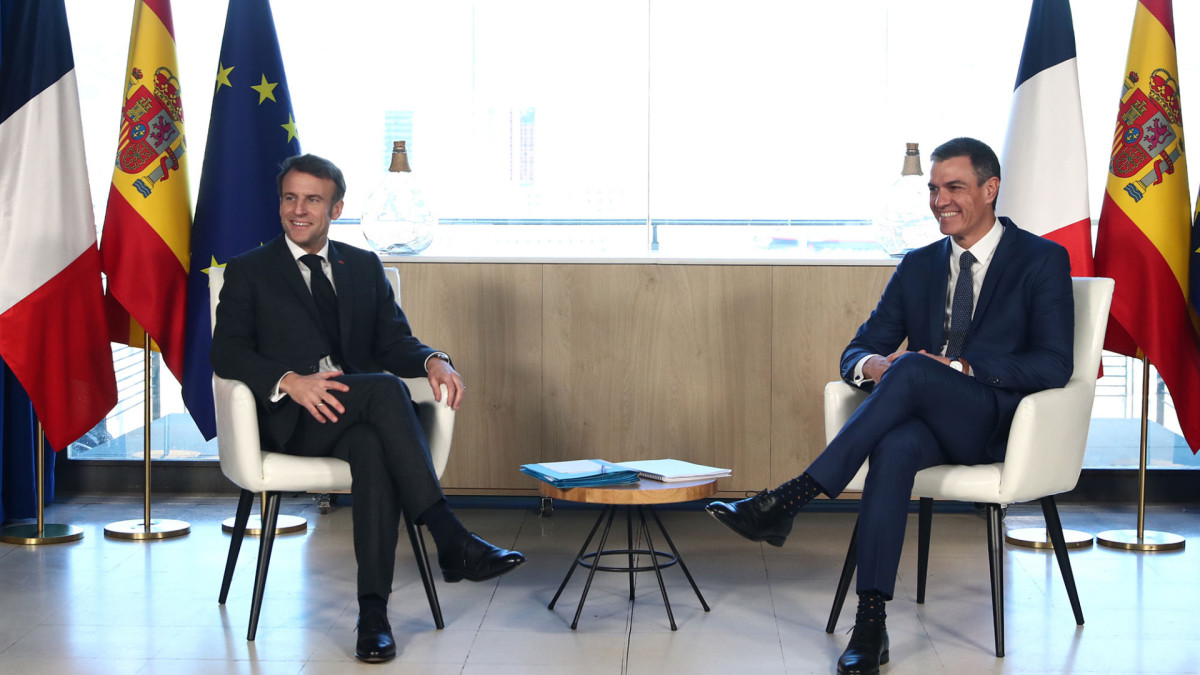
March 2, 2026. At the Île Longue submarine base in Brittany, Emmanuel Macron stepped to the podium and delivered the most consequential European nuclear speech since the end of the Cold War. Anunciou o primeiro aumento de ojivas francesas desde 1992, ordenó la construcción de un nuevo submarino balístico bautizado L’Invincible and, above all, offered his European partners something unprecedented: to sit at the table of continental deterrence, participate in strategic planning, and fall under the umbrella of France’s vital interests. Eight countries accepted: Germany, Poland, the Netherlands, Belgium, Greece, Sweden, Denmark, and the United Kingdom.
Spain was not on the list and, meanwhile, the Europe that for decades shared its pacifism had crossed to the other side.
The week that reconfigured Europe
To understand what happened one must go back barely three weeks, to the Munich Security Conference. There, on February 13, Chancellor Friedrich Merz confirmed talks with Macron about European nuclear deterrence, invoking Article 42 of the Treaty on the European Union as the legal basis for a form of collective solidarity that no one had articulated so openly since the Cold War. In the same setting, Pedro Sánchez took the opposite direction: he declared that “nuclear rearmament is not the right path” and that atomic deterrence was not a guarantee, but “a dangerous bet”. It wasn’t a spontaneous stance. Just two days later, on February 15, the Government published in the BOE the Estrategia Nacional contra la Proliferación de Arm as de Destrucción Masiva, the first document of this kind in Spain’s democratic history. Madrid closed the door before Paris opened the window.
“The only EU member state with its own nuclear capacity offers to extend its umbrella, and Spain responds with a non-proliferation document drafted the previous month.”
Spain stood outside the French nuclear plan, conditioned by the 1986 referendum and its anti-nuclear strategic culture. The paradox could hardly be more striking: while Berlin (which for a long time embodied European pacifism and bears the moral weight of having triggered two world wars) negotiated access to the continent’s most advanced nuclear doctrine, Madrid invoked a forty-year-old public consultation to stay out. The geopolitical scenario that has triggered all this does not admit naivety. Russia maintains tactical nuclear weapons deployed in Belarus and has lowered its threshold for use. Donald Trump has repeatedly questioned the American commitment to NATO’s Article 5. China has tripled its estimated arsenal in a decade. In this context, the only EU member state with its own nuclear capacity offers to extend its umbrella and Spain responds with a non-proliferation document drafted the previous month.
The legal weight of the past
Spain’s prohibition goes beyond rhetoric. The referendum of March 12, 1986, convened by Felipe González under Article 92 of the Constitution, established as an express condition for staying in NATO the “prohibition of installing, storing or introducing nuclear weapons on Spanish soil”. 52.54% of Spaniards backed that condition. To that is added the Nuclear Non-Proliferation Treaty, which Spain signed in 1987 as a non-nuclear-armed state and which prohibits receiving transfers of nuclear weapons or control over them. Moreover, the 2023 National Security Strategy places multilateralism and disarmament as pillars of Spain’s external action.
Nevertheless, the Macron proposal does not require placing weapons on Spanish soil. France retains at all times the final decision on whether to use its arsenal. What it offers is participation in consultation, planning, and joint maneuvers, a model similar to NATO’s Nuclear Planning Group, in which Germany, Belgium or the Netherlands have participated for decades without owning a single warhead. If that violates the spirit of the 1986 referendum, it is a political statement, not a legal certainty, and has never been submitted to the Council of State for opinion.
“Spain has spent four decades confusing two distinct things: opposing nuclear proliferation (a legitimate principle) and refusing to participate in the deterrence architecture that has kept peace in Europe.”
The core problem is that Spain has never legally resolved what exactly that mandate means. Unlike Germany, whose anti-nuclear stance rests on the 1990 2+4 Treaty (an instrument of international law with full legal force), Spain’s commitment rests on the wording of a consultative referendum question. Organic Law 2/1980 does not specify whether the conditions included in that question are politically oriented or legally binding. Spain has spent four decades confusing two distinct things: opposing nuclear proliferation (a legitimate principle) and refusing to participate in the deterrence architecture that has kept peace in Europe. These stances are compatible in many contexts, but not necessarily in this one.
The cost of not sitting at the table
The consequences, therefore, transcend the symbolic. After the Spanish rejection in Munich, the United States pulled back at least fifteen tanker aircraft from the Rota and Morón bases, facilities that constitute the greatest lever of Spanish military influence on the Atlantic chessboard. The former ambassador to NATO Nicolás Pascual de la Parte stated: “Spain loses the capacity to build the structure of Europe’s nuclear defense. Even if another government joins later, we will not have participated in the decisions made now.” Security architectures, like constitutions, are written in foundational moments and this is one.
What the historical moment requires is not for Spain to manufacture warheads or to renounce the Non-Proliferation Treaty. It is something more modest: a informed public deliberation about what collective security means for a Europe in 2026, what it implies legally to participate in consultation mechanisms without weapons on one’s own soil, and whether the anti-nuclear consensus of 1986 was built for this world or for one that no longer exists. That debate is taking place in Germany, in Poland or in Sweden. It is uncomfortable, full of moral and technical edges, and demands a democratic maturity that does not always accompany electoral cycles. In Spain, by contrast, the only institutional voice has been the Government saying no before it is explained exactly to what.
“The bet should be to build the instruments so that that culture can be updated when society decides, with information and without the weight of inherited taboos.”
The reform Spain needs is not a new referendum on the bomb, but institutional instruments to address the debate seriously: a permanent parliamentary commission on nuclear security and strategic deterrence, an Organic Law of National Defense that distinguishes between possession of weapons and participation in collective consultation mechanisms, and a National Security Strategy that recognises that non-proliferation and shared deterrence are not necessarily contradictory terms. It is not about changing Spain’s strategic culture overnight. The aim is to build the instruments so that that culture can update itself when society decides, with information and without the weight of inherited taboos.
The complex nuclear legacy of Spain
Since De Gaulle founded the force de frappe in 1960, France has had a very clear idea of what it means to be a sovereign power. Macron has merely updated that doctrine for the 21st century, with the novelty of offering that umbrella instead of reserving it for Paris. It is, on the one hand, a gesture with a generous face and, on the other, a strategic cross. A France that deters alone is expensive; a France that deters on behalf of eight European partners is a continental hegemonic power with collective legitimacy.
Forty years of anti-nuclear consensus do not dissolve in a week, but they also do not survive indefinitely in a world that has moved on. The longest-lasting consensuses are not those that are never questioned, but those that survive questioning. Unamuno said that in history all that is not politics is archaeology, something inert. Turning a conviction into a taboo is the first step toward turning it into archaeology.
In 1986, saying no to nuclear weapons was, in a sense, an act of independence. Spain refused to be dragged by the logic of the superpowers, to turn its territory into a pawn on the Washington or Moscow nuclear board. There was genuine sovereignty in that gesture. The issue is that, forty years later, that same stance yields the opposite result: by staying out of the European deterrence conversation, Spain does not free itself from any umbrella, but instead becomes dependent on the one others build without it. The problem is not what Spain chose in 1986, but that since then no one has had the courage to ask whether it remains the right decision. Therefore, the understanding must be that the only way to influence the Europe that is being built now is to be inside the conversation. Those who stay out do not preserve their principles. They simply lose their voice.
