
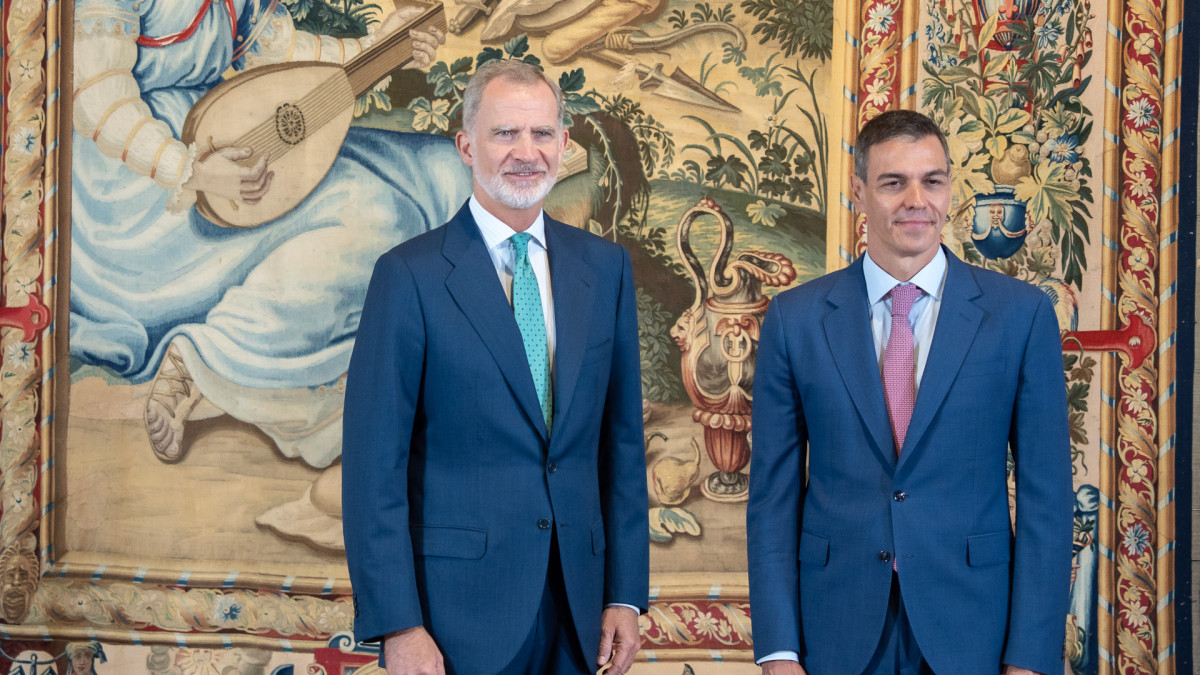
The exclusive survey by Cluster17 for Agenda Pública captures citizens’ preferences regarding the form of the State, presenting a clear view: 62.2% of respondents would keep the monarchy, though with several options on the table: 28.7% call for greater weight and intervention by the Crown, 26% would preserve its current duties, and 7.5% would reduce its role to a strictly symbolic and ceremonial function. By contrast, 36.2% think the institution should be replaced by a republic.
The Socialists Lean More Toward the King, While Vox Voters Favor the Monarchy
The assessment of the current head of state, already examined in depth in a prior analysis, noted that 58% of Spaniards rate the way Felipe VI carries out his duties as good or very good, compared with 35% who regard it as bad or very bad. And the differences in responses to this question about the king’s figure and the support for the institution allow for a detailed and nuanced analysis across the different electorates.
Among Socialist voters, for example, 51.9% would prefer replacing the monarchy with a republic, and simultaneously, 63.3% positively rate Felipe VI’s performance. Is this a contradiction? Not necessarily: a citizen can prefer a different institutional model while considering that the current head of state fulfills his duties well or very well.
“A citizen can prefer another institutional model and consider that the current head of state fulfills his duties well or very well”
In Vox the opposite is almost the case. 63.7% of its voters want a Crown with greater political intervention and another 20.5% would maintain its current functions. Yet, only 39.9% rate Felipe VI’s performance positively, compared with 54.3% who rate it negatively. The contrast also appears among the other electorates. The king’s performance receives a positive rating of 84.5% among PP voters and 63.3% among Socialists, while it falls to 38% among Sumar and to 15.7% among Junts voters.
A Thematic Look at the Institution Through a Socialist Electorate Split Nearly in Half
The differences widen even more when directly asked about the institution’s future. Among PP voters, only 3.9% want to replace the monarchy with a republic. 34.4% would keep its functions as they are, and 57.8% would push for greater political weight for the Crown. In Vox, only 13.2% choose the republic, versus 20.5% who would maintain the functions and 63.7% who demand greater intervention by the Crown. In both electorates, therefore, the prevailing option is not merely to preserve the monarchy, but to expand its political presence.
“In both electorates the most chosen option is not simply preserving the monarchy, but expanding its political presence”
The distribution changes among PSOE voters: it is the most divided electorate. 55.9% would opt for a republic, versus 44.0% who would prefer the monarchy with different functions: 27.6% would keep the current functions, 11.2% would keep it with a strictly symbolic role, and only 9.3% believes the Crown should have greater political weight. Further left, and among nationalists, republican preference rises even more. It reaches 79.3% among Sumar voters and 79.8% among Junts voters.
A View Shaped by the Territorial Debate
From a territorial perspective, in Catalonia 53.2% want to replace the monarchy with a republic; in the Basque Country the figure climbs to 58.4%.
In Andalucía the opposite occurs. Only 24.3% opt for the republic and 42.1% even demand a monarchy with greater political weight. Madrid likewise shows clearly lower republican percentages: 24.5% choose that option, while 30.3% would keep the functions and 39.1% would expand them. In short, the territorial question carries weight, especially where nationalism and independence movements have a stronger foothold.
“The territorial question carries weight, especially where nationalism and independence movements have a stronger foothold”
The age factor, however, yields more nuanced readings. Among 25- to 34-year-olds, 30.5% opt for a republic, but 39.8% directly want a monarchy with greater political weight. In the next bracket, 35 to 49 years old, support for the republic rises to 41.7%. At least among these cohorts there is no simple trajectory in which republicanism automatically increases as age decreases.
The differences between how Felipe VI’s performance is valued and the preference for the form of state culminate in a 62.2% support for the monarchy’s continuity in its various forms and a favorable rating of the current king by 58% of Spaniards. This is a level of backing for the institution that even surpasses the king’s positive appraisal.
The pan-European polling firm Cluster17 has established itself as one of Spain’s most accurate pollsters. Its survey of the 2023 general elections was the second-most precise in terms of vote shares and the third in seats, according to Electomanía. In 2024, with the survey published in Agenda Pública, it achieved the most precise Catalan election estimate and, also in partnership with this outlet, the third most accurate in the global ranking of seats and votes in the European elections.
For a sample of this size, the conventional 95% precision margin is ±2.4 percentage points.

Natalie Foster
I’m a political writer focused on making complex issues clear, accessible, and worth engaging with. From local dynamics to national debates, I aim to connect facts with context so readers can form their own informed views. I believe strong journalism should challenge, question, and open space for thoughtful discussion rather than amplify noise.