
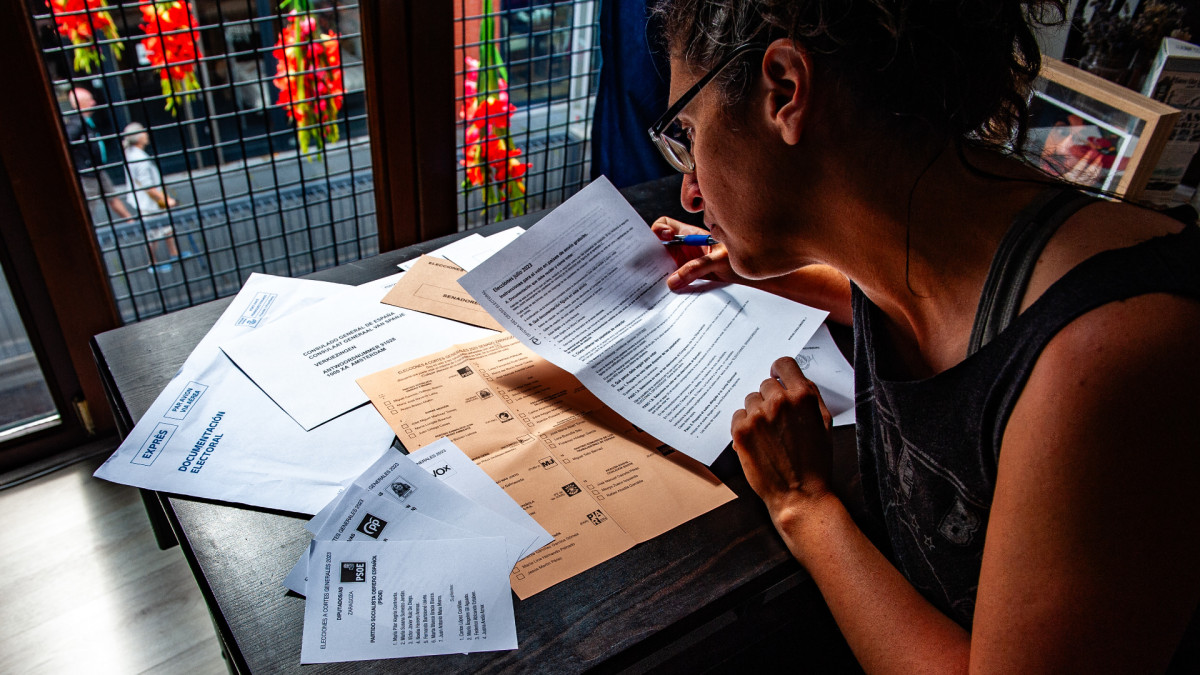
The debate over the CERA vote has reentered Spanish politics. The growth of the overseas electorate, linked to the “grandchildren law,” has reopened a discussion touching on such diverse aspects as exterior voting, immigration, and institutional trust. In a context of narrower majorities like the current one, any pool of ballots that could tilt a seat will be scrutinized to the utmost. And the overseas vote, precisely because of its physical distance and the complexity of its management, is a particularly fertile ground for controversy.
“Since 1996, the CERA vote has had a limited impact on the distribution of seats in general elections”
In order to gauge the scale of the controversy, let us consult historical data. Since 1996, the CERA vote has had a limited impact on the distribution of seats in general elections. It has not been a structural actor in Spanish politics nor has it recurrently altered the composition of Congress. Since that year, only on two occasions has it tipped a seat to one side or the other. In 2019, the PNV lost a seat in Bizkaia. And in 2023, the PSOE lost another in Madrid. In both cases, the beneficiary was the Partido Popular. Outside of those margins, although there are other instances of very tight seats, its weight has been far smaller than the intensity of the current debate suggests.
In global terms, the overseas census has grown clearly. The CERA accounted for 1.6% of the total census in 1996 and reached 6.2% in 2023. In volume, it rose from under half a million electors to over 2.2 million, which represents an evident demographic and electoral transformation. Spain today has a much larger overseas political community than three decades ago, formed both by emigrants and by descendants of Spaniards living abroad. Today, it is expected that, for the next general elections, the electoral census will surpass four million people.
However, the level of participation varies greatly inside and outside Spain. While domestic residents’ participation has remained, with some fluctuations, in a relatively stable band—between 67% and 75%—the participation for the CERA vote has followed a much sharper trajectory. Before the vote-by-petition era, the overseas vote reached significant percentages: around 32% in 1996, near 29% in 2008, and about 25% in 2004. After the 2011 reform, the decline was immediate. Overseas participation fell to record lows, around 2% or 3% in several elections, and only began to recover after the elimination of the vote-by-petition system.
This break is essential for understanding the debate. The bureaucratic barrier strongly separated the formal right to vote from the actual vote. For this reason, the subsequent reform aimed precisely to fix that problem: facilitate access to the ballots, extend deadlines, and restore normality to a participation that had been artificially depressed.
“A very large CERA with very low participation has limited potential to alter outcomes”
The 2023 result allows us to observe that slight recovery, as CERA participation rose again to around 6%. It is a leap compared to the years of petition voting, but it remains far from pre-2011 levels and even farther from the participation of residents in Spain. This point is decisive: the size of the overseas census matters, but less than its participation rate. A very large CERA with very low participation has limited potential to alter outcomes. A similarly large CERA, but with participation returning to levels of 20% or 30%, would completely change the scale of the debate.
Nevertheless, those years of high CERA participation did not end up tipping the balance. Of the 520 provincial apportionments analyzed—52 constituencies across ten elections since 1996—only two show changes attributable to the overseas vote. Therefore, historically, the overseas vote has not been a major driver of electoral change. In other words, it does not decide the country’s overall direction, and in few cases can it determine the last seat in a province.
The current controversy also introduces a new element: the possibility that the CERA could grow much larger in the coming years. If new nationalities and registrations derived from the Democracy Memory Law push the overseas census above four million electors, Spain would enter an unprecedented phase. That increase would be substantial. In gross terms, we would be talking about an overseas electoral body roughly the size of some large autonomous communities. The figure alone carries political weight.
“Although there is a perceived overrepresentation of the left compared to the electoral cycle, there is generally no clear trend”
Depending on participation, the scenario could range from 200,000 to 600,000 voters; at the higher end, the participation rate would exceed 10%. This is not irrelevant, but the unpredictability of participation is compounded by the very sense of the vote itself. In the map below, one can consult the evolution of the overseas vote’s provincial political map. While there is a perceived overrepresentation of the left relative to the electoral cycle, there is generally no clear trend, and this vote tends to fluctuate with the political moment. In 2015, the rise of new parties also pushed a change in the overseas vote which, in the last 2023 elections, again left a two-party map very similar to that of 1996.
It is also important to note that the census is not distributed evenly within Spain. In this regard, Galicia’s overrepresentation in this CERA vote is particularly notable: the region hosts 472,141 voters abroad (2023 data), surpassing the figures for Madrid Community (376,505), Catalonia (281,551), or Andalusia (269,380), although its participation is lower.
Since this issue extends beyond Spain, other countries have proposed an intriguing solution to this problem. Italy and Portugal have their own dedicated overseas voting constituency. Broadly speaking, this would carve voters out of the province to which they are registered and consolidate their vote into an additional “province” that would allocate a number of seats proportional to the census it represents. In this way, distortions that could occur in smaller constituencies—such as those in Galicia—are avoided. It would also help reduce the noise surrounding a supposed alteration of the electoral census, which, as the data indicate, could not even be controlled by the legislature. Moreover, it would allow Spaniards abroad to have their demands better addressed by having representatives elected directly by them.
