
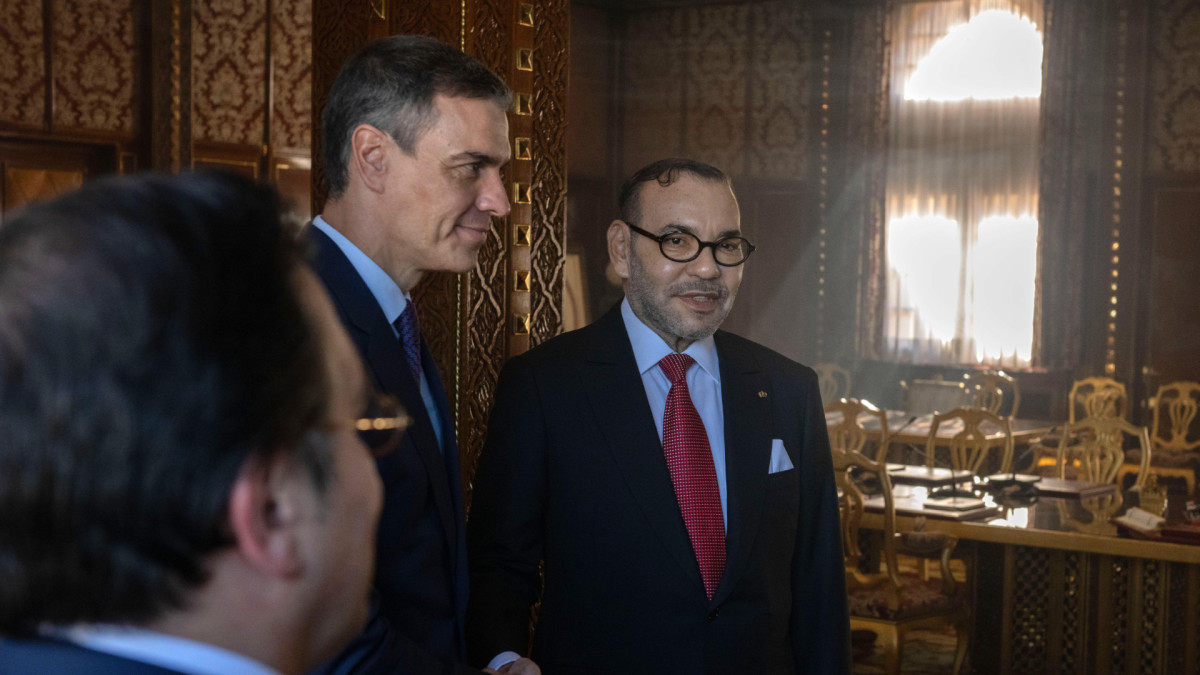
Amid the Ceuta crisis, 77.6% of Spaniards have a negative image of Mohamed VI. This perception spills into other spheres, as reflected by the fact that 61.9% reject Spain and Portugal sharing with Morocco the organization of the 2030 World Cup. The discontent with Rabat is widespread, crossing ideological borders and also entering the agenda of Socialist voters.
The Cluster17 survey for Agenda Pública, conducted during the crisis —between August 22 and 25— records this rejection unequivocally. However, this negative perception does not translate into a willingness to break off relations: in the event of a new massive and irregular entry through Ceuta or Melilla, only 3.1% would choose suspending diplomatic relations as the main option.
A rejection that crosses blocs
As the leading political figure of the neighboring country, Mohamed VI concentrates the most emphatic result. 56.7% of Spaniards give him a rating of zero and another 21% place him between 1 and 3. Conversely, only 5.2% grant him a rating of 7 or higher. Of all the figures and political leaders queried, such as Giorgia Meloni, Donald Trump, Mark Rutte or Emmanuel Macron, the Moroccan king is the one who receives the worst ratings.
“The 56.7% of Spaniards give Mohamed VI a rating of zero and another 21% place him between the 1 and 3”
In the face of such broad disapproval, the distance between electorates is relatively small. For example, 88.7% of Vox voters rate him below 3, as does 83.2% of PP voters. Among those who voted for PSOE this rejection reaches 80.3% and among those of Sumar, 75.6%.
The 2030 World Cup, which has sneaked into the debates in the Congress of Deputies, is a second indicator. 61.9% are fairly or very opposed to Spain and Portugal organizing the tournament together with Morocco, compared to 10% who are fairly or very in favor. Another 23.6% adopt a middle position.
But here political differences widen. The rejection reaches 86.9% among Vox voters and 78.7% among PP voters, while on the left the PSOE supporters reject it only 42.7% —which remains the most widespread position ahead of 17.3% who back the organization of the World Cup with Rabat—. In Sumar, the percentages are 46% and 11%, respectively.
“In the left the PSOE voters only reject it at 42.7% —which remains the most widespread position ahead of 17.3% who back the organization of the World Cup with Rabat—”
Back in the day, the joint bid was presented from its origins as a tool of cooperation among Spain, Portugal and Morocco and as a bridge between Europe and Africa. Sharing the tournament would project cooperation among Spain, Portugal and Morocco beyond the usual concerns of security, immigration or trade. Now, the rejection by Spanish citizens captured in the survey makes that political dimension of the World Cup a much less consensus-driven issue.
The responses in the face of a new crisis
After the massive entry on July 30 and 31, several dates have been proposed for future entries. When it is suggested that these new massive arrivals could occur again in Ceuta or Melilla, Spaniards do not consider suspending diplomatic relations with the Moroccan kingdom as their first option: only 3.1% would choose this path.
The preferred option is to request direct intervention by the European Union, including a possible deployment of Frontex, with 23.9%. Immediately returning individuals at the border, almost tied, appears with 23.6%. After that comes the deployment of the Armed Forces to control the border perimeter, at 14.6%; economic sanctions on Morocco, a policy that would also be disruptive, at 12.4%; and humanitarian reception and the processing of individual asylum applications, at 11.7%. Bilateral negotiations with Rabat offering economic counterparts to strengthen border control obtain 5.5%.
“The preferred option is to seek direct intervention by the European Union, including a possible Frontex deployment, at 23.9%”
The preferred recipe varies greatly depending on whom you ask. Among PSOE voters, European Union intervention occupies the top spot, at 28.7%, followed by humanitarian reception and the processing of individual asylum applications, at 23.4%. Immediate returns receive 11.5%. In Sumar, the preference is for humanitarian reception, at 29.7%. They are followed by European intervention, at 23.6%, and economic sanctions, at 17.5%.
On the right, the preferred response is different. 36.4% of PP voters would opt for immediate returns, 24.4% would call for EU intervention and 17.5% would deploy the Armed Forces. Among Vox voters, 40.4% would choose returns and 35.1% would opt for military deployment; European intervention stands at 13.7%.
In short, Mohamed VI’s rating brings together very different electorates, but there is no consensus on the solutions. In this case, parties may be acting as drivers of these demands, shaping voters’ preferences because the positions align with their frames. That is, if the government shows more interest in European intervention, it makes sense that PSOE and Sumar voters might lean toward that option. Similarly, if Vox —especially— and the PP adopt a securitization discourse, the survey results should not surprise.
The discontent also reaches the Socialist electorate
In the discussion about Morocco as a partner, attention focuses particularly on the PSOE electorate. 80.3% of those who voted for PSOE in the last general elections have a negative image of Mohamed VI and the option of rejecting the World Cup if it is organized with Morocco is the most widespread. This is a notable fact for a government that has aimed to maintain a close and stable relationship with Rabat. The Spanish shift on Western Sahara in 2022, which moved the government’s stance toward the Moroccan-autonomy proposal of 2007, was the most visible manifestation of that policy. However, the rapprochement between Madrid and Rabat extends to other core issues for Spain, such as immigration, security, the fight against terrorism, trade and the management of Ceuta and Melilla’s borders.
“Mohamed VI’s evaluation brings together very different electorates, but there is no agreement on solutions
The editor and director of Agenda Pública, Marc López Plana, already suggested in “The Moroccan dossier: the European test that separates the PP and PSOE” that Morocco could become one of the arenas where the Conservatives and Socialists reveal differing conceptions of Spanish foreign policy.
With Cluster17’s data on the table, part of that difference in preferred tools in the face of a new crisis is explained. Now, Spain will continue needing Morocco’s cooperation on immigration, security, trade and border management. The poll results sketch a very critical public opinion of Mohamed VI and largely against sharing the World Cup, but not inclined to break relations. In the event of a new crisis, EU intervention is, by a narrow margin, the option with the most support.
The pan-European polling firm Cluster17 has established itself as one of the most accurate in Spain. Its 2023 general election survey was the second most precise in votes and the third in seats, according to Electomanía. In 2024, with the survey published in Agenda Pública, it achieved the most precise estimate of the Catalan elections and, likewise with this outlet, the third most accurate in the overall ranking of seats and votes in the European elections.
For a sample of this size, the conventional 95% precision reference places the maximum margin at ±2.4 percentage points.
