
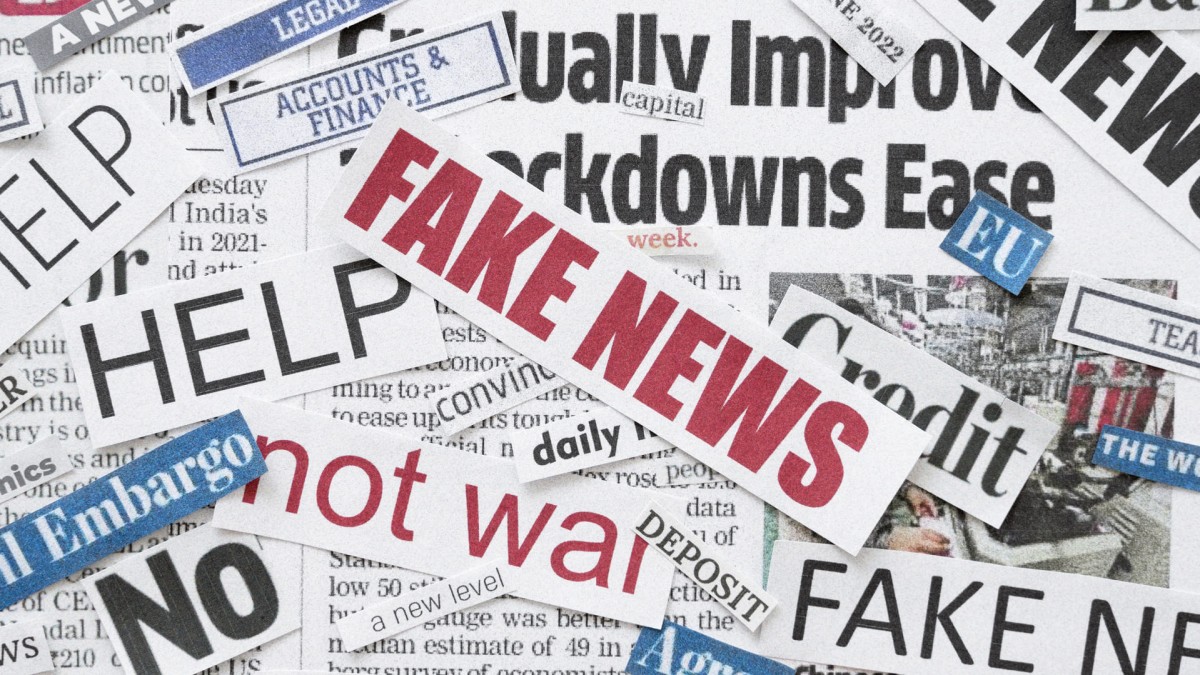
In the contemporary digital ecosystem, where every click holds value and every moment of attention is a commodity, a covert threat is spreading: the consolidation of the fake media industry. This phenomenon, driven by the logic and opacity of programmatic advertising and by the sophistication of artificial intelligence tools, not only erodes trust in information, but also jeopardizes the viability of traditional media.
The report The New Contours of Disinformation, coordinated by journalist Carmela Ríos and promoted by the Luca de Tena Foundation, denounces the emergence of websites that imitate the design of legitimate media, but whose sole aim is to monetize digital traffic through viral content and disinformation backed by advertisements from real brands, such as Correos, Temu, or Orange. “This is a scam for the industry,” warns Ríos. “A scam, moreover, with a business model.”
“The research was based on an exercise of active listening in the months leading up to the European elections. The team designed eight fictitious profiles on social networks, each with their ages, lifestyles and ideological biases”
The research was based on an active listening exercise in the months prior to the June 2024 European elections. The team designed eight fictitious profiles on social networks such as TikTok, X (formerly Twitter), Facebook and Instagram, each with different interests, ages, lifestyles and ideological biases. These profiles acted as real users for three months, without intervening or guiding their navigation. The objective: observe what kind of content the algorithm would select for each of them. The result not only confirmed known trends, but also revealed new and alarming ones.
First, that disinformation campaigns no longer respond to the electoral calendar. They operate continuously, outside the institutional radar, mutating and adapting to contexts and audiences. With the help of artificial intelligence, these campaigns construct narratives tailored to each profile. In other words, political campaigning has become permanent.
Second, that maintaining a moderate or apolitical stance on social media is practically impossible. Although several of the created profiles did not express clear ideological preferences, they were dragged toward polarizing content. The algorithm not only fails to neutralize conflict: it fuels it.
A threat to professional journalism
Third, that disinformation no longer merely distorts the truth: it also competes economically with legitimate media. Content farms operate as counterfeit outlets: they imitate the design and tone of professional press, spread emotionally charged hoaxes to promote clickbait, and generate revenue through programmatic advertising. AI fuels the entire cycle: from generating text, to creating images, designing the websites, or personalizing messages.
Behind that seemingly innocent façade lies a complex operation. Each click activates a monetization system that does not distinguish between real or fraudulent media. Programmatic advertising distributes ads automatically, without brands knowing where their ads will appear. This is where the system fails: legitimate companies unknowingly fund platforms that deceive users and amplify disinformation. According to research by NewsGuard and Comscore, this ecosystem generated $2.6 billion in annual revenue in 2021.
“To a young person with doubts about immigration, xenophobic messages are served. To an ecologist, hoaxes about climate change. Disinformation seeps in through the emotional or ideological crack”
Fourth, algorithms do not merely recommend content. They refine it as well. They are capable of detecting users’ vulnerabilities and offering disinformation tailored to their interests and susceptibilities. To a young person with doubts about immigration, xenophobic messages are served. To an ecologist, hoaxes about climate change. What emerges is targeted, surgical disinformation designed to penetrate the most sensitive emotional or ideological fissure.
Fifth, artificial intelligence marks a turning point. It has made disinformation more sophisticated, harder to detect, and more effective. It affects every phase of the process: content creation, its design, audience segmentation, account automation, and the amplification of dissemination.
Sexth, disinformation knows no borders. The same narratives, barely adjusted, circulate across different countries and cultural contexts. The migration issue is the clearest example. The same formulas—fear, invasion, replacement—are replicated in Italy, Spain, France, or Germany with only minor variations.
From conspiracy theories to Russian influence
Although not a new phenomenon, the COVID-19 pandemic accelerated its spread. Sites that looked like information outlets promoted unproven treatments and conspiracy theories that thrived in fertile ground: fear. Disinformation not only found an audience, but also a path to profitability. Since then, artificial intelligence has only refined the model.
Additionally, there is a rise in financial scams that use manipulated videos of political leaders as bait. The study does not hesitate to point to organized actors behind these campaigns, including Russia, which would have directed content to Spanish users with the aim of tarnishing Ukraine’s image and reinforcing the Kremlin’s narrative.
The conclusion of the report is clear: disinformation is no longer an accident or anomaly. It is a structural part of the contemporary digital experience. Its engine is economic, its vehicle is technology, and its shield is the opacity of algorithms. In the face of this, there is an urgent need for regulatory review, but also for a new ethics in digital architecture. Because if anything this phenomenon reveals is that disinformation is not only profitable. It is, in many cases, good business.
