
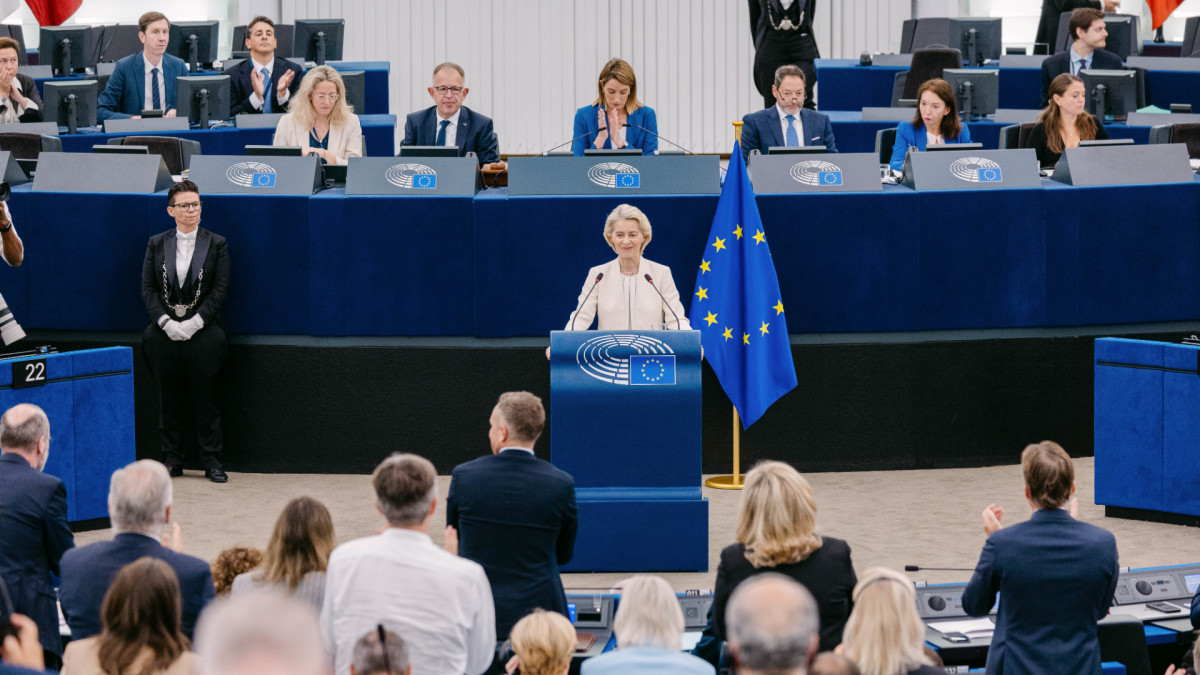
Starting the new term means paying attention to the State of the Union (SOTEU) address by the President of the European Commission. Established by the Framework Agreement between the European Parliament and the European Commission in 2010 and inaugurated that same year by then-President Barroso, its goal is to assess what has been achieved in the previous year and set new objectives and priorities for the coming twelve months.
Why the SOTEU matters: guidance, agenda and tone
This is not a minor matter: it sets the tone for the Commission. In fact, the tone has evolved over the years. If under Barroso the tone was cautious and technically oriented, in a context marked by the sovereign debt crisis, with Juncker (2014-2019) it was given greater political weight and leadership, with a certain underlying institutional optimism. With the current president, von der Leyen, there have been significant changes: the shift moved from a crisis-management tone in 2020 and 2021, with a turn toward the principle of solidarity, to another one more economic (Green Deal, technology and competitiveness) and oriented toward strategic autonomy.
However, in 2026 its character has been different. The quote chosen to describe a complex era of deep geopolitical, economic and political disruption was “It was the best of times, it was the worst of times.” The speech moves from an optimistic tone to a realistic one that requires execution, speed and positioning. And, for this reason, it announces a Congress for Europe that will allow reflection on the future of our continent, similar to the 1948 model after World War II.
An economic and technological agenda
Among all the topics mentioned — trade policy, international relations, the single market, omnibus, industry (electricity and energy prices), climate change, food and water security, scalability, social rights, security and defense, disinformation, AI, minors, migration and borders, and sanctions — the economic and technological agenda is of particular interest. And, especially, the needs and the steps to follow.
“The speech moves from an optimistic to a realistic tone that requires execution, speed and positioning”
First, the single market. Now that the political agreement One Europe, One Market has been in place since April, it is essential to implement it rapidly. In the digital realm it is not straightforward. To this end, the proposal of a Pact against the gold-plating is key, due to the impact of additional obligations that can be imposed at the national level and that generate geographic differences and differential treatment for companies that want to be competitive in different national jurisdictions of the EU. It is crucial to have political will to materialize this issue. An example of this is the proposal for the regime 28, which, by its nature, should be proposed as a regulation and is encountering divergences with national regimes.
Second, the scalability. Since 2025, the European Startup and Scaleup Strategy has been working nimbly to implement its initiatives. Equally important was to have methodologically sound data to make evidence-based decisions — with the novel Startup and Scaleup Scoreboard, which ranks countries by the maturity and development of these up-and-coming companies — as to establish the Scaleup Europe Fund, an entity promoted by the public sector and privately managed that aims to invest in startups in artificial intelligence, quantum technologies, clean technologies, biotechnologies and space.
From the operational to the strategic, from the regulatory to the investor, scalability, however, has received limited treatment in the SOTEU. It has been indicated that a new banking package will be proposed to incentivize risk appetite and that new ways to deploy public and private funds will be sought, but without further precision.
“The proposal for the regime 28, by its nature, should be proposed as a regulation and is encountering divergences with national regimes”
In the case of Spain, there should be a faster pace to implement scalability measures. Spain is placed in the third category (out of four), called catching-up, in the referenced European classification. It is true that there is a concentration of cutting-edge hubs in Spain, such as Barcelona and Valencia, but the reality is that the national score places us below the European average. Hence, when the European Commission makes proposals, our country truly benefits from the opportunities offered, including recent initiatives such as the proposed Innovation Regulation.
Third, artificial intelligence. This is the occasion on which AI has been mentioned the most in the SOTEU. And not only because of the number of mentions, but also due to the breadth of topics. It has addressed frontier models and their greater capacity to generate risks; the hybridity between AI and cybersecurity; the challenges of self-improving models; incidents generated by AI agents and the increased ease of inserting malicious code. Three specific proposals have been made. First, to work with like-minded partners — pointing to countries such as Canada and the United Kingdom — for the assessment, verification and early warning of models, AI safety and much more. Second, to invite leading frontier laboratories to a debate on how current industry efforts can be supported to set the pace at the frontier. Third, to identify an industrial AI approach, leveraging the value of data at a European scale and promoting applications in sectors identified as key: health, transport, agri-food, advanced manufacturing, defense and space.
There remains a question: AI has been linked for the first time to national security, indicating a need to “protect” in a highly sensitive area that has thus far been identified as a state competence.
“The proposal to invite the leading frontier laboratories to a debate on how current industry efforts can be supported to set the pace at the frontier”
All of this can be linked to the fourth point: the international arena, trade policy, security and defense. The proposal to create a Technology Alliance is important to consider, especially in a context of fragmentation of international collaboration. It will be crucial to include countries that are not digitally mature in the same conversation. At the same time, there is talk of equal conditions in trade policy and the need to develop a new European Corporation for Critical Raw Materials, with the aim of obtaining and storing strategic components needed for electric cars, chips, batteries, clean technologies and defense. And, finally, a new European Security Strategy, a European Security Council and an Instrument for Strategic Enablers aligned with NATO.
“The proposal to create a Technology Alliance is important to consider, especially in a context of fragmentation of international collaboration”
Although technology is not explicitly mentioned, this dimension will be essential. Increasingly, the dual-use nature of seemingly civilian technologies is a topic that requires attention and has been articulated under the Economic Security Package. Providing legal clarity, guidance and support to companies in handling the technologies they develop and the limits for whether they are dual-use will be key to ensuring the growth of European competitiveness. Likewise, the role of technology in improving the EU’s capacity to respond to emergencies is crucial.
Finally, and no less important, the SOTEU speaks of the social dimension and the protection of minors. On the one hand, it has been announced that, due to the tenth anniversary of the European Pillar of Social Rights in 2027, the President of the European Council, António Costa, will be invited to assess results and reflect on the impact of technology. On the other hand, the European Commission’s proposal for an “EU KIDS Act” is of great interest. With a gradual and differentiated approach, it is proposed to prohibit access to social networks for those under thirteen and to prevent them from having a personal account until age fifteen. This means there will only be accounts for minors between thirteen and fifteen, configured and supervised by parents, with limited features and time restrictions. And, between fifteen and eighteen, safe-by-design will be mandatory for platforms. Beyond regulation, it will be especially valuable to see how it is accompanied by initiatives to empower and educate minors, their families and teachers in the digital environment, so that they acquire the skills needed to navigate this realm safely and responsibly. These initiatives should address, at the same time, the right to information and the effective participation of minors.
“Technology is not merely a public policy among others, but the backbone of Europe’s future and, in Spain, a matter of state policy”
What is certain is that this year’s SOTEU has reaffirmed technology as the most mentioned and repeated theme throughout the speech. Its linkage to geopolitics, the economy and the social sphere demonstrates that technology is not just another public policy but the backbone of Europe’s future and, in Spain, a matter of state policy.
