
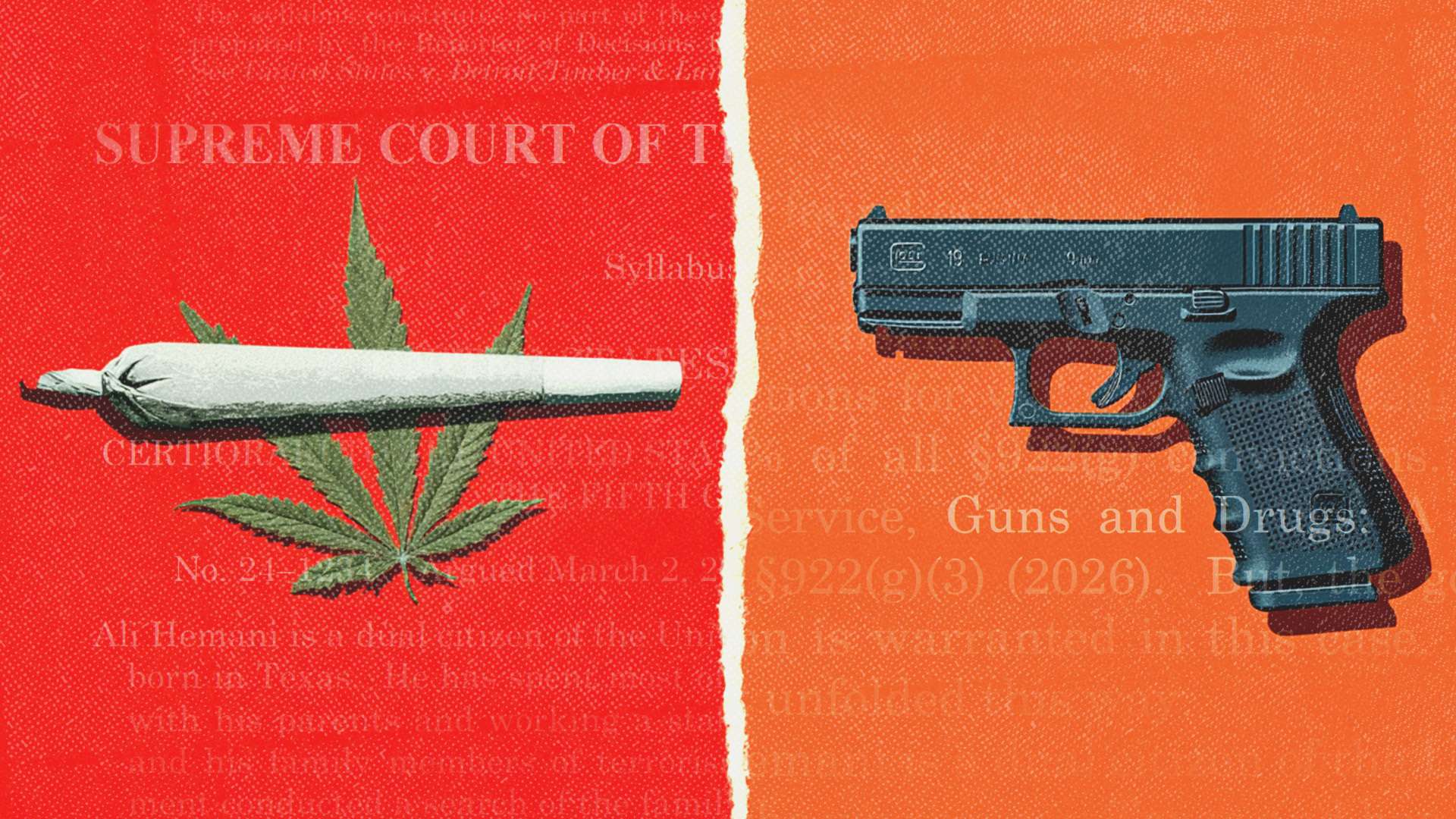
The Court’s unanimous ruling safeguarding the gun rights of people who use cannabis stands out against the Supreme Court’s long-running pattern of aligning with drug‑war policy preferences. In United States v. Hemani, the Court explained that neither disarming cannabis users nor prosecuting them for illegal firearm possession merely because they smoke marijuana corresponds with this nation’s historical approach to regulating firearms, as defined by the Bruen framework established in 2022.
Given how the oral arguments sounded in March, the outcome was not shocking. Yet the unanimity—confirming that the government failed to satisfy Bruen’s standard—highlights the fragility of the Trump administration’s rationale for barring cannabis users from firearms, which rested on a problematic analogy to how “habitual drunkards” were treated in the past. The decision also casts doubt on the logic of 18 U.S.C. 922(g)(3), which makes it a felony, carrying up to 15 years in prison, for an “unlawful user” of “any controlled substance” to receive or possess a firearm.
Still, the ruling is striking in light of the Court’s history of bending constitutional restraints to drug-enforcement efforts. Critics have long argued there exists a “drug exception” to the Fourth Amendment due to the Court’s deference to drug policy. But in Hemani the Court makes clear that no such exception applies to the Second Amendment.
The case concerns Ali Hemani, a Texan who faced charges under Section 922(g)(3) on two facts: he owned a pistol and he acknowledged using marijuana several times a week. Although those facts would typically suffice for a conviction, the case did not go to trial after a federal judge dismissed the charge in February 2024 on Second Amendment grounds, and the Fifth Circuit affirmed that decision in January 2025.
That result aligned with the Fifth Circuit’s August 2024 ruling in United States v. Connelly, which held that the Second Amendment bars Section 922(g)(3) prosecutions when they rest solely on the statutory elements. The Trump administration, while professing to defend “protecting Second Amendment rights,” pressed the Supreme Court to reject Connelly and revive the Hemani charge.
The government’s attorneys may have hoped the circumstances surrounding the FBI terrorism investigation that led to the search—ultimately yielding Hemani’s gun and marijuana—would shape the Court’s view of him. If so, their expectation was misplaced. Although Justice Neil Gorsuch’s majority opinion notes that the FBI had suspected Hemani and his relatives of terrorism-related activity, that fact plays no role in the analysis.
That is not hard to see why. The government asks us to conclude that anyone who regularly uses marijuana is categorically violent and dangerous without any further showing, as Gorsuch observes. The Trump administration’s defense did not rest on claiming Hemani was unusually dangerous, and the absence of any such claim doomed its case.
“Ali Hemani uses marijuana a few times a week,” Gorsuch notes. “That fact alone, the government says, means he is automatically barred from possessing a firearm under federal law. And because Mr. Hemani admits he owns a gun despite this ban, the government now seeks to prosecute him, imprison him for up to 15 years, and disarm him for life.” That last consequence arises from another gun statute, 18 U.S.C. 922(g)(1), which forbids firearm possession by anyone convicted of a crime punishable by more than a year in prison.
In trying to justify such severe penalties for a man with no history of violence, the government argued that Section 922(g)(3) resembles early laws that permitted confinement of “habitual drunkards” in jails, workhouses, or asylums. The justices did not strain to see any validity in that comparison, recognizing its fundamental flaws.
In the 18th and 19th centuries, a habitual drunkard was not simply someone who drank regularly, even at levels that today might seem extreme. “Had habitual drunkard laws applied to those who merely drank regularly, many notable early Americans could have faced trouble,” Gorsuch notes. “John Adams took ‘a tankard of hard cider’ with his ‘daily breakfast.’ Some say James Madison ‘consumed a pint of whiskey daily.’ George Washington often drank three glasses of madeira in the evening—‘not enough to be considered a heavy drinker in his day.’”
Gorsuch also points to the bar tab from Washington’s 1787 farewell party at City Tavern in Philadelphia. The 55 guests reportedly ordered a vast array of drinks—madeira, wine, old stock, porter, cider, beer, and punch.
Even the American Temperance Society itself viewed people who “drank 12 ounces of hard liquor daily” as only “occasional drunkards,” according to Gorsuch. In that organization’s view, “it took 24 ounces” to qualify as a “confirmed drunkard.”
Given the era’s culture of heavy drinking, Gorsuch argues, it is clear that labeling someone a “habitual drunkard” required more than routine use. Historically, the category encompassed individuals whose drinking materially disrupted their lives. “The government’s historical laws targeted habitual drunkards not merely because they regularly used intoxicants, or even sometimes used them to excess,” Gorsuch writes. “Instead, those laws focused on habitual drunkards because their drinking rendered them practically incapacitated and incapable of managing their affairs.”
The government’s analogy linking occasional or regular cannabis users to habitual drunkards, in other words, collapses at the outset. “The habitual drunkard laws on which the government relies here differ dramatically from §922(g)(3)’s unlawful user provision on every single metric the government invites us to consider,” Gorsuch writes. “They targeted different kinds of people, did so for different purposes, and operated in different ways.”
The government contends that Section 922(g)(3) makes sense because it aims to shield the public from “unusually dangerous” individuals who commit “violent crime.” It argued that the laws aimed at habitual drunkards served a comparable purpose. Gorsuch disagrees.
The cited vagrancy laws, the Justice notes, targeted people who “did not meet the societal expectation of work.” Such laws may have sought to promote productivity or suppress vice, but they were not aimed at a class of people deemed “unusually dangerous.” Civil-commitment laws likewise did not seek to shield the public from violence so much as protect habitual drunkards from themselves and from the financial ruin that their condition could bring to their families, Gorsuch explains.
The government also pointed to surety laws, which required individuals to post bonds that could be forfeited for misbehavior. But those laws did not resemble §922(g)(3) either. “Under those laws, a judge could impose a good-behavior bond on individuals who threatened a ‘scandal,’” Gorsuch notes. “A scandal could range from visiting bawdy houses to eavesdropping to, yes, being a ‘common drunkard.’” Imposing a surety did not normally require a showing that the person posed a violence risk.
Gorsuch emphasizes another key distinction: the historical analogs cited by the government all involved some form of judicial review before a person’s rights could be restricted. Section 922(g)(3), by contrast, “automatically strips an individual of his constitutional right to bear arms the moment he becomes an unlawful user and until he ends his drug use—all without any pre-deprivation process.”
Gorsuch also questions the government’s assertion that Section 922(g)(3) is designed to prevent violence. He notes that it applies to every drug listed in one of the Controlled Substances Act’s five schedules—criteria like medical utility and abuse potential govern these schedules and have nothing to do with violence.
Beyond Schedule I drugs, which are wholly prohibited, the CSA encompasses many substances that can be legally prescribed. Yet if someone uses one of those drugs without a physician’s approval, they fall into the “unlawful user” category. As Gorsuch explains, that could include examples like a husband who regularly uses his wife’s prescribed Ambien to sleep, or a college student who routinely uses a friend’s Adderall to cram for exams—thus losing Second Amendment rights under §922(g)(3).
“The drug involved makes no difference,” Gorsuch writes. Nor “does it matter how much a person uses or what effects it has.” Simply regular use of any substance on the CSA’s five schedules for purposes other than its prescribed use is enough for the government to press an analogy to habitual drunkards—an analogy the Court finds lacking.
According to the government, the identity of the drug, its quantity, or whether its use has ever made someone dangerous should be irrelevant. The Court rejects that approach as unfair and illogical, and a unanimous decision holds that it is unconstitutional as well.
The Hemani ruling, like the Fifth Circuit’s Connelly decision, leaves room for a prosecution under §922(g)(3) if the government can present individualized evidence that the defendant’s drug use renders him dangerous. But it rules out prosecutions that rely solely on the statute’s bare elements without any such showing.
When the Trump administration urged the Court to hear this case, Solicitor General D. John Sauer warned that the Fifth Circuit’s reading of the Second Amendment “invalidates Section 922(g)(3) in the lion’s share of its applications.” The Court’s decision, by contrast, represents a meaningful limitation on that position.
