
Understanding what’s at stake in
Mullin v. Refugee and Immigrant Center for Education and Legal Services.
So far this term, the U.S. Supreme Court has not delivered the kind of splashy docket that tends to dominate headlines. I’m not suggesting the Court has skipped important matters—indeed, just last week it heard arguments in a significant case about holding federal officials to account for breaches of constitutional rights. Rather, the sense is that the term hasn’t yet produced the big, nationally galvanizing controversies that rally activists and shape public debate.
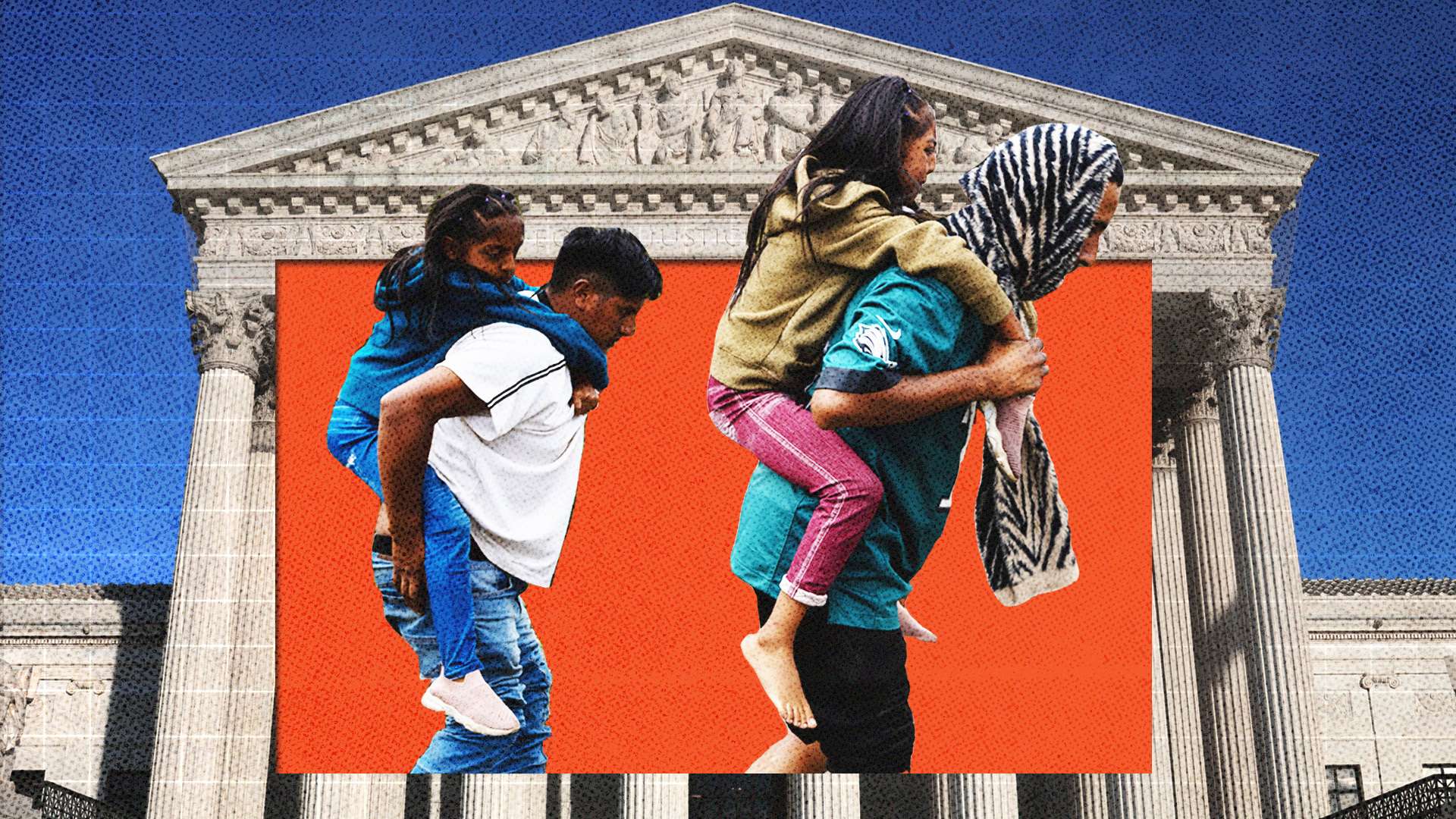
That dynamic might be about to shift. On Friday, the justices agreed to hear Mullin v. Refugee and Immigrant Center for Education and Legal Services, a dispute arising from the Trump administration’s unilateral executive move to suspend asylum protections for people at the U.S.–Mexico border. Much like last term’s landmark tariff clash, the core issue is whether President Donald Trump exercised authority that properly belongs to another branch of government. At the very least, a Supreme Court confrontation over immigration and executive overreach toward the end of the Trump era has all the makings of a blockbuster.
You’re reading Injustice System from Damon Root and Reason. Get more of Damon’s commentary on constitutional law and American history.
Under federal immigration law, individuals who are unlawfully present in the United States are subject to removal proceedings. At the same time, federal law also allows such individuals to pursue relief from removal by seeking asylum, or by seeking withholding from removal, under either the Immigration and Nationality Act (INA) or the Convention Against Torture, on grounds that they would face persecution or torture if deported.
Nevertheless, the Trump administration contends that it may unilaterally suspend these asylum and withholding protections for those who entered across the southern border without authorization. A January 2025 presidential proclamation asserted that “the President’s inherent powers to control the borders of the United States, including those deriving from his authority to manage foreign affairs, necessarily include the ability to prevent the physical entry of aliens involved in an invasion into the United States, and to rapidly repatriate them to an alternative location.”
In April 2026, the U.S. Court of Appeals for the District of Columbia Circuit rejected this executive theory. “Our task is to determine whether Congress has granted the Executive the authority to remove foreign individuals present in the United States without following the removal procedures or the substantive protections that Congress laid out in the INA,” the appellate court said. “We conclude that the INA’s text, structure, and history show that by authorizing suspension of entry through a Presidential proclamation, Congress did not intend to grant the Executive the broad removal power it asserts.”
That ruling from the D.C. Circuit is what the Trump administration has persuaded the Supreme Court to review now.
Beyond reexamining the statutory question identified by the D.C. Circuit, it is possible that the Court will also engage with the broader constitutional issue of what qualifies as an “invasion” for purposes of executive power, since Trump’s claim of “inherent” power hinges on his view that operations at the border amount to an invasion. This is a familiar line of argument—that routine constitutional limits on presidential power should be loosened or even shed when the President acts in the name of foreign policy or national security.
My expectation is that the Court will likely steer clear of that broader constitutional minefield and focus on straightforward statutory interpretation. Still, the possibility of a larger constitutional clash cannot be ruled out.
