
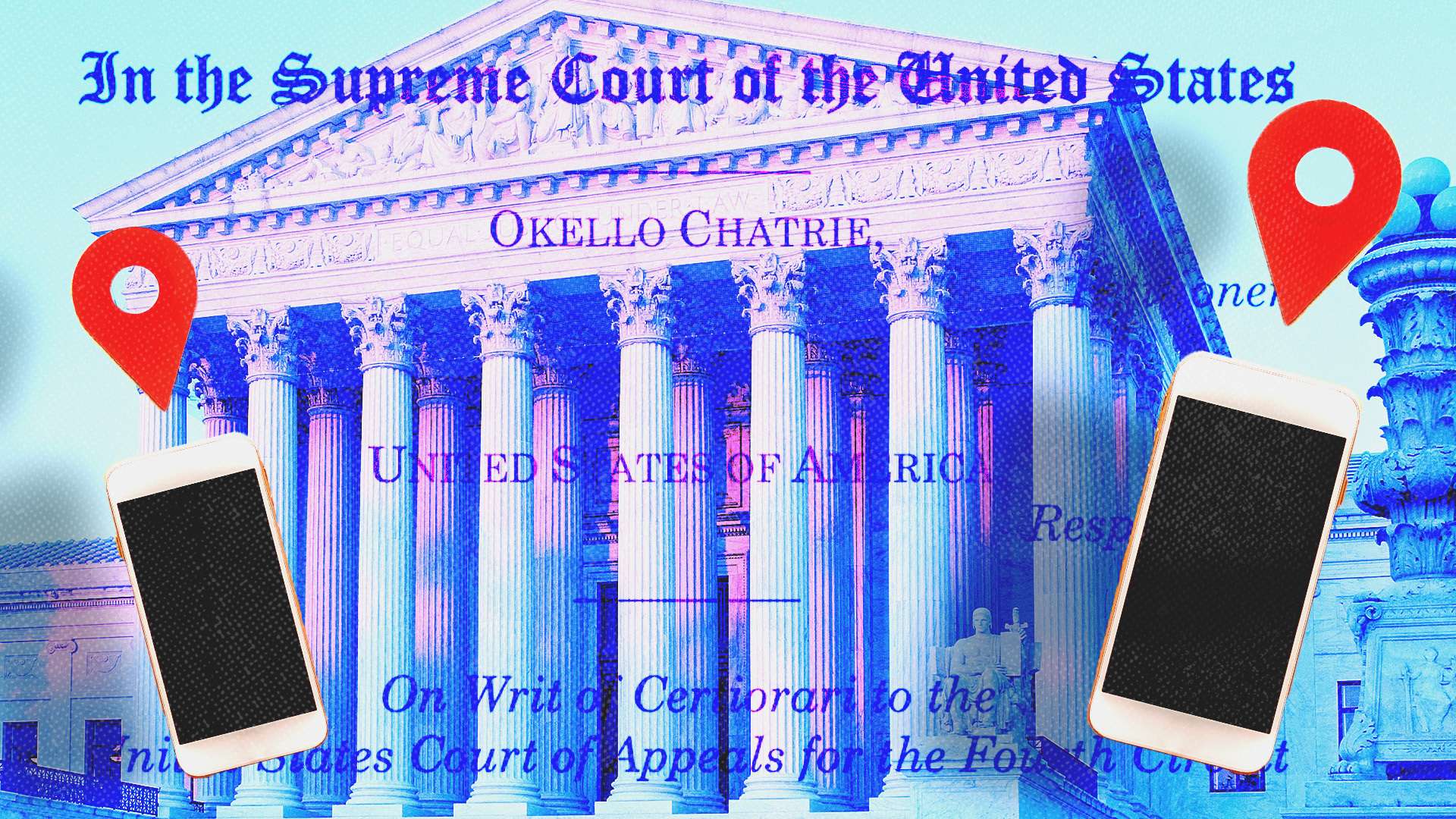
A Look at Chatrie v. United States.
On Monday, the United States Supreme Court issued a landmark ruling about the constitutionality of a law-enforcement instrument that lets authorities access the location histories of millions of cellphone users. For civil-liberties advocates, the decision was welcome: the justices held that geofence warrants count as a search under the Constitution and therefore trigger the Fourth Amendment’s protections against unreasonable searches and seizures.
The geofence warrant at issue in this case, Chatrie v. United States, was directed to Google. The order required the company to comb through the location histories of all its users to determine who happened to be near the scene of a bank robbery. That information ultimately contributed to the arrest of Okello Chatrie.
Chatrie’s lawyers contended that this policing tactic amounted to an unconstitutional general warrant, forcing Google to conduct a fishing expedition through millions of Google accounts without any basis for believing that any single one would contain incriminating evidence—the very sort of sweeping encroachment on civil liberties that the Fourth Amendment was designed to curb. “The Fourth Amendment was born from the Founders’ revulsion for general warrants and writs of assistance—instruments that allowed the government to search first and develop suspicions later,” they told the Court.
Writing for the majority, Justice Elena Kagan sided with Chatrie. “The police conducted a search when they gained access to Location History data,” Kagan wrote. “An individual has a reasonable expectation of privacy in records about his cell phone’s location, and police intrude on that constitutionally protected interest when they demand the information—even though for only a limited time, and from a third-party tech company.”
Kagan’s opinion was joined in full by Chief Justice John Roberts and by Justices Sonia Sotomayor, Brett Kavanaugh, and Ketanji Brown Jackson.
Writing alone in concurrence, Justice Neil Gorsuch agreed that Chatrie deserved to prevail but argued for a different legal rationale. “As I see it, Mr. Chatrie’s Location History data qualifies as his personal property,” Gorsuch wrote, which would place it among his “effects,” a specific category listed in the Fourth Amendment itself. And “just as the First Amendment protects speech over the internet today no less than it did speech delivered in the town square in 1791,” Gorsuch argued, “it should hardly come as a surprise that the Fourth Amendment might protect as personal ‘effects’ electronic diaries of one’s travels as it always has more traditional ones.”
With Gorsuch thus voting in favor of Chatrie, the final result of the case was 5–1–3 on the legal reasoning and 6–3 on the outcome.
Justice Samuel Alito wrote the principal dissent, joined in full by Justice Clarence Thomas and joined mostly by Justice Amy Coney Barrett. According to Alito, the Court’s “pose as a great champion of privacy in the digital age” will only “unleash” an “upheaval in Fourth Amendment law.” Alito said, “I cannot support this irresponsible escapade.”
Here’s a little rule of thumb for Fourth Amendment cases: Whenever you find Gorsuch and Alito on opposite sides, you may safely bet on the likelihood that civil libertarians will be cheering Gorsuch and jeering Alito. That’s certainly the upshot of today’s decision.
