Europe still seeks how to respond to a Russia that blends conventional warfare with drones, disinformation, sabotage, and migratory pressure. Svetlana Tikhanovskaya, Belarusian opposition activist and politician, analyzes this challenge from a country that, under Alexander Lukashenko, has become a component of the Kremlin’s strategy.
For the leader of the Belarusian opposition, the problem goes far beyond the political future of her country: “Belarus is a matter of European security”. An Europe that for years grew used to peace, she argues, must learn to respond more firmly when Moscow tests its limits.
In this conversation at the La Toja Forum, Tikhanovskaya discusses the instrumentalization of migration, the tensions in the transatlantic relationship, the role of the United States, and the future of the war in Ukraine. She also warns of the risk of new provocations on the eastern flank of Europe —“there is no need to panic, but we must be prepared”— and explains why a peace that leaves Belarus subjected to Russia would not solve the problem. Regarding Spain, she highlights its support for Belarusian democratic forces and recalls that, “when Belarus has needed help, Spain has been there”.
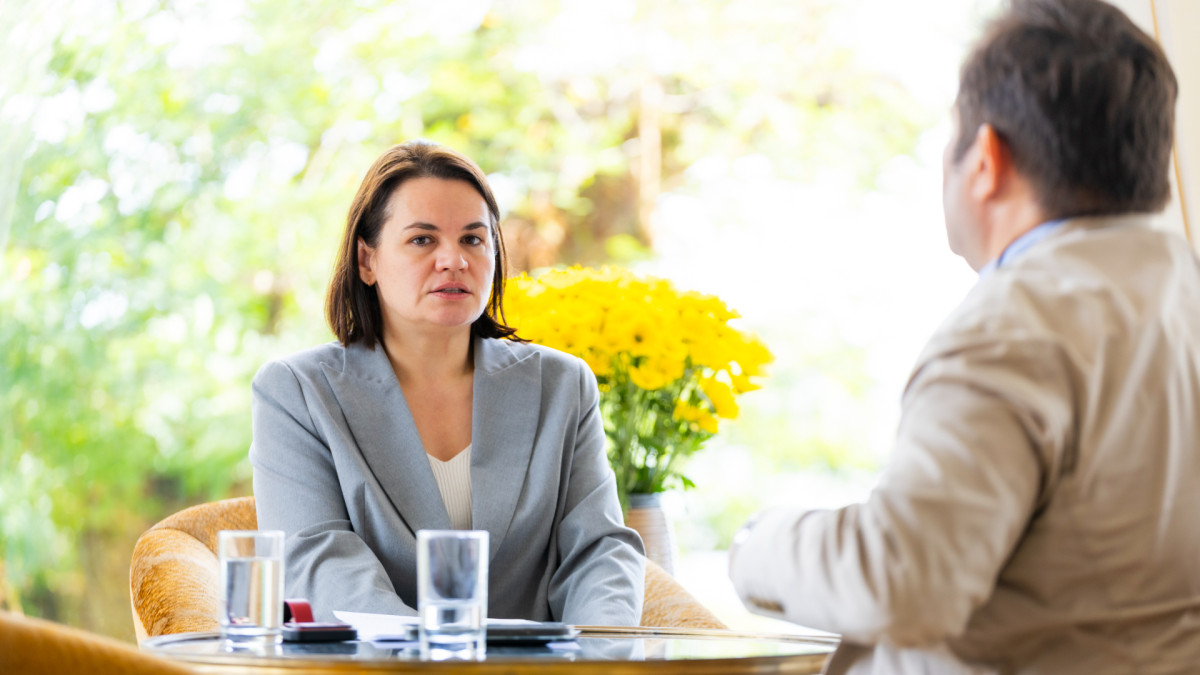
Svetlana Tikhanovskaya, during the conversation with Agenda Pública at the La Toja Forum. Photo: Agenda Pública / Yanka Soto
There is something Europe still seems unable to resolve: how to respond effectively to Russian hybrid warfare. As a Belarusian, you know Russia extremely well and know what it is capable of. Perhaps you can help us understand both countries better and, above all, how Europe should respond.
With a free, democratic, and independent Belarus, Europe would be much stronger. Since we share a border with Russia and have endured Russian domination for so long, we have substantial experience resisting subjugation and hybrid attacks.
The current situation is that Belarus, due to the policies of [Alexander] Lukashenko and his alliance with [Vladímir] Putin, has become part of these hybrid attacks against Ukraine and, of course, against Europe. As long as Lukashenko remains in power, there will be constant threats emanating from Russia, through Belarusian territory, toward the borders of the European Union and NATO.
It hurts me deeply to see migrants used to pressure the borders; to see drones flying over Lithuania, Poland, and Latvia; to watch the regime disrupting airport operations with balloons used for smuggling; and to see how Russian and Belarusian propaganda tries to poison Europeans’ minds with populist narratives.
I also understand that if—or when—Ukraine wins this war and Belarus becomes free, Europe will find it much easier to confront these hybrid attacks.
“It is very painful to see how migrants are used to pressure borders; to see drones over Lithuania, Poland and Latvia”
Regarding the broader question of how to safeguard Europe, I do not have a simple answer. The world’s most powerful people are thinking about it. But after living next to Russia for so long, I know one thing: Russia will not stop until someone stops it. And Russia can only be stopped by a strong, powerful, determined, and brave Europe.
Russia is better prepared for hybrid warfare because Europe grew accustomed to living in peace. European institutions were built for peacetime. Europe was not ready for escalation or provocation because, for many years, its policy toward Putin was based on appeasement and a business-oriented approach.
However, we have finally learned that Russia is neither a neighbor nor a partner whom one can trust. In fact, it is not a partner at all.
Therefore, Europe faces new challenges. But I believe everything starts with citizens and their governments. Belarusian society is different: we know who our enemy is and what we are fighting against. We do not need to persuade Belarusians that Russia poses a threat.
“Russia is better prepared for hybrid warfare because Europe grew accustomed to living in peace. European institutions were built for peacetime”
One of Russia’s tactics is to overwhelm citizens with information, create such an avalanche of data that people can no longer distinguish truth from falsehood. In the end, people withdraw from politics altogether. And that is precisely the aim of Russia and the Lukashenko regime.
That is why it is important to find new ways to engage people in politics and provide them with reliable information. Everyone has a responsibility here: businesses, media, artificial intelligence companies, governments, and NGOs. We must find ways to bring people back into politics and make them interested in what is happening in the world.
You know very well how the Belarusian Government has used migration as a lever to pressure Poland. Recently, in Spain, we have witnessed something that raises some of the same questions. Do you see similarities between the instrumentalization of migration at Europe’s eastern border and what could happen at your southern frontier?
Migration by itself already poses a huge challenge to societies. But when migration is organized or instrumentalized, it becomes a double problem. At our borders we know how the system works. People are flown in, transported to the border, and then pushed to cross it.
What these regimes want to achieve is to divert governments and societies from fundamental issues —peace and war, democracy and dictatorship— and to direct attention toward migration. They also compel governments to divert resources toward managing the migratory crisis.
In our region, for example, the war in Ukraine continues. The resources allocated to dealing with a migratory crisis artificially created are resources and political attention that cannot be devoted to other matters, including supporting Ukraine. That is part of the objective.
“What these regimes want to achieve is to divert governments and societies from fundamental issues and direct attention toward migration”
At the same time, these regimes are exploiting human beings and human lives. Therefore, the problem always has a moral dimension. Democratic societies endlessly debate how to help people while preventing the instrumentalization of migration. On the Belarusian border, for example, walls have been built.
For authoritarian regimes, however, human lives mean very little. They are willing to use people as instruments to pressure and blackmail democratic countries. I don’t know if there is any simple way to resist this. On one hand, sometimes you must negotiate with the responsible countries to avert these situations. On the other hand, dictators do not necessarily want to negotiate. They want to humiliate you. They want you to come to them and ask for something and, ultimately, compromise your principles.
This is part of the confrontation between democracy and dictatorship. Any hesitation will be seen as weakness by the authoritarian regimes, and that will embolden them. We can already see that this is not only about migrants. There are many forms of hybrid attack. They are constantly testing how far they will be allowed to go. If there is no response, they take another step.
Look, for example, at the drones that recently fell on Lithuanian territory. There was no particularly forceful Western reaction. No one was injured and nothing catastrophic happened. But the message Russia could take from that is: we can go further.
What happens next? Does a building get destroyed? And after that? Do people die from drone attacks? At what moment will there be a sufficiently forceful reaction for Russia to understand that this is unacceptable?
These operations are also attempts to divide governments, parliaments, political parties, and societies. We can see populist forces growing in Europe. But populists often offer to close one issue rather than resolve the underlying problem. That is not a solution.
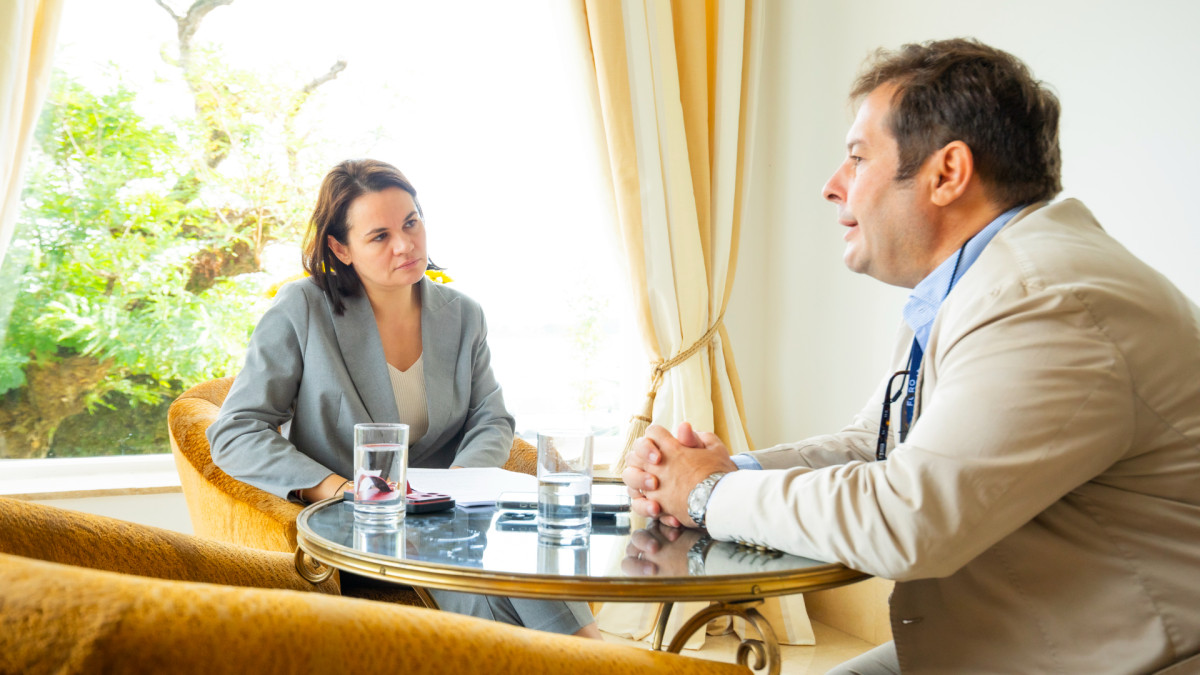
The Belarusian opposition leader discusses transatlantic ties and Belarus’s future with Marc López Plana. Photo: Agenda Pública / Yanka Soto
How does Washington’s approach affect your strategy in Belarus and, more broadly, Ukraine and Eastern Europe?
First of all, from a Belarusian perspective, we are grateful to the United States for its efforts to secure the release of political prisoners. That humanitarian track continues.
“These operations are also attempts to divide governments, parliaments, political parties and societies”
Around five hundred people have already been released from Belarusian prisons. Of course, Lukashenko continues to detain new individuals, so it may look like a revolving door. However, five hundred people have been released, five hundred lives have been saved for now, and we urge the United States to keep up these efforts.
As for Ukraine, we need that war to end with a victory for Ukraine, and we appreciate American attempts to initiate negotiations. We see U.S. representatives traveling to Russia and Ukraine to help organize a process.
But what matters is that any peace is durable and fair, not just a brief pause that lets Russia regroup and strike again. I want to believe that, ultimately, Americans want the same.
Of course, we all see the turbulence in the transatlantic relationship. Reactions to that turbulence vary. Some believe it is terrible for the transatlantic community — and in many ways it is. Others contend that it has forced Europe to acknowledge that it must strengthen itself on its own.
We can already see moves in that direction: Europe is thinking much more seriously about its own defense and how to protect itself if, for example, the United States reduces its commitment to European security.
In that sense, these turbulences have strengthened Europe’s resolve to act from a position of greater strength. Yet I believe the world would be far safer if the transatlantic bloc remained united and even more robust. The most important thing is that shifts in the United States’ stance do not divide the European Union.
Take Belarus as an example. The United States’ engagement with the Lukashenko regime to secure the release of political prisoners has sparked a debate in Europe: perhaps Europe should also start talking to Lukashenko. That would be dangerous.
We encourage our European partners to stay firm, true to their principles, and resolute about Belarus. There should be no appeasement nor legitimization of the regime.
“What is especially important is that changes in the United States’ stance do not divide the European Union”
US sanctions can be used as a tool of pressure to liberate political prisoners. But Europe has a different role: Belarus is its neighbor. A free, independent, and democratic Belarus also serves Europe’s security interests. Our view is that U.S. sanctions can help free individuals, and European sanctions should help free the country.
Let’s talk about Spain and its support for the Belarusian democratic movement.
It may surprise some, but Spain has proven to be one of Belarus’s strongest supporters and of its democratic forces.
Geographically, Spain is far away. Belarus might not seem a clear priority for Spain. Yet the solidarity shown by the Spanish government, parliament, and, I hope, Spanish society, has been substantial.
First, Spain has consistently aligned with the European Union’s policy toward Belarus, including sanctions and political pressure on the regime.
Our strategy has two dimensions: to pressure the regime while at the same time helping Belarusian civil society grow stronger. We are not asking anyone to fight in our place. We ask for help to become stronger and more resilient ourselves.
But Spain has also adopted measures that, in some respects, are unprecedented. Many people forced to flee Belarus due to repression continue to suffer transnational oppression. One tool the regime uses is to deprive Belarusians living abroad of valid documentation. We cannot renew our passports.
In Spain, thanks to the Foreign Minister, Albares, specific instructions were introduced that allow Belarusian citizens to use expired documents to renew their residence permits. It is an extremely important measure.
“Spain has consistently aligned with the European Union’s policy toward Belarus, including sanctions and political pressure on the regime”
There is also the issue of political prisoners. Thousands remain imprisoned. Some have been released thanks to American diplomatic efforts, but many of those released are immediately expelled from Belarus. The democratic forces bear the responsibility of helping them start a new life because they have lost everything.
We created the International Humanitarian Fund, to which Spain has contributed on two occasions. That money truly saves lives. It funds physical and psychological rehabilitation, housing, and relocation. We have also opened the Democratic Belarus Mission in Madrid to represent Belarusians in Spain and provide an organized focal point for the diaspora. That was also possible thanks to support from the Spanish Ministry of Foreign Affairs.
President Sánchez has shown strong support for Belarus and has spoken publicly on the issue. I have met with him on several occasions. We are also trying to think about Belarus’s future.
After Franco’s dictatorship, Spanish society had to undergo its own democratic transition and reconciliation process. Belarus will eventually have to face similar questions, and we want to learn from Spain’s experience about how such a process can be managed. Thus, our cooperation operates on many levels: experts, human rights advocates, and political institutions.
I fully understand that Spanish citizens cannot think about Belarus every day. They have many of their own problems and there are many crises around the world. But when Belarus has needed help, Spain has been there.
We will not forget it. And when democracy finally prevails in Belarus, Spain will have been part of that story.
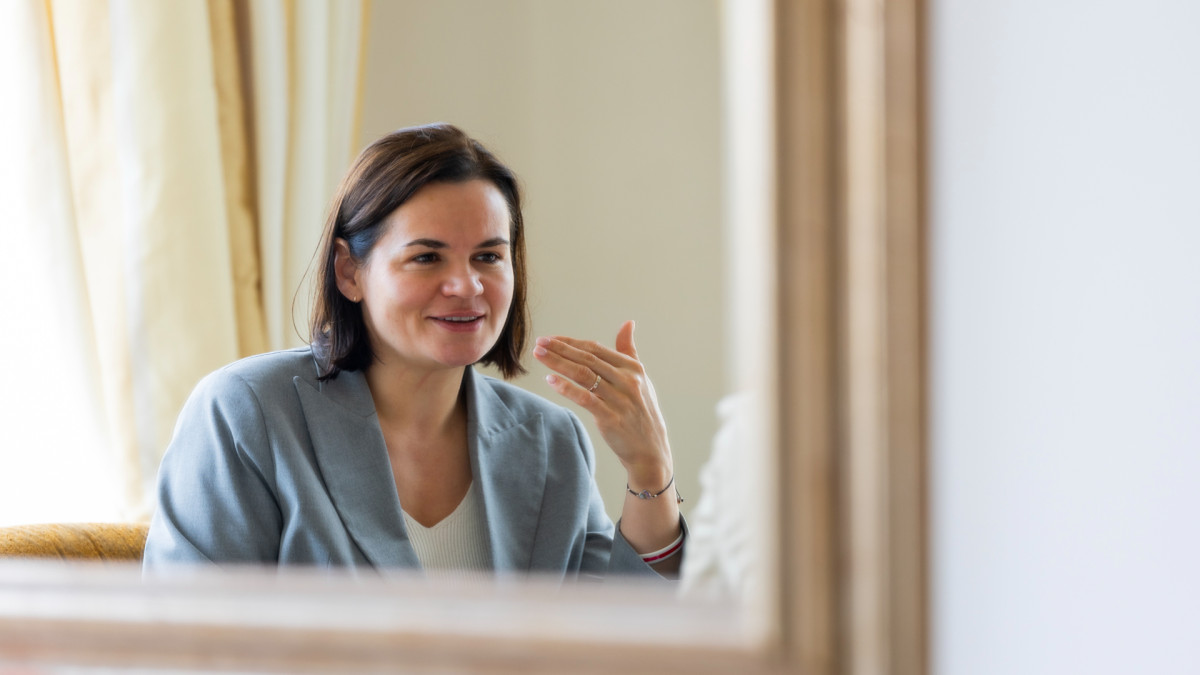
Tikhanovskaya discusses Spain’s support for the Belarusian democratic movement and the opposition’s next steps. Photo: Agenda Pública / Yanka Soto
May I ask about your next steps. How are you currently working—and how do you plan to work in the coming years—to achieve democracy in Belarus?
Belarus is, to some extent, a hostage to broader geostrategic events, above all the war between Russia and Ukraine.
The regime participates in the conflict because it allows Russia to deploy missiles, nuclear weapons, and military infrastructure from Belarusian territory. No one knows whether provocations or an escalation near the European Union’s border could occur at any moment.
The Belarusian society and the democratic movement strongly oppose Lukashenko’s regime. We stand with Ukraine and want a European future for Belarus.
Our current task is to preserve unity and continue developing the institutions and tools needed to resist the regime both inside and outside the country. I am proud of what we have achieved.
In 2020 we had a massive democratic uprising. It was brutally repressed. Putin supported Lukashenko, and today Putin and Lukashenko are extremely close allies. It is no longer realistic to imagine they could simply separate.
For six years, Belarus has suffered enormous repression. In many respects, people live in conditions reminiscent of the Stalin era. Today, more than 900 people are imprisoned for political reasons and at least half a million have been forced to leave the country due to repression. And yet we have managed to build alternative power structures in exile.
The independent media that were destroyed inside Belarus have restarted operations from abroad. About 70% of their audience remains inside Belarus. That tells us something important: people are still engaged. Despite fear and repression, those inside the country continue to provide information and data to democratic institutions.
We have also established formal relations with the European Union, the United States, the United Kingdom, Canada, and other countries. We have become part of international political infrastructures.
Today there are, politically speaking, two Belaruses: a regime serving Russian interests and a Belarusian society that wants a European future and to become a reliable partner for Europe, rather than a perpetual source of insecurity.
Despite having limited space and resources, we have managed to keep Belarus on the international agenda. We continue to remind the world of our struggle and the situation of political prisoners.
And after Russia’s invasion of Ukraine, we have also shown something else: Belarus is no longer merely a human rights or humanitarian issue. Belarus is a matter of European security.
“Belarus is no longer simply a question of human rights or humanitarian concerns. Belarus is a matter of European security”
A free and democratic Belarus responds to Europe’s national and collective security interests. Only with a free Belarus can the eastern border of Europe become safer.
Therefore, Ukraine’s victory is essential. If the war merely freezes or if Ukraine loses, the status quo in Belarus could also be frozen for decades. Russia would continue to subjugate and slowly absorb our country.
So my question to Europe is whether it is prepared to be brave and determined enough to defend its own interest in a free and democratic Belarus.
We need more than expressions of solidarity and condemnations. We need practical and technical support, political backing, and assistance for Belarusians living abroad. We need the resources and energy to continue this struggle. Supporting Belarusian democracy is not charity. It is an investment in European security.
Right now, understandably, much of the focus is on a possible Russian-Ukrainian peace agreement. But Belarus is typically treated as a separate issue to be dealt with later. Our message is: you cannot postpone the Belarus question until the day after a deal in Ukraine.
If the Belarus question is not addressed alongside the Ukrainian one, you may simply be delaying the next escalation. Russia will not forget Belarus. Russia’s subjugation of Ukraine and Belarus is part of the same strategic problem.
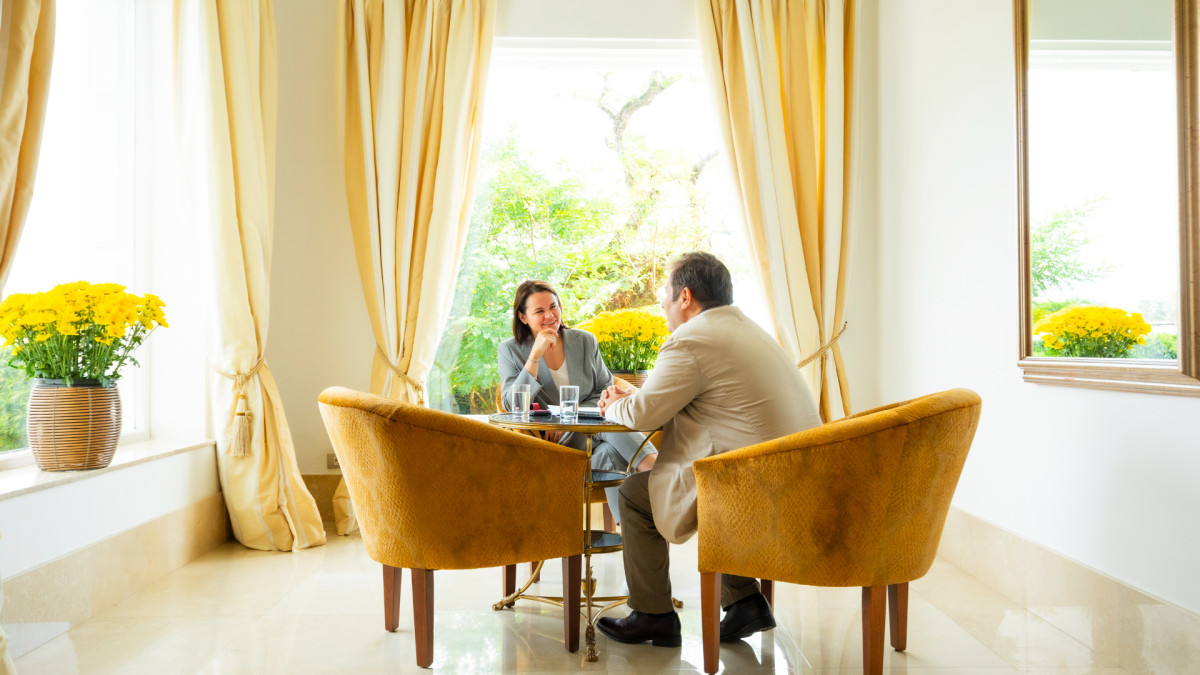
Tijanóvskaya and López Plana talk about European security and the risk of a Russian escalation. Photo: Agenda Pública / Yanka Soto
Do you think Putin could launch a military attack against any of the Baltic States in the foreseeable future? Some experts consider that could be the next step. To what extent should Europe prepare for that possibility?
As I always say: there is no need to panic, but we must be prepared. A lot depends on whether Europe shows unity. Look at the drones over Lithuania; there was no substantial response, and Russia may read that as a green light to go further.
I lived in Lithuania for five years before moving to Warsaw. When the war began, people were already talking about whether Lithuania or other regional countries could eventually be attacked. The first challenge was military readiness, and since then the situation has improved considerably.
“There is no need to panic, but we must be prepared. A lot depends on whether Europe shows unity”
But there is another issue: society. I remember people asking whether, in case of an attack, our partners would actually come to help us and defend us. There was uncertainty about that, and that feeling is extremely dangerous because it means citizens do not fully trust the strength of the alliance to which they belong. Perhaps that uncertainty exists not only in society but also in the political arena.
If Russia senses weakness or disunity, it may decide to test Europe. Experts often mention, for example, the Suwałki Gap, but we must also understand that the current war has many fronts and is no longer just a ground invasion. Russian soldiers do not necessarily have to cross a border: there are drones, cyber operations, sabotage, and other forms of attack.
New military infrastructure is being built in Belarus that would not be necessary if the country were not preparing for a possible conflict. There are antennas capable of redirecting drones and increasing intelligence activities along the borders with the European Union. Does this mean provocations or an escalation are possible? Yes. Does it mean we can be sure they will happen? Of course not.
Russia is allocating enormous resources to the war instead of improving the lives of its people. Is there any limit to what Russian society is willing to tolerate?
Russia has never invested enough in its people. Even before the war, there was a huge gap between the wealth accumulated by companies, oligarchs, and Putin’s circle and the resources allocated to ordinary citizens.
Moreover, there is another problem: imperialist attitudes remain deeply rooted in significant segments of Russian society. Many people believe the war against Ukraine is justified. Propaganda is also preparing them to now view Europe as an enemy and to consider the possibility of a much broader confrontation.
The narrative goes: we are a great country; how dare you challenge us? People influenced by these imperial ideas can support confrontation. Changing that mindset could take decades, perhaps generations. But for that process to even begin, Russia must first be defeated in its attempt to subjugate its neighbors.
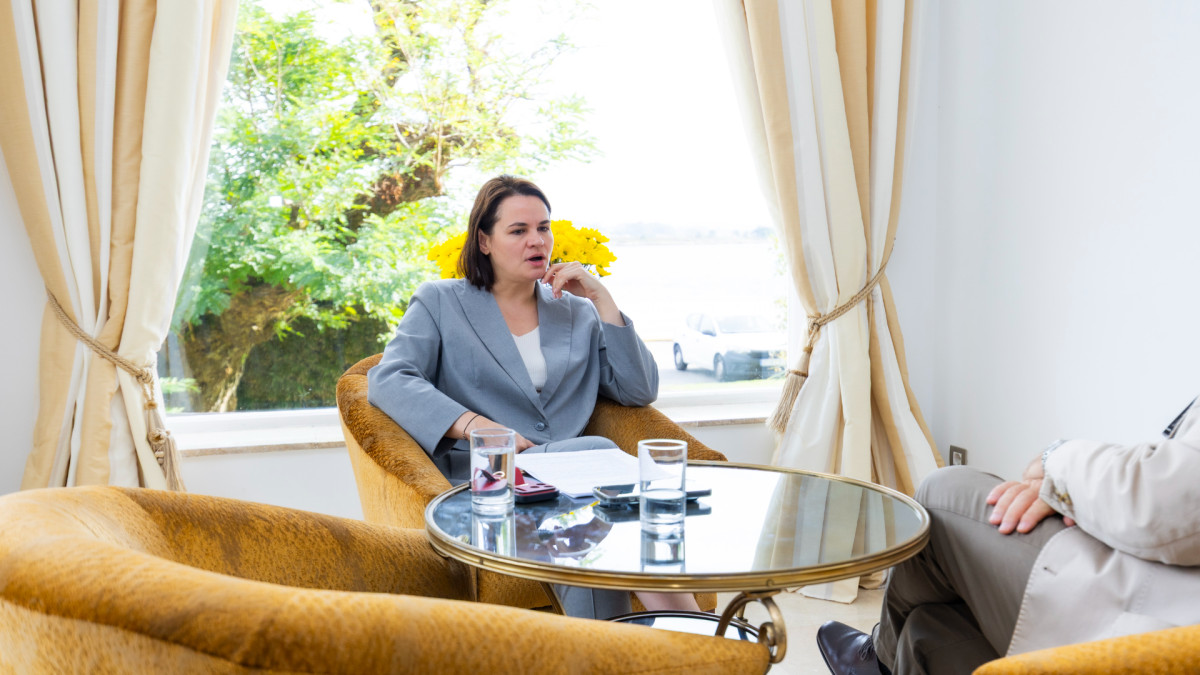
Tijanóvskaya answers about the impact of sanctions and the war economy in Belarus and Russia. Photo: Agenda Pública / Yanka Soto
You’ve mentioned oligarchs. Could economic pressure and sanctions eventually push them to change their stance toward Putin? They’re losing access to markets and assets. Could that translate into political pressure?
It’s hard for me to judge Russia directly because the Russian and Belarusian contexts differ. I can speak more confidently about Belarus. Of course, businesspeople are unhappy when they cannot trade normally. But dictators build systems designed to protect the dictator.
Even powerful entrepreneurs can be kept in check through fear. Security services act on behalf of the regime; the courts operate in a vertical manner; and, at any moment, a businessman can be detained and imprisoned. We have seen this in Belarus.
“Businesspeople are not happy when they cannot trade normally. But dictators build systems designed to protect the dictator”
At the same time, some regime-linked entrepreneurs can still profit alongside the dictator. War can also close some economic opportunities and create others.
In Belarus, for example, the war has created significant economic opportunities for certain parts of Lukashenko’s system because Belarusian companies are manufacturing equipment and supplies for Russia’s military machine.
So, while some oligarchs or firms may lose money due to sanctions, others may benefit from the war economy. Something similar could be happening in Russia, though I cannot judge the Russian situation with the same certainty.
Thank you very much.
In alliance with