
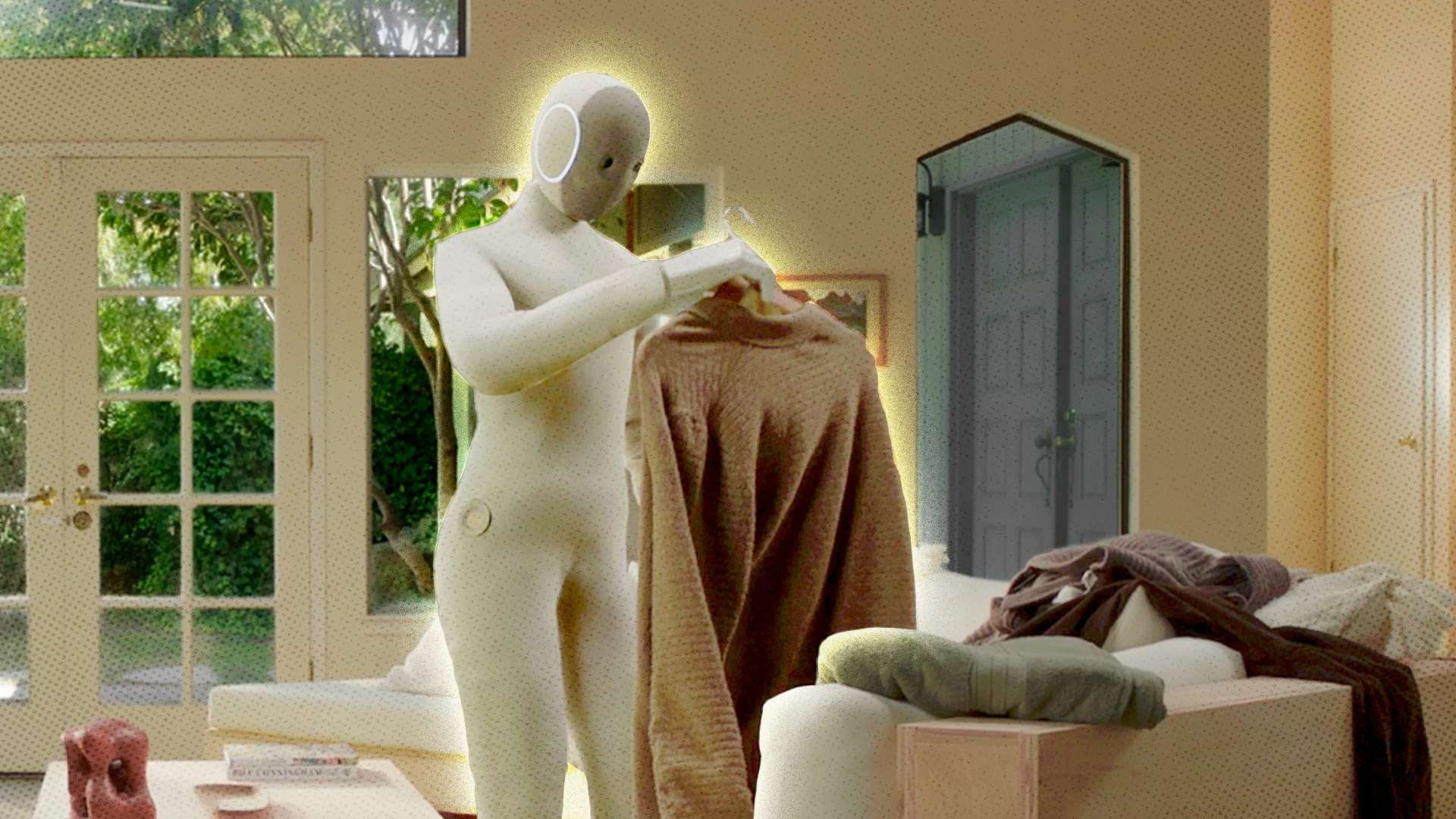
Engineers are leveraging footage of real-world tasks to train the next generation of robots.
The latest generation of home robots resembles a droid more than a typical vacuum, edging toward the look of C-3PO.
Last year, a demonstration of 1X Technologies’ home robot, NEO, captured widespread attention. In a video produced by The Wall Street Journal, the mouthless machine attempted to unload a dishwasher. NEO moved with some awkwardness but managed to complete the job—with assistance from a human teleoperator. In July, 1X revealed NEO’s upgraded, highly dexterous hands that are driven by tendons. According to the company, these hands “elevate what humanoid robots can physically achieve beyond traditional hardware” and suggest that “data will be the sole limiting factor to capabilities.”
1X is among several firms pursuing humanoid robots built with physical AI—an approach that enables robots to operate autonomously in real-world environments. Competitors such as Figure, Tesla, Agility, and Boston Dynamics are racing to bring bots capable of human tasks to market. As in the broader AI race, China stands as a significant player.
In a May post on X, OpenAI CEO Sam Altman speculated that “in the long run, we envision everyone having a personal robot capable of assisting with whatever they need.” Humanoid robots have yet to reach the autonomy and finesse of the Ex Machina robowomen. Attaining that level of expertise will require ongoing human input—and a massive volume of data.
Just as large language models like ChatGPT depend on text, robots need vast datasets to operate autonomously, as the Los Angeles Times noted last year. For some robotics outfits, this means gathering extensive videos—some public, some licensed—of people performing everyday tasks.
Data collection to train humanoid robots has spawned its own industry. Take Shift, for instance, which compensates participants to film themselves doing chores or manual labor. The ultimate aim of supplying training data to robotics companies is to create a “world of abundance” devoid of labor shortages, says Shift co-founder Anton Poletaev. In May, to entice people to contribute training data from their homes, the company offered New Yorkers complimentary cleaning services performed by staff wearing head-mounted cameras.
Shift’s privacy policy bars contributors from recording videos of children, intimate moments, or passwords. Poletaev says Shift’s algorithms scrub personal details from session footage, including faces and identifying information.
Shift users choose to act as the eyes for robotics developers in exchange for payment. Buyers of humanoid robots, however, must weigh a different set of tradeoffs.
During the 2025 NEO demonstration, a human engineer teleoperated the robot throughout. Yet 1X asserts that the latest NEO edition, expected to reach consumers by the end of 2026, will function autonomously by default. If a task proves unfamiliar, owners can request a specialist teleoperator to take control remotely and guide the robot.
“In 2026, if you purchase this product, you are agreeing to that social contract,” said 1X founder and CEO Bernt Børnich to The Wall Street Journal technology journalist Joanna Stern last fall. “If we don’t have your data, we can’t improve the product.”
The company claims it has privacy protections designed to safeguard users. According to 1X, owners must arrange sessions with U.S.-based experts who operate NEO, and the robot’s head-mounted lights will change color to indicate an operator is active. 1X also says owners retain control over the operation session and can opt out of data sharing.
These safeguards are particularly crucial for home robotics, given ongoing privacy and security concerns about vulnerable robotic vacuums. In 2024, several Ecovacs Deebot X2 owners in China reported unauthorized access to their devices. In one incident, a man claimed the bot emitted a voice that shouted obscenities. The Australian Broadcasting Corporation demonstrated a hack of the vacuum, uncovering security flaws. More recently, a hobbyist attempting to manage his own DJI Romo robovacuum inadvertently gained control of about 7,000 robots, gaining access to their live feeds and IP addresses.
Matthew Rueben, a biomedical engineering professor at the University of Portland who specializes in human–robot interaction, stresses that ongoing transparency is essential to protect privacy. He argues that a once-and-done notice-and-consent framework may be insufficient for clearly communicating privacy risks.
Even when users consent to having a robot in their home, bystanders, including children, may not realize the robot is collecting data. To provide ongoing notices of their presence, Rueben has suggested that robots could signal their movements and tracking through recognizable cues—think expressive video-game-like indicators. Imagine a yellow arrow bobbing above an NPC’s head or a foe’s eyes lighting up red.
Although newer robots can appear strikingly human, Rueben urges viewing them as machines—not sentient beings—when weighing privacy risks. This perspective helps consumers consider the broader design choices behind the robot and how a company might collect or process data from it. “I ask questions about the types of sensors it has and what its software truly does,” Rueben says, “and I avoid assuming capabilities based on what a human might do.”
The Jetsons-era future may not be here yet, but an increasing number of humanoid robots could soon enter homes and lighten human workloads. Consumers must decide how much information they are willing to share with their new helpers.
