Brussels has kicked off this week the countdown toward the birth of large European banking entities capable of rivaling or, at least, rubbing shoulders with the American or Chinese financial giants. Although the dream of a banking union in the euro area remains far off, the unconditional approval by the European Commission of the merger between two behemoths such as the Italian UniCredit and the German Commerzbank, which together count 26 million clients in two of the continent’s industrial powerhouses, marks the path to follow, according to the Commission after approving the operation.
Brussels trusts that, finally, almost three decades after the euro’s launch, the era of pan-European big banks that compete at a continental level will begin. The fragmentation of the banking sector has left European institutions far behind the Americans in terms of profitability and financing capacity. As Mario Draghi recalled in his renowned and largely ignored report, only JPMorgan’s market capitalization is greater than the combined market value of the ten largest European banks.
“Brussels trusts that, finally, almost three decades after the euro’s launch, the era of pan-European big banks that compete at a continental level will begin”
In principle, it was not expected to reach the second quarter of the 21st century with a euro-area financial market shattered by national and even regional demarcations. The introduction of the euro in 1999 started a consolidation process in the sector that seemed doomed to yield a handful of pan-European operators, as has happened in other industries, from air transport to retail or telecommunications. But the 2008 global financial crisis thwarted the first consolidation attempts. And pioneering integration operations, such as the Fortis bank or the multi-party takeover of ABN AMRO, collapsed.
That crisis left deep scars. And institutions and regulators came away scorched. Each bank, with few exceptions, retreated into its stronghold. And the tightening of capital and prudential rules discouraged, if not penalized, the drive to grow in foreign markets. The blow has not been forgotten. But the urgent capital needs to prevent Europe from eventually falling behind in the technological, energy, and security revolutions led by the United States and China have driven Brussels to back the emergence of European giants in core sectors, including the financial one.
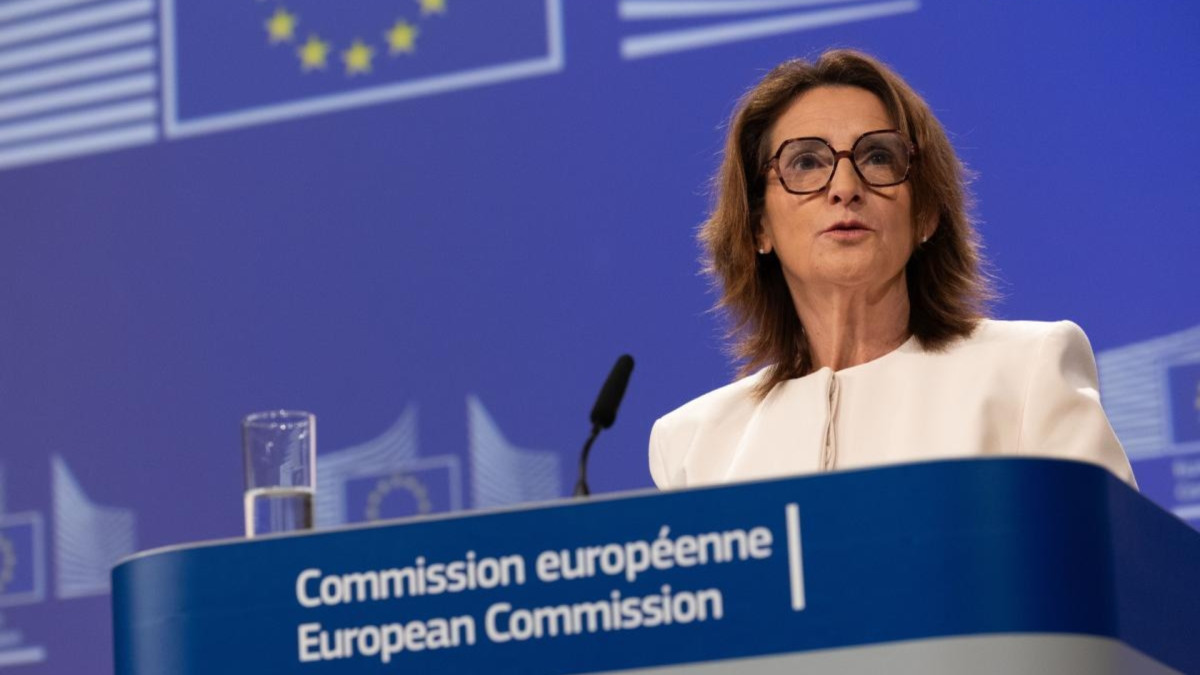
The foray of UniCredit into a market as hostile as Germany thus redraws the path toward banking integration in the euro area. For Brussels, as noted by the Commission’s Vice-President and Competition Commissioner, Teresa Ribera, the largest cross-border financial operation of the last twenty years “is a good example of the kind of cross-border mergers that can bring positive growth to EU banks, improve their efficiency and help them compete better internationally”.
Ribera regrets that, after almost three decades of monetary union, “capital and liquidity cannot move freely within banks operating cross-border”. The anachronistic situation is evident in the day-to-day life of entities, businesses, and individuals, even for the most routine and less sophisticated financial operations. As the vice-president recalled, it is still very likely that a European bank will not grant a loan to an SME unless it is domiciled in its own country. And it remains almost unthinkable to purchase a home with a cross-border mortgage. In practice, the EU remains divided into twenty-seven financial markets, with their own peculiarities and insurmountable barriers. And with the euro reduced to serving as a shared unit of account but not fully exploited.
“In practice, the EU remains divided into twenty-seven financial markets, with their own peculiarities and insurmountable barriers”
The winds are blowing in favor of overcoming fragmentation. The fact that the German government has, at least so far, failed to prevent UniCredit from taking control of the second German bank shows that political obstacles are beginning to yield before the urgent need to scale entities to the global reality. In the same vein, the move by Crédit Agricole to take over the Italian BPM is noted, an operation that in other times would probably have run into Rome’s explicit or implicit veto.
Nevertheless, as Draghi noted in his day, banking consolidation needs regulatory changes to move faster. The current rules expose cross-border entities to the risk of an internal bank run in a crisis (if the parent regulator cuts flows to subsidiaries in other countries) and can force them to multiply capital provisions redundantly, immobilizing and neutralizing the potential of their scale. Draghi proposed, for the time being without success, the design of bespoke rules for the large pan-European banks, enabling them to undertake larger-scale operations and shielding them from a possible regulatory capital blockade. The emergence of giants like UniCredit-Commerzbank could accelerate that economic leap and pave the way toward a banking union always postponed for political reasons.