
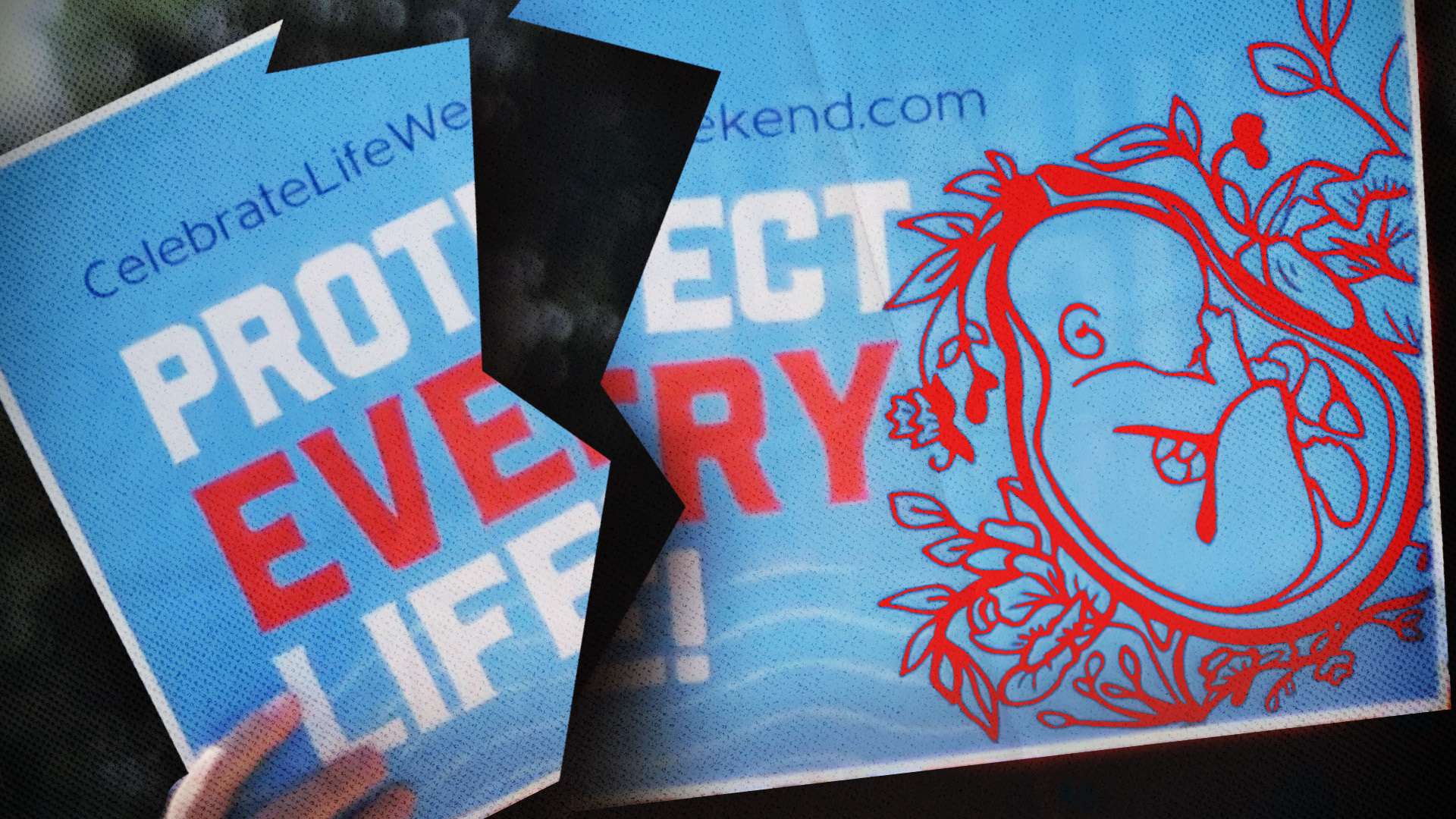
The case, framed as a challenge to Texas’s so-called vigilante-law, seeks to sanction anti-abortion activists for speech protected by the Constitution.
In March, Kristan Hawkins—the head of Students for Life—shared on Instagram a picture of herself with two other members of the Virginia-based group standing outside Space Center Houston. The captions described Hawkins and the others, one of whom held a cellphone, as if they were “placing an abortion pill order undercover.”
A suit filed recently in Harris County, which includes Houston, characterizes that Instagram moment as merely a publicity stunt. The lawsuit, which aims to weaponize a Texas abortion statute promoted by Students for Life against the organization, is likewise a publicity maneuver. Yet while it may succeed in that respect, the legal obstacles ahead appear substantial.
The complaint, brought by a Texas woman who opposes her state’s abortion ban under the alias Maria Puerto with assistance from Amplify Legal, is meant to demonstrate the vagueness and broad reach of House Bill 7, a 2025 law allowing private civil actions to enforce limits on “abortion-inducing” drugs. But Puerto’s gambit—an ostensibly clever legal tactic—rests on a questionable interpretation of the statute to demand “monetary compensation” that the law does not authorize, thereby punishing anti-abortion activists for speech protected by the First Amendment.
HB 7, also called the Woman and Child Protection Act, prohibits anyone from manufacturing or distributing an abortion-inducing drug within the state, or from mailing, transporting, delivering, prescribing, or providing an abortion-inducing drug to or from any person or place in Texas. The act adds that these prohibitions may be enforced only through a qui tam action brought by a “person” who “violates” or “plans to violate” them.
Any “person” other than a state or local official may qualify as a “relator” authorized to pursue such an action. The relator may seek injunctive relief and “an amount of not less than $100,000 for each violation,” plus “costs and reasonable attorney’s fees.” Typically, the relator receives $10,000 of that sum, with the remainder going to a charitable organization chosen by the relator.
Puerto, as a private individual, thus satisfies HB 7’s basic standing requirement. And although HB 7 blocks lawsuits against pregnant women who obtain an abortion-inducing drug, Puerto contends Hawkins and the other activists “are not pregnant and were not pregnant” at the time of the Instagram post. So far, so plausible. Yet the suit notes that Hawkins and the others “openly and flagrantly violated” the prohibitions, without detailing how that occurred.
A photo accompanying a recent Mother Jones profile of Hawkins shows her and her social media coordinator, Lydia Taylor Davis, outside Space Center Houston amid their so-called abortion-pill sting operation. Another Mother Jones image depicts Hawkins holding a cellphone the suit describes as containing “an order confirmation.”
Based on the Mother Jones account, it remains unclear whether that description is accurate. “The scheme quickly spiraled out of control,” writes Amy Littlefield. “The plan called for buying pills from several services, with Hawkins posing as a male abuser while Davis pretended to be a 16-year-old—all to portray mail-order suppliers as reckless and dangerous. For reasons even she couldn’t explain, Hawkins adopted the alias ‘Wanda’ for her male-abuser role. But when Davis entered her information, a snag occurred.”
Davis was attempting to order pills from the Massachusetts Medication Abortion Access Project. Yet Littlefield notes that the organization “had blocked Davis in its system after Students for Life publicized the sting.” Hawkins “tried to salvage the stunt by placing her own order, but ‘Wanda’ accidentally listed her age as 15,” below the supplier’s minimum. “Now a security guard was approaching to tell them they couldn’t film. Having aimed to show that telemedicine services screen their clients poorly, they inadvertently demonstrated the opposite.”
Puerto “will need proof that the Students for Life leaders actually obtained or intended to obtain the pills,” abortion-law scholar Mary Ziegler notes in Slate. “The activists may argue that the post wasn’t earnest, and that no one involved ever seriously intended to bring pills into Texas.”
Even if Hawkins and the other activists did successfully order abortion pills, that act alone does not fit HB 7’s language, which targets individuals who “distribute” such drugs or who “mail, transport, deliver, prescribe, or provide” them “to or from any person or location in this state.” The wording includes out-of-state suppliers, raising obvious concerns about extraterritorial application. But on its face, the prohibition does not cover someone who merely orders abortion pills.
Puerto’s attorney, Amplify Legal’s Molly Duane, contends that Hawkins and the others could fall under the statute’s transportation clause. “The statute states that moving abortion drugs from one location to another within the state constitutes a violation of HB 7,” Duane told The Texas Tribune. “By the statute’s plain language, this would appear to be a violation. This illustrates the problem of drafting such a confusing and vague law.”
Under that interpretation, Hawkins, Davis, and the other two activists named in the suit would be in violation of HB 7 only if they 1) successfully ordered abortion pills, 2) accepted delivery of them, and 3) subsequently relocated them within Texas. The suit asserts only that they “ordered abortion pills, apparently multiple times.” The Texas Tribune reports that Duane and Puerto hope the suit will eventually reveal what the defendants did with the pills after ordering them.
The suit encounters another hurdle. HB 7 does not apply to “speech or conduct protected by the First Amendment.” The activists’ efforts to illustrate how easily state abortion bans can be circumvented appear to fall squarely into that protected domain. “Students for Life may emphasize that the case targets their political speech about abortion,” which remains protected, notes Ziegler.
There are additional oddities in the filing. Puerto, a 26-year-old single mother of two, stresses that she “had no choice but to continue” those pregnancies because she lacked “transportation or the financial means to travel out of state.” The complaint spends 11 paragraphs detailing the burdens imposed by Texas’s denial of genuine reproductive rights, arguing that this justifies some form of compensation.
All of that seems legally irrelevant under HB 7, which does not require a relator to allege any damages, much less damages connected to the abortion ban the statute seeks to reinforce. “With nowhere else to turn for help,” the filing states, “Ms. Puerto is seeking financial compensation” from Hawkins and colleagues “in the amount of $459,782—the average cost of raising two children from birth to 18 in Texas.”
Although HB 7 sets a minimum award of $100,000, the suit notes that “there is no cap on the monetary compensation owed a relator.” But the law does not describe HB 7 awards as “monetary compensation” for injuries allegedly suffered by the relator.
The statute’s sole reference to “compensatory damages” concerns lawsuits brought against HB 7 relators under “clawback provisions” in other states that have attempted to block such litigation. In response to a “clawback” action, the law says, an HB 7 relator may seek “compensatory damages, including money damages in an amount equal to the judgment damages and costs, expenses, and reasonable attorney’s fees spent in defending the action.” By contrast, the reward for proving a violation of the abortion-pill restrictions is simply “an amount.”
The suit itself—emphasizing the lax filing standards under HB 7—notes that Puerto “did not suffer an injury traceable to [the defendants’] ordering of abortion pills that is capable of being remedied by a court.” Yet it suggests that an award to Puerto would be appropriate given the defendants’ anti-abortion activism.
The filing notes that Students for Life “proudly advertised” its support for HB 7. Puerto contends that Hawkins and colleagues “ignore the immense harms and multiple deaths already attributed to Texas’s cruel abortion bans” and “demean the six million Texans of reproductive age who have had their capacity to decide when to start or expand a family stripped away by these bans.” Whatever one thinks of that charge, the activists’ advocacy remains constitutionally protected and cannot form the basis of a civil action in court.
“Texas is a peculiar place, full of vigilante statutes” that “seek to pit Texans against one another,” Duane told The Texas Tribune. “But if anyone should be benefiting from these legal regimes, it should be people like our client.” While “linking these two ideas…may be unusual,” she said, “this is the situation Texas has placed its citizens in.”
Depending on your view, you may sympathize with Duane’s reasoning or not. Yet it seems unlikely that the argument would withstand a legal challenge.
