
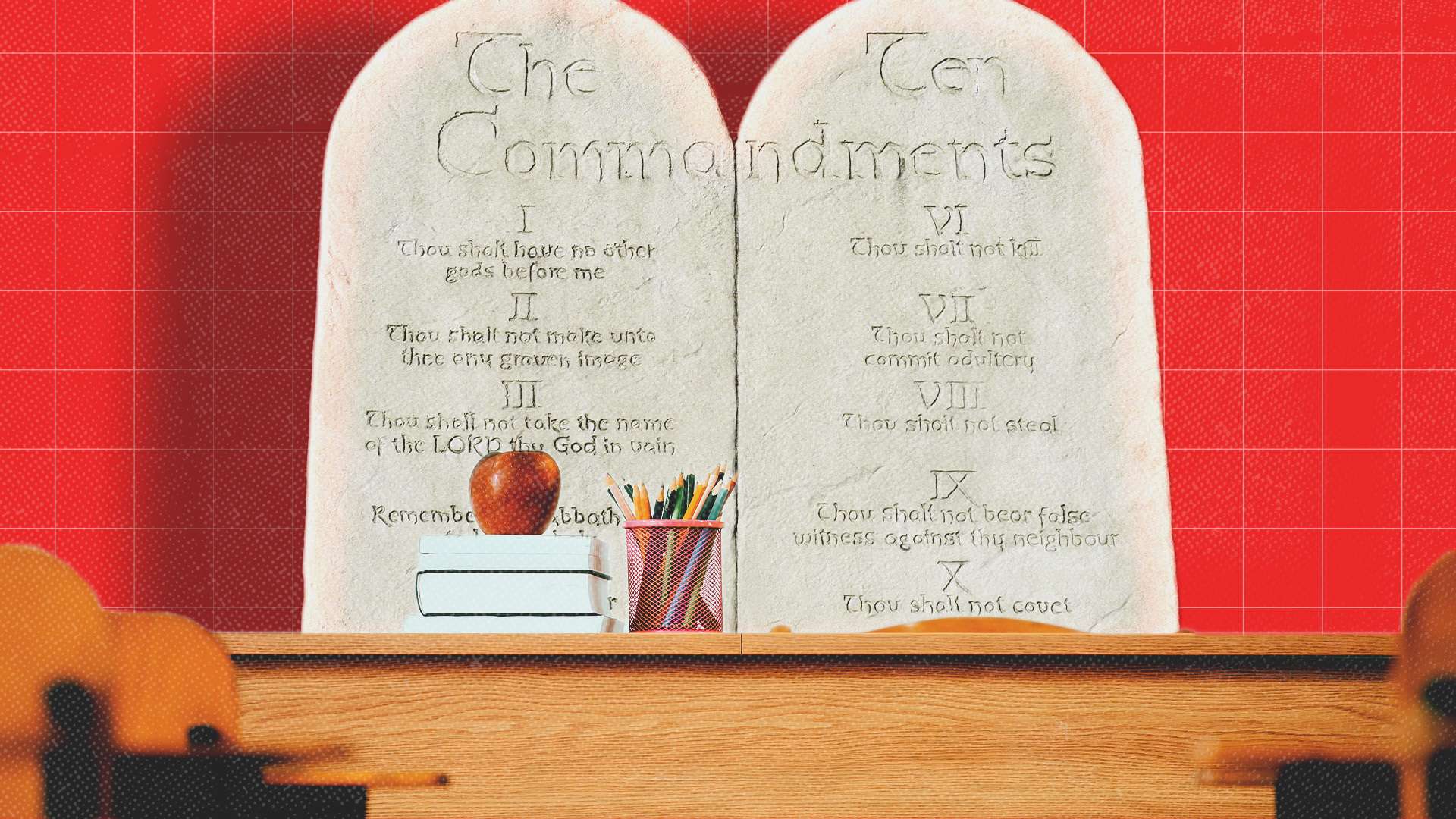
A pivotal church-state showdown heads to the Supreme Court
The First Amendment to the U.S. Constitution forbids the government from enacting any law “respecting the establishment of religion.” Yet Texas has enacted a statute that requires the Ten Commandments, as printed in the King James Bible, to be prominently displayed in every public school classroom. Does this state law run afoul of the Establishment Clause?
Earlier this week, lawyers from the American Civil Liberties Union (ACLU), representing several Texas families “of diverse faiths and beliefs—including Baha’ism, Christianity, Hinduism, Judaism, Unitarian Universalism, and nonreligious traditions—whose children attend Texas public schools,” urged the U.S. Supreme Court to step in and strike down the Texas law.
The challengers’ case rests on established Supreme Court precedent. In Stone v. Graham (1980), the Court invalidated a nearly identical Kentucky ordinance that mandated posting the Ten Commandments in public school classrooms. The Court explained that this was not a situation where the Bible was being integrated into the curriculum for legitimate study of history, civilization, ethics, or comparative religion. If the posted commandments are to have any effect at all, they would likely prompt students to read, reflect upon, perhaps venerate and obey the Commandments. Even if such private devotion is desirable, it is not an acceptable objective for a state under the Establishment Clause.
And more recently, in Mahmoud v. Taylor (2025), the Court held that the First Amendment right to freely exercise religion is violated when a school substantially interferes with a family’s religious development or poses “a very real threat of undermining” the religious beliefs and practices a parent seeks to pass on to the child. As the ACLU brief put it this week, “if the permanent, unavoidable imposition of biblical scripture in public-school classrooms does not interfere with, or threaten to undermine, parents’ ability to direct their children’s religious education…it is difficult to imagine what would.”
However, not every member of the current Supreme Court is a fan of the Court’s existing jurisprudence in this area. Justice Clarence Thomas, for one, has argued that the Establishment Clause should be read as a limitation only on the federal government. “The Establishment Clause is a federalism provision,” Thomas has written, “which…resists incorporation.”
Incorporation refers to the legal doctrine by which the various individual liberties and constraints on governmental power contained in the Bill of Rights have been applied, or incorporated, against the states through the Fourteenth Amendment. By labeling the Establishment Clause a “federalism provision,” Thomas meant that the clause was added to the Constitution primarily as a structural check on federal action and should not necessarily function as a constraint on state conduct. The clause, he argues, “protects state establishments from federal interference,” but does not safeguard any individual right.
I don’t expect the Supreme Court to go that far if it chooses to hear this dispute. Yet some conservative justices have also voiced concerns about contemporary Establishment Clause doctrine, viewing it as overly antagonistic to religious displays and observances by state actors, including public school teachers and coaches. It is conceivable that such conservative perspectives could tilt in favor of upholding this particular statute.
One thing appears quite clear: if the Supreme Court weighs in on whether a state law requiring the Ten Commandments be displayed in every public school classroom is constitutional, it would represent one of the most consequential church-state rulings in years.
