
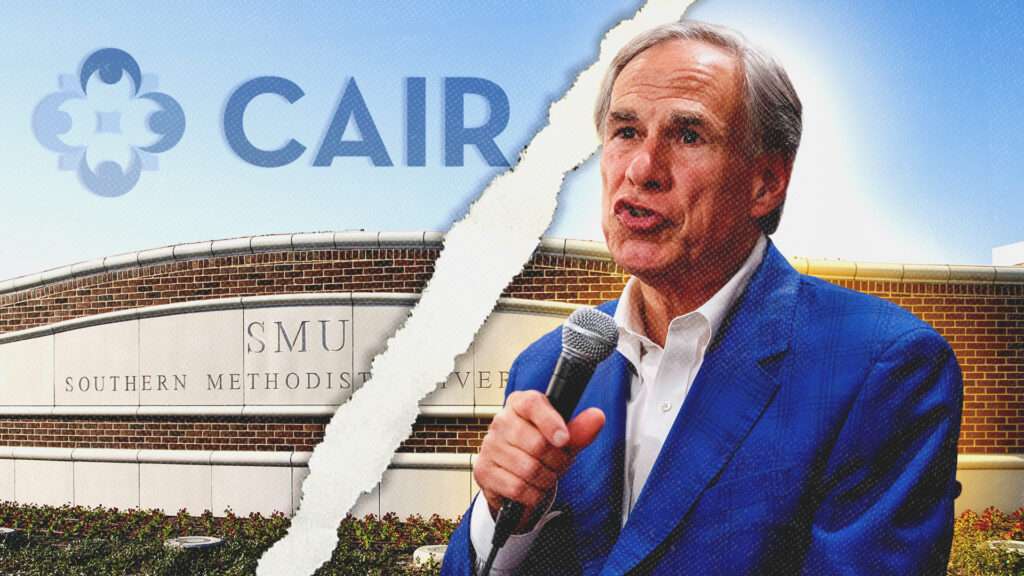
Labeling this group as a terrorist organization chills more than the speech rights of Muslims.
Texas Republican Governor Greg Abbott contends that civics and leadership training are essential to keep Texas defined as the premier state in the nation. Yet, his policies are making it harder for certain Texas students to access the civic education he so highly values.
Last week, Southern Methodist University informed the Texas chapter of the Council on American-Islamic Relations that it could no longer host the Muslim Youth Leadership Symposium in September. The event would have gathered Muslim youths from across the state for a day devoted to leadership and civic involvement, featuring panels with community leaders, hands-on sessions, and a tour of Dallas City Hall.
In a statement to The Christian Post, SMU’s media relations director Megan Jacob explained that the university had concluded that allowing the event to take place on campus, given the current Texas designation of the symposium’s organizer, would be inconsistent with the university’s mission and related policies. The “current designation” cited refers to Abbott’s November proclamation labeling CAIR a foreign terrorist organization.
Abbott’s power to designate CAIR as a terrorist organization stems from Texas Senate Bill 1900, signed into law in 2023. The act allows property owned by such an organization to be designated a public nuisance, facilitating lawsuits and seizure by the state. It also requires law enforcement agencies to compile and maintain local or regional intelligence reports on potentially criminal activities of designated groups, forwarding this material to a centralized state database. Additionally, certain violent or drug-related offenses committed by members of a designated group can result in harsher penalties.
Lawmakers initially framed the new statute as a tool against Latin American cartel networks, but its broad definition of a terrorist organization has opened doors for political use. SB 1900 defines a terrorist organization as “three or more individuals operating as an entity at least partly outside the United States who engage in criminal activity and threaten the security of the state or its residents.”
Most of these provisions do not directly apply to CAIR; the organization, whose mission is to promote understanding of Islam, defend civil rights, advance justice, and empower American Muslims, has never faced criminal charges, nor does it operate outside U.S. borders. Nevertheless, prosecutors identified CAIR as an unindicted co-conspirator in the 2009 Holy Land Foundation terrorism-financing trial. In Abbott’s declaration, CAIR is described as the successor to the Muslim Brotherhood, with individuals linked to CAIR having either voiced violent sentiments or been charged with financially aiding terrorist groups, leading the state to claim the organization itself is criminal. CAIR has challenged the designation, and the litigation continues.
The confrontation between Texas and CAIR was not unforeseen. A 2024 report from the International Center for Not-for-Profit Law notes that the broad and vague provisions of state domestic terrorism laws raise significant First Amendment and free-speech concerns.
Texas is not alone. Shortly after Abbott’s move, Florida’s Republican Governor Ron DeSantis also unilaterally designated CAIR as a terrorist organization. In Florida, this label means CAIR and anyone who has provided material support or resources to the group are barred from receiving state funds, contracts, or benefits.
Civil liberties advocates warn that Florida’s legislation could suppress free expression. Meagan O’Rourke of Reason spoke with Tyler Coward, an attorney with the Foundation for Individual Rights and Expression, who argued that the bill overreaches in regulating unlawful conduct and could chill campus dialogue in Florida’s colleges and universities.
The ICNL report also notes that 32 states and Washington, D.C., now have their own domestic terrorism laws. In many states—Georgia and Oklahoma among them—these laws resemble Texas’s and were initially aimed at cartels. Others, like Oregon, have enacted measures that add penalties if crimes are deemed motivated by domestic terrorism. Nearly all of these laws broaden the definition of terrorism and grant authorities broader powers.
CAIR plans to proceed with the Dallas leadership conference and is currently seeking an alternative location. Until a new venue is found, residents of Texas can thank their state government for shielding them from the perceived danger of students engaging with the country’s civic processes.
