
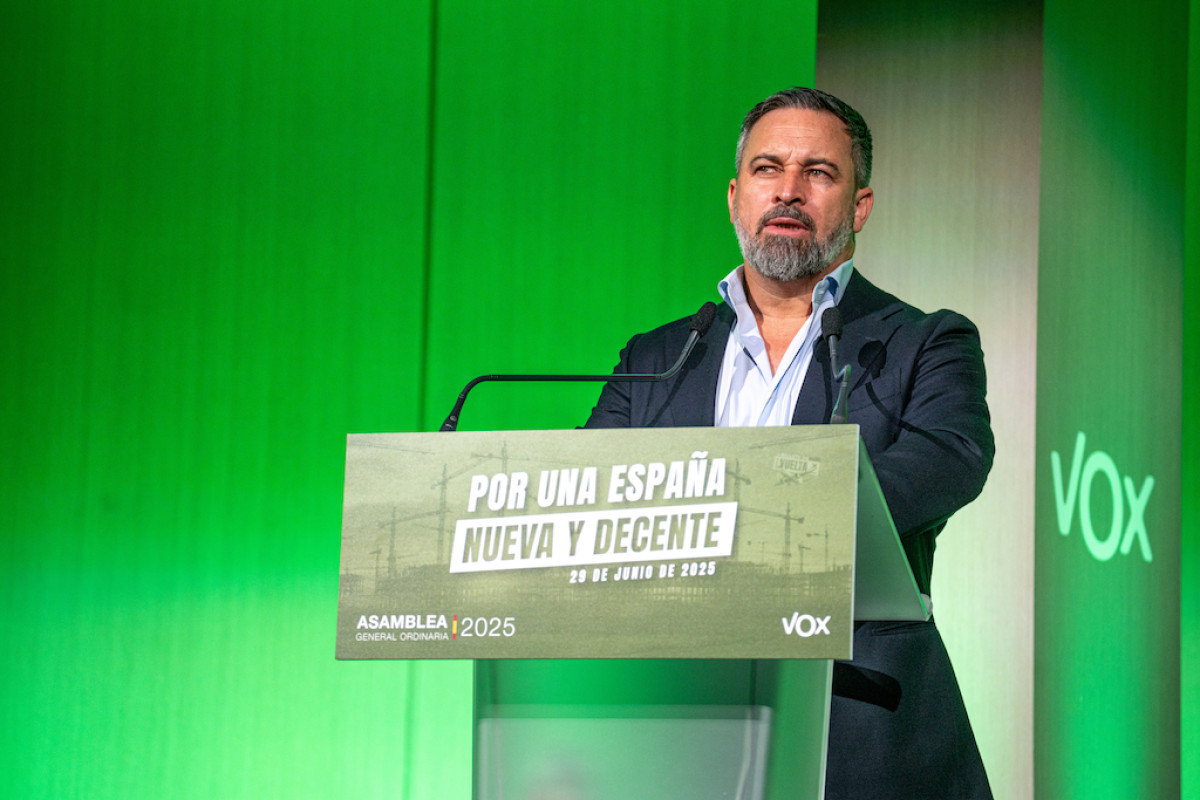
Immigration is one of Vox’s flagship topics, and it is well known that the party that puts on the table the issues people talk about at home or in the bar wins elections. Immigration and its relationship with crime occupy front pages and hours of discussion. The CIS acknowledges that immigration is Spaniards’ second concern, behind access to housing. What has happened this summer in Torre-Pacheco, Jumilla, Alcalá de Henares, or Piera favors Vox because it gives current relevance and interest to its discourse.
In the 2023 elections, Pedro Sánchez used, successfully, the tactic the French counterpart François Mitterrand practiced in the 1980s, which was to confront Jean-Marie Le Pen to overshadow Chirac, but that strategy no longer works. Surveys indicate that the PP and Vox can rise, and they are doing so, simultaneously.
All the demoscopic studies published in recent weeks place the PP and Vox around 200 deputies out of 350 that form the Congress, with a stronger rise for Vox than for the PP. Despite these figures, Feijóo nourishes the possibility of achieving, on his own, a total of deputies equal to or higher than the current investiture majority, which would make Vox’s participation in a future Government of Spain dispensable, but the trends may thwart Feijóo’s dreams.
In Spain, the Organic Law of the General Electoral Regime (LOREG) states that to enter the allotment of seats in any of the 52 electoral constituencies it is necessary to surpass 3% of the votes cast in that constituency. However, reaching that 3% does not guarantee winning a seat due to the so-called effective electoral threshold. Let us see why.
“In 2019 Vox reached 52 seats with 15.08% of the votes and, losing only 2.62 points in 2023, gave up 19 deputies along the way. A harsh penalty for a modest setback.”
Ten Spanish provinces elect four deputies and another eight elect three; in those eighteen constituencies, where 64 of the 350 seats are at stake, winning a seat hovers around 15% of the votes. Almost all these provinces belong to the so-called empty Spain with a significant rural component where Vox has a strong foothold. With the D’Hondt method, the seat allocation system used in Spain, 15% is the magical figure from which a party soars and begins to accumulate deputies one after another. In 2019 Vox reached 52 seats with 15.08% of the votes and, losing only 2.62 points in 2023, gave up 19 deputies along the way. A heavy price for a moderate retreat.
What if there were elections?
Therefore, we can clear up the first question: Can Vox surpass 60 seats? It is not certain, but in the current political context it is very possible. Let us answer the second question: can Feijóo govern alone with Vox on the rise? That is not guaranteed either, because for Feijóo Vox’s rise beyond 15% presents a major obstacle.
Let us look at some examples, with real data, that demonstrate why Vox’s ascent is not a lifeline for Sánchez and proves to be a nuisance for Feijóo:
- In the latest general elections in the province of Cáceres, which elects four seats, Vox lost the deputy it had won in 2019 by moving from 16.06% (above 15%) to 13.06%. The setback was “only” 2.36 points.
- In Salamanca, also with four seats at stake, Vox lost its deputy by moving from 17.69% to 14.68%. In the neighboring Zamora, with three seats in play, Vox dropped the seat in the count as it fell from 17.07% to 13.2%. Also in León Vox lost its deputy as it fell from 15.56% to 12.88%.
- If we look at the result of Castile and León in the general elections as a whole, we see that Vox went from 16.61% in 2019 to 13.78% in 2023, a slight drop of 2.83 points, 33,000 votes, which cost it a staggering five seats and they all went to the PP, none to the PSOE.
- In Andalusia, Vox experienced something similar by dropping from 20.36% in 2019 to 15.32% in 2023, that fall of 4.96 points led it to lose three seats while the PP gained ten thanks to not only Vox’s decline but also the PSOE losing four seats.
Make no mistake: Vox is not only a rural party or one anchored in conflict zones. In 2019 it won the general elections in the Region of Murcia and in Ceuta and it came close to winning them in the province of Almería. If the current scenario persists, with a PSOE on a downward slope, the PP does not surge and continues climbing step by step and Vox remains on the rise, Sánchez will have neither enough support, not even close, with the backing of Bildu, PNV, ERC, BNG and Junts, who do maintain the positions achieved in 2023.
Today, in potential near-future elections, which I bet will not be held because La Moncloa and Ferraz know these data to perfection, the question is whether Feijóo would manage the investiture alone or would need Vox’s support. What no one knows is whether Sánchez has used his days at La Mareta to solve the electoral Sudoku he faces. If elections are called now he loses, but, if there is no Copernican and unforeseen turn, by the date slated for elections, his defeat in 2027 will be far more substantial than it would be today, because with every poll published Vox clearly grows and the PP gains, albeit more modestly, a few tenths.
