
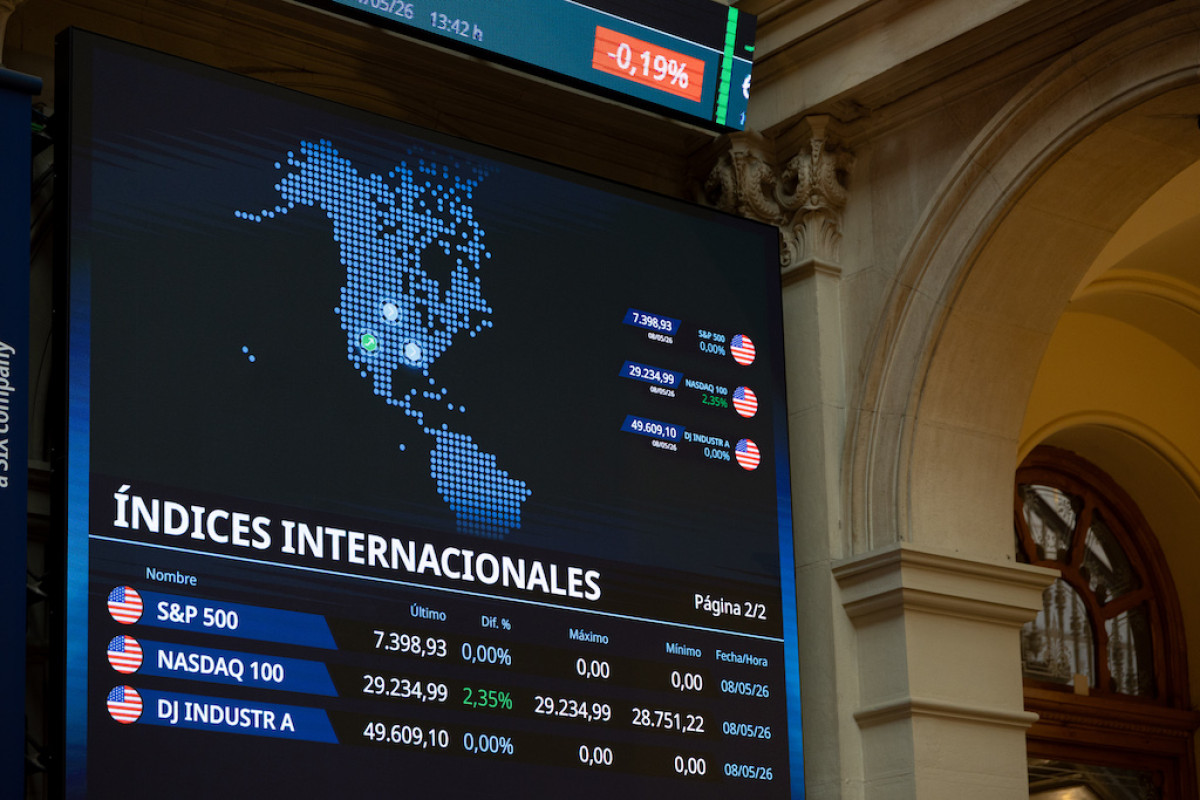
When the director of Agenda Pública, Marc López, asked me early last week to write about the Spanish stock market trading at highs, I cautioned him: “By next Monday, it could be in trouble.” At the time I’m drafting this, that hasn’t happened yet, but it could happen at any moment next week, or perhaps in six months. Stock prices are expensive in the United States, very expensive, but when the market moves on emotion rather than on fundamentals, uncertainty becomes total. At what point will investors who have bet on the AI boom lose their faith and begin, to use market jargon, unwinding positions and taking profits? It is as unpredictable a question as it was to forecast the current levels on Wall Street.
“The U.S. stock market is at astronomical levels measured by almost all traditional parameters.”
The truth is that the U.S. stock market is at astronomical levels by almost every traditional metric and, by comparison, the benchmark Spanish index, the Ibex 35, could be seen as cheap. If we look at the P/E ratio —the figure that tells us how many years of earnings are needed to recoup the investment—, the Schiller CAPE —which extends this payback period to the average of the last decade— or the Buffett indicator —which compares the stock market’s performance with the country’s real economy—, they are at or near their historical highs. They have already surpassed the price mispricing signals that accompanied the 1929 crisis and are on the verge of surpassing those of the dot-com crash in 2001.
The dot-com crisis is the mirror in which experts view the current situation, which has several parallels: the tech sector, the promise of change, inflated expectations, and many gurus. But the experts disagree on whether history will unfold in the same way. David Cano, partner at AFI, points to a fundamental difference: the tech companies are generating enormous profits now whereas in 2000 the startups were unprofitable. “By definition, if there are profits there is no bubble,” says Cano, who compares today’s situation to the railroad boom of the 19th century. When the train became popular in the 1840s, bourgeois and noble families invested everything in its development. The train ended up being critical for any economy, delivered the promised transformation, and its rollout marked a before and after for the economies that adopted it — and it coincided with China’s decline, which was hesitant to embrace it, Cano recalls. Yet even if the wealth promised by the train was real, it did not prevent many families from going bankrupt because they paid prices that the subsequent abundance did not truly justify.
One of the most charismatic Fed governors, Alan Greenspan, described this stock-market disturbance as “irrational exuberance.” Investors are carried away by a sentiment that Miguel Ángel Rodríguez, an analyst at Willybit, calls FOMO — Fear of Missing Out. “Many did not foresee Nvidia’s benefits (the chipmaker). So now nobody wants to miss the next Nvidia,” he concludes, arguing that the correction might be near.
“What is being debated is whether the return can in a mid-term horizon exceed all the money invested in the sector.”
In the past weeks, tech stocks have begun to cool, coinciding with growing doubts about the profitability of AI services. The level of support is so high that, as with railroads, the uncertainty isn’t whether it will be transformative, but whether the returns can outpace the money poured into the sector in the medium term, which, as with rail, requires the deployment of costly infrastructure. Despite the unease, Elon Musk has taken SpaceX to market, a company that continues to incur losses, and his wealth has surged exponentially as a result.
It’s worth pausing here to note how this collective fervor around SpaceX has made Musk the first trillionaire in the world. He already possesses more wealth than the five richest individuals combined. The gap is so vast that, in this WSJ analysis, the fortune of the next in line, Jeff Bezos, is closer to that of a pauper than to Elon Musk. It’s hard to comprehend, difficult to believe, and challenging to put into perspective.
“Markets are never rational, they have expectations and they buy and sell assets and seek prices upon them,” explains José Carlos Díez, professor of Economics at the University of Alcalá. “People spend money and make purchases based on expectations that may or may not be real, sometimes they are euphoric and other times discouraged,” Díez concludes. The problem is that the shift from one emotion to another is not orderly and can trigger stampedes, which in some cases precipitate stock-market crashes. Díez recalls how, in 1996, Wall Street valuations already spoke of an overpricing in tech stocks, and there wasn’t a correction until five years later. He agrees with Cano that enormous inflows break the parallel with the dot-com debacle, but sharpens the point of friction. “The sector is very immature; we still don’t know who the winners will be, and money is invested in everyone.”
The economist cites the psychological theories of Nobel laureates Daniel Kahneman and Vernon Smith on how emotions and risk aversion shape investment decisions. Following this line of thought, Díez argues that risk aversion is at a minimum, which is why people buy regardless of price.
“The risk in the United States is highly concentrated in around ten companies.”
What the experts agree on is that the risk in the U.S. is highly concentrated in about ten companies. It’s worth noting that the 2001 stock-market crash did not trigger a systemic crisis; it was a recalibration that left the real economy with a mild cold (whereas the 1929 crash led to a severe recession).
They also concur that European stocks, including Spain’s, look cheap next to the United States. As happened with the real economy, Europe’s markets recovered far more slowly from the 2008 recession, and the continent’s indices remain well behind those on the other side of the Atlantic. Europe’s lower exposure to technology has widened this gap between the two markets.
Yet in virtually all cases, when Wall Street sniffles, Europe almost coughs, even if the origin of the sell-off bears no relation to the trigger. Panic travels from one shore to another in minutes, and the motive becomes irrelevant. Half of the world’s equity money is invested in Wall Street.
Having resolved the big question of whether the market is expensive, the next inquiry is whether markets are a good reflection of economic reality. The theory also suggests not to a great extent, although markets can function as leading indicators of trends. David Cano notes that the number of publicly traded companies is a fraction of those that operate globally. (In Spain, about 500 companies are listed while the universe totals around 3.3 million companies registered according to INE). “If the stock market goes up, it doesn’t benefit everyone; it benefits those invested in the market. In the same way, we extrapolate the performance of public companies when they are not representative of the whole economy.”
“There may be an adjustment, but not a bubble,” says Díez, capturing the sentiment of the experts consulted. The forecast is that the stock market will correct by around 10% in the short term, without expecting a crash.
“The still unanswered question is whether this dissonance between the street and the market can take its toll”
The level of political uncertainty, fueled by the erratic decision-making of the world’s leading economy’s president, Donald Trump, is something investors do not seem to have priced in. Or perhaps they price it in as a very low risk. They also do not perceive as a risk the discomfort of the middle classes from the loss of purchasing power or the housing crisis. The still unanswered question is whether this dissonance between the street and the market—justified by the idea that markets price the future, not the present—can come back to haunt us.
