
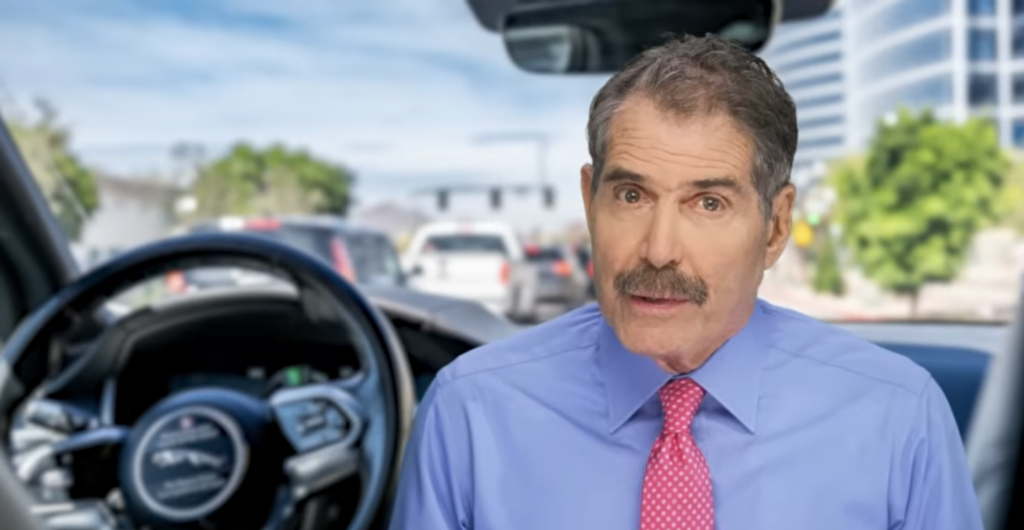
Data indicate that Waymo records markedly fewer injury-related and property-damage claims. So what explains the opposition from certain lawmakers?
Every day, approximately 100 Americans lose their lives to traffic crashes.
Yet a groundbreaking remedy has arrived: autonomous vehicles.
Robotaxi services such as Waymo—the Google-backed company—stand as a prime example.
Passengers who test them generally approve. In places where robotaxi operations are permitted, ride volumes rise rapidly. Two years ago, there were 50,000 trips each week; now the figure is 500,000.
“The car performed better than if a human had been behind the wheel!” a rider says in my latest video.
Waymo asserts that its vehicles are ten times safer than human-driven cars. I would doubt it if insurers, who have real money at stake, weren’t in agreement.
Reinsurance News notes Waymos achieved an “88 percent reduction in property damage claims and a 92 percent decrease in bodily injury claims.”
“We have the data,” argues Adam Thierer, author of Permissionless Innovation. “Ninety-four percent of all accidents stem from human error…We can address one of the leading killers of Americans.”
Regrettably, some politicians argue that trying robotaxis should be off-limits.
New York State Senator Luis Sepulveda (D–Bronx) advocates a rule stating that motor-for-hare vehicles “shall not be…operated by an automated driving system without a human driver…seated behind the steering wheel and engaged in the act of driving.”
He contends the state must shield immigrant taxi and Uber drivers who live in his district.
“I cannot support something that could almost overnight erase the jobs of more than 100,000 people,” he says.
“Even if a human isn’t strictly necessary?” I ask. “Even if he’s less reliable than the machine?”
“I don’t think that having a person in a vehicle would be worse than a machine,” Sepulveda responds.
“That’s just wrong,” counters Thierer. “Humans get intoxicated, tired, and distracted. Say what you will about robots, but they don’t get drunk.”
Sepulveda retorts: “Waymo is going to amass billions—let them cover the disruption to workers.”
“That sounds like a mafia pitch,” I fire back. “So, Waymo, you want to operate here? You must pay.”
“If the pitch resembles a mafia one, so be it,” Sepulveda shoots back.
I considered challenging his stance with a stark analogy, noting that a ban could claim more lives than those of infamous serial killers combined. Ted Bundy, Jeffrey Dahmer, and John Wayne Gacy together killed about 80 people. By contrast, human-driven cars claim far more lives every day.
“The Waymo data isn’t perfectly safe,” he replies. “A Waymo vehicle struck a child in California.”
Like many critics, he points to isolated incidents. Even that child, in fact, was unharmed.
Millions of miles of testing show robocars to be much safer.
And they continue to improve. Humans learn from personal experience, but self-driving cars learn from millions of miles of data. They get better even while we sleep.
True, some workers will lose their jobs. Yet technological progress has always produced displacement. Despite the upheaval caused by computers, unemployment in the U.S. has remained relatively low.
Typists, switchboard operators, and elevator operators suffered losses. Most eventually found new employment, often in better roles.
“Some people want driverless cars,” I tell Sepulveda. “Women may feel unsafe. Some drivers aren’t pleasant. Some are reckless.”
“Many women feel safer with a driver,” he replies.
“Shouldn’t people have a choice?” I ask.
“Absolutely.”
“But you’re trying to remove that option!”
“No,” says Sepulveda. “I’m advocating protecting the drivers who exist today.”
Given that roughly 100 Americans die in car accidents daily, politicians who slow the uptake of self-driving cars bear responsibility for lives lost.
COPYRIGHT 2026 BY JFS PRODUCTIONS INC.
