
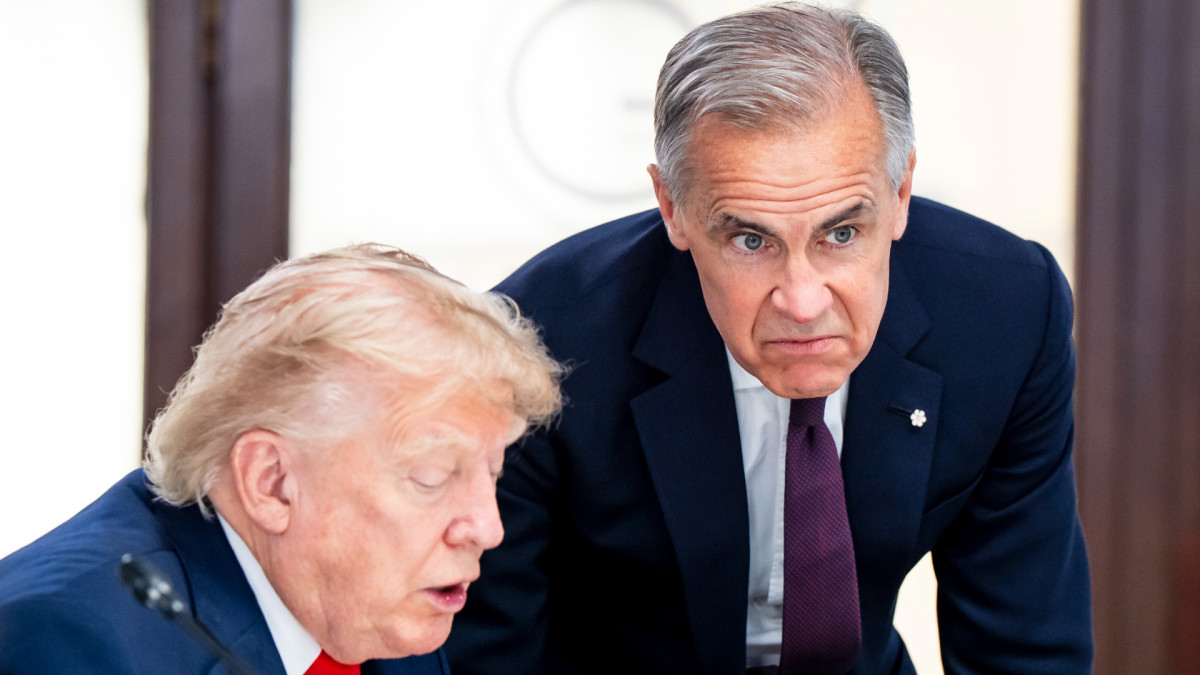
On Tuesday, Donald Trump announced a trade agreement with Canada. He did it his way, posting “DEAL” in uppercase on his social network and delaying for three days the entry into force of new tariffs while the papers were being finalized. By Friday there was no deal. On Saturday, the United States began applying 50% tariffs on about $20 billion of Canadian imports; Mark Carney responded by announcing retaliatory measures equivalent to those starting on September 8. And this Monday Trump escalated by threatening to extend, starting in January, the 50% tariff to automobiles, trucks, components and steel. Between proclaimed victory and the trade war lay four days. Few deals have aged so quickly.
In January I analyzed in these pages what I called the Carney doctrine, a national liberalism that does not renounce economic openness, but assumes globalization has become a rougher place. His prescription is to strengthen the national economy, diversify dependencies and deal with Trump without theater or genuflection. August offers the first serious test of that thesis.
“The Carney doctrine consists of a national liberalism that does not renounce economic openness, but assumes globalization has become a rougher place”
Canada did not rise from the table out of pride. There had been a lot offered. The agreement contemplated reducing US tariffs on Canadian cars from 25% to 15%, with substantial cuts in steel and aluminum. The rupture came when Washington changed the rules mid-game and introduced two demands of another nature. The first, according to available information, aimed to give Washington the capacity to condition future Canadian trade agreements. The second, according to press reports that neither Ottawa nor Washington have confirmed, sought a right of first refusal on Canadian critical minerals. Neither is tariff-related. The negotiation had shifted from focusing on the terms of trade to focusing on who sets these terms sovereignly. For Carney that was the red line and that is why he stood up from the table.
It is worth understanding what Trump’s trade policy is really aiming at. It is not about protecting sectors or closing deficits. Seen as a whole, it is a kind of Monroe Doctrine — which he calls Donroe — in an economic version, with the American hemisphere as the private domain of US interests and its strategic resources as Washington’s assets. The exclusivity demanded over Venezuelan oil and the demand over Canadian minerals respond to the same principle. Canada is the clearest case because it is the most captive. In 2025 it still allocated 72% of its goods exports to the US, with bilateral goods and services trade above $870 billion. These are two economies that have been manufacturing together for decades, with supply chains especially intertwined in automotive, energy, agriculture and manufacturing. The fact that the January threat pointed at the car industry is no accident, because it is the sector where the border matters least and where the damage is shared on both sides of it.
“In 2025, Canada still allocated 72% of its goods exports to the US, with bilateral trade in goods and services above $870 billion”
The blow is serious and still bounded. Affects roughly 5% of Canadian exports to the US. And the decree itself reveals Washington’s priorities and the limits of its coercion, for energy, potash and critical minerals are exempt, i.e., precisely what the US economy needs to buy from Canada. The tariff serves to display toughness to its voters, while the list of exemptions shows where the real dependence lies. The numbers do not support the grievance that sparked this trade war. The US deficit with Canada in goods hovered around $48 billion in 2025 (barely 0.2% of US GDP and less than half if services are counted, where the US has a surplus) and it is entirely due to energy. If you exclude oil and gas, the US sells to Canada more than it buys, with a surplus of a similar size. In other words, the “deficit” Trump complains about consists of Canada selling discounted oil to Midwest refineries. Few trade wars have been declared over such a flimsy grievance.
From there, diversification is the heart of Carney’s project. It does not aim to replace the American market, something impossible and economically absurd, but it does seek to reduce concentration enough to widen the room for independent decision-making. And there are tangible gains. The expansion of the Trans Mountain pipeline has raised its capacity to about 890,000 barrels per day (roughly one-sixth of domestic production) and opens Canadian crude to Pacific outlets. China became in 2025 the main buyer of that crude carried by Trans Mountain, with about 207,000 barrels per day compared to the 7,000 daily average of the previous decade. The system reached its full capacity this summer for the first time, and Ottawa is studying new outlets toward Asia, while accelerating the commercial rapprochement with China, negotiating with India and deploying the infrastructure strategy that Carney calls nation-building.
“The ‘national liberalism’ of Carney is not autarky nor classic protectionism, but the attempt to keep an open economy by pruning concentrations that narrow the state’s ability to decide”
However, replacing dependence on Washington with dependence on Beijing does not solve the situation, because China practices exactly the kind of economic coercion that Ottawa is now denouncing in its neighbor, and its control of certain supply chains is a vulnerability for all of Western Europe. For a middle power, the sensible strategy is not to choose who to depend on, but not to depend too much on anyone. That is the most relevant aspect of Carney’s “national liberalism,” which is not autarky nor classic protectionism, but the attempt to maintain an open economy by pruning concentrations that narrow the state’s decision-making capacity. The dependence also does not flow in a single direction. Canada depends on the US market, but possesses oil, gas, potash, electricity and minerals that the US cannot substitute in the short term, as implicitly acknowledged by the exemptions in the tariff decree.
The asymmetry is huge, but not absolute, and that is why Washington needs to squeeze every lever of pressure available. Last year, Trump had built much of his tariff wall on the IEEPA, the 1977 Economic Powers Act designed to sanction adversaries, but in February the Supreme Court ruled that it did not authorize the president to impose tariffs. The Administration responded by reviving the nearly forgotten Section 338 of the Tariff Act of 1930, which allows duties up to 50% against countries deemed discriminatory with a mere thirty days’ notice, which denotes a certain desperation at the White House to rummage through legislative gaps in the face of judicial setbacks.
And that erodes a more valuable good than any tariff, predictability. The T-MEC, the trade agreement among the US, Mexico and Canada, remains formally in force, but a trade treaty to which sectoral tariffs and unilateral measures are superimposed ceases to serve for what a treaty truly offers, the certainty that today’s rules will govern tomorrow. For a company the tariff level matters; what matters more is knowing whether today’s investment will still be protected five years from now. Carney has stated it plainly. The US has changed and the old relationship will not return. Canada must organize itself not waiting for the return of the predictable partner, but assuming that the US uncertainty has arrived to stay.
“Canada must organize itself not in waiting for the return of the predictable partner, but assuming that US uncertainty has arrived to stay”
The American electoral calendar adds its own irony. The midterm elections are held on November 3 and Trump arrives wounded. The Reuters/Ipsos poll of August 17 put his approval at 33%, the lowest of his presidency, with the Democrats slightly ahead in managing the economy. A White House with little patience for prolonged negotiations and needing to keep its electorate mobilized seeks scorable victories. But that same pressure works in Ottawa’s favor. Trump already contributed decisively to Carney’s electoral victory in 2025 by toying with the fantasy of annexing Canada, and the new escalation again closes ranks in Canada. Pierre Poilievre’s Conservatives are not asking Carney to yield; before the negotiations broke down they reproached him for having conceded too much. On the red lines against Washington, there is more consensus in Ottawa than on almost any other issue.
None of this guarantees that the strategy will work. Canada remains extraordinarily exposed, and it will remain so as long as the MAGA movement occupies the White House, with Trump or a successor. The novelty is that Ottawa seems to have accepted the invitation rather than trying to dissolve it through successive concessions. That, in essence, was Carney’s doctrine. As I noted in January, his strategy does not promise victory, but a certain dignity.
Europe would do well to take note, and not only out of empathy, because the Twenty-Seven face the same dilemma with a different arithmetic. The EU allocates around a fifth of its goods exports to the US, compared with 72% for Canada, and last summer it chose a different path, accepting a general 15% tariff in exchange for promises of investments and purchases of energy that, being declarations of intent by private companies, Brussels cannot guarantee will be fulfilled. They are not directly comparable strategies, but they pose the same question: how much should an open economy concede to buy predictability and how valuable is that predictability when the rules can change again. Canada is the extreme laboratory because it cannot choose its neighbor nor do without it. It can, however, slowly reduce the cost of challenging it. That, more than any victory in a particular negotiation, will be the true test of Carney’s doctrine.
